← All books
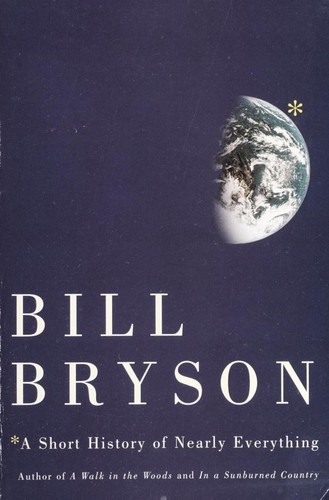
A Short History of Nearly Everything
by Bill Bryson · 2003
Buy on Amazon
A Short History of Nearly Everything by American author Bill Bryson is a popular science book that explains some areas of science, using easily accessible language that appeals more so to the general public than many other books dedicated to the subject. It was one of the bestselling popular science books of 2005 in the United Kingdom, selling over 300,000 copies. A Short History deviates from Bryson's popular travel book genre, instead describing general sciences such as chemistry, paleontology, astronomy, and particle physics. In it, he explores time from the Big Bang to the discovery of quantum mechanics, via evolution and geology. Bill Bryson wrote this book because he was dissatisfied with his scientific knowledge—that was, not much at all.…
Recommended by
"This broad survey of scientific history, from the Big Bang to the rise of civilization, fits Jamie Dimon's interest in foundational knowledge and the interconnectedness of various fields. It offers a comprehensive perspective on how the world works, aligning with a CEO's need for a wide lens."
Jamie Dimon's Recommended Reading List ·
fs.blog
"Stephen Hawking’s book came first, and I’m sure that Bill Bryson very intentionally named his book to resemble it, but they’re very different books. Bill Bryson is not a physicist, and he makes a very big point of that: most of his books are travel writing , but he’s also written on the history of the English language, the British Isles, things like that. What I really liked about A Short History of Nearly Everything is that it gives an excellent account of a lot of the personalities, and the interconnectedness of important discoveries, in cosmology and elsewhere. He does such a great job of bringing together our understanding of cosmology, evolution, palaeontology, and geology in a very, very fluid way. He talks a lot about our understanding of how old the Earth is, and the relationship of that to how old the sun or the universe as a whole is, and those are cosmological questions. The Earth’s age is important if you want to know if there has been enough time for human beings to evolve or if you want to understand when and how the dinosaurs went extinct – everything interrelates. He tells a really nice story, intertwining seemingly disparate areas, putting our cosmological understanding into context. I think you have a point, because it’s definitely a major goal in many areas of human thought to try to fuse seemingly disparate ideas. It can be boring to concentrate on your own tiny little problem, and it’s important to see that our understanding of the world around us is not just cosmology and geology as totally separate fields. There is an important way in which one influences the other. Physicists are still today constantly looking for a theory of everything – this is one of the major, major goals of physics, because the idea of solving things in the same way is a really strong driving force. For example, we have a really good understanding of electricity and magnetism – a major triumph of mostly 19th-century physics, though today we’ve started to understand it even better as it relates to relativity and quantum mechanics. But we’re still working on how to fuse them with the other fundamental forces. Today, we believe we understand very, very well – the theory makes some excellent predictions – how electricity and magnetism are combined with the weak nuclear force. A big prediction that came out of that model is that there should be a particle called the Higgs boson – one of the things that they’re looking for in the Large Hadron Collider. Anyway, this idea that all of science is one, or all of physics is one, and that there are deep underlying unities, is a very consistent theme."
"It’s quite a daunting task for somebody to write. It does more-or-less what it says on the cover! As a human being, reading about the beginning of time and the vastness of the universe, the way matter is constructed and the way human beings have evolved since the year dot puts your small, temporary existence in perspective. He does it with such wit and warmth that you come away feeling the wonder rather than the weight of the universe. There are many stories in the book which are fascinating in themselves. My favourite was about the man who invented CFC’s and put lead in petrol. So, he was possibly one of the worst inventors in the entire world. He finally contracted some disease and so he invented a machine for turning himself over in bed but it strangled him! “Whenever you see any human imperfection, you should think, “Yeah, that’s good. That is creative”” I love the way that Bill Bryson picks out these things, things that no-one else had ever told me about. I find it full of fascinating stories. Another that the first dinosaur bones were found by a woman in Sussex but her husband then claimed the credit and he tried to get famous for having found these bones. He ended up in a rival’s lab – his bones as the lab skeleton. It’s full of human stories within all this information which makes it entertaining, as well as informative. And this feeds that hunger to keep going and to learn more. I would say if you could only read one science book, then this is the one for you. Well, one of the things I think he says in the book is that the reason why anything exists is because when the big bang happened, it wasn’t perfect symmetry. If everything was perfect, if all the hydrogen atoms were exactly equal distance from each other, then nothing could exist because gravity couldn’t then force them together and if they’re not forced together, then they can’t form suns and other elements – life wouldn’t have begun. So, it’s the imperfection at the beginning of the universe that means anything exists at all. So, whenever you see any human imperfection, you should think, yeah, that’s good. That is creative."