Evelyn Arizpe's Reading List
Evelyn Arizpe is Professor of Children’s Literature (Culture, Literacies, Inclusion & Pedagogy) at the University of Glasgow. Her doctoral work was on adolescent readers and Young Adult literature. More recent research projects have included migration and displacement, and she has developed a programme for migrant readers through the Salas de Lectura project in the Mexican Ministry of Culture. Prof. Arizpe has published widely in both English and Spanish. Her co-authored book Children Reading Picturebooks: Interpreting visual texts is considered a classic study in the field.
Open in WellRead Daily app →The Best Wordless Picture Books (2025)
Scraped from fivebooks.com (2025-07-06).
Source: fivebooks.com

Suzy Lee · Buy on Amazon
"Yes, it wasn’t too hard to decide to give her the prize, although there were other amazing illustrators, too. Wave is about a little girl who goes to the ocean. She is quite cautious and keeps her distance from the wave but then she begins to interact with it, until it gets a bit too close for comfort and she gets rolled over by the wave, but ends up with a gift of shells that the wave has offered to her. This book is a very good example in a wordless picture book of reading emotions in the characters, which allows you to understand a character’s motivations. By looking at not only the little girl’s face but also her body posture and the way she is leaning forward or leaning back, the gestures that she’s making — she sticks out her tongue at the wave — I think even a very young child would be able to identify those emotions and empathise with them, to read fear or shock or pleasure. When the girl is dancing in the waves, it’s an expression of joy that comes across so strongly. But interestingly, one could say the wave also has emotions. Suzy Lee is such a brilliant, talented illustrator that, at one point, the wave seems to have its own attitude towards the girl. It’s not an aggressive attitude, you can tell that it’s an invitation to play. Somehow, with brush strokes, she’s managed to convey water that is happy. Yes, Mirror , Wave and Shadow are the three books that make up what Lee calls ‘ The Border Trilogy ’. They all have a little girl as a character who is playing with the other side of the page, literally, because Suzy Lee uses the gutter in a very clever way to separate the pages and to act as a border between reality and that other place of almost magic, which can be either shadows or the other little girl in the mirror. At some point, they come together. At the beginning, the girl and the wave are separated; in the end there is a continuum between the beach, the girl and the wave."
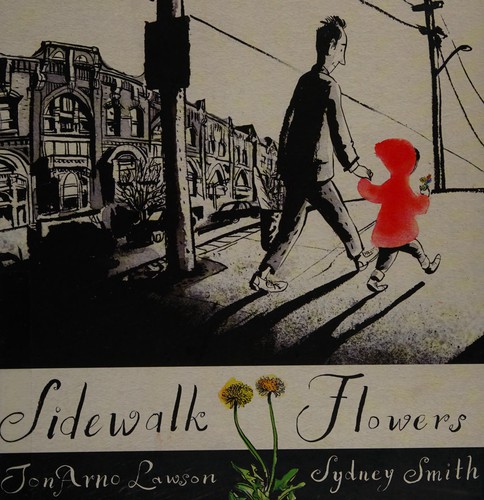
JonArno Lawson · Buy on Amazon
"This is another apparently very simple story, of a little girl walking home with her father. He is very distracted and is just talking on his phone while she is noticing and picking up the flowers in the pavement, the little flowers that some people would call weeds. She’s being attentive as she walks, she notices the flowers and she also notices other things, like a dead bird, and she gives it a flower, and a homeless man, a dog… She starts distributing the flowers that she has collected, and as she does so, the pages change colour. They begin to go from black, white and grey to colourful. So she is illuminating, really, the places where she goes through these flowers. It’s about love and attention and caring for someone else and spending a little bit of time with a dog or looking at the bird. There’s also that self-love at the end where she puts a flower in her hair. Exactly. And the end papers change from just the flowers to her being in the flower field. All of those things, if you look at the book too quickly, you don’t notice, but there are many layers of meaning there. Not everyone will access all those layers, but they are there for the reader to explore. Yes. JonArno Lawson is a poet and he has his own books that are with words. He and the illustrator speak about that collaboration as almost illustrating a poem that doesn’t exist, but it is still a very poetic book. Yes, he won it last year. I was also on the jury last year, so you can see he is also one of my favourites."

Issa Watanabe · Buy on Amazon
"So this is moving into slightly darker topics, and the book has a black background (as compared to Suzy Lee’s Wave , which is very much white). That is already setting the scene for what is going to be a difficult story, the story of people who have had to leave their place of origin for some reason, and are looking for a place to be. They are carrying all their belongings with them, but the journey is difficult, and at times it’s dangerous and death joins them. Yes, they are symbolic people, all of them with different animal heads, which is to show diversity and not a particular group, I think. The presence of death, of the skeleton, is also quite striking. They don’t seem to be rejecting the figure, they seem to be accepting of it. It’s a death figure that’s very tender when the character with a rabbit face drowns in the boat crossing. It rides on a blue ibis, which is a symbol of regeneration and hope. And it becomes more colourful as it goes along. I think Migrants is a very good example of a wordless picture book, because it is very much about silence. Even if the book had words, there would be very few words; they seem to walk in silence and interact in silence. Yes, and that’s also very important. They are helping each other, they are caring for each other, they cook for everyone, they share what they have."

Aaron Becker · Buy on Amazon
"Aaron Becker is another author who publishes quite a lot of wordless picture books. His stories tend to be about journeys and going through slightly magical places. This one begins in a very familiar situation of the death of a family pet and the grief of the little girl. There is a page, all white with just her in the middle, which is very much an expression of her grief. But at the same time, it’s a book that attracts you because of the colours in the cover image. They’re unusual shades of blue, and then suddenly a gold that stands out. You begin to see how that gold colour has a particular place within the book, through the journey of this golden-coloured stone. One image at the start shows a little girl facing the water. You can tell from how she’s very still and her expression of grief, and possibly of anger, when she’s remembering her dog. As she throws a normal stone into the water, there is a change of scene which takes us out into space and we see how a meteor evolves over time, through nature as well as humans, into the golden stone she finds in the ocean. The universe gives her back a gift that connects her with the story, including her own ancestors. Again, you can read the book very quickly and not notice the clues that show that some of the people in it were part of her own family history. It is about the material objects that connect us to each other over space and time."
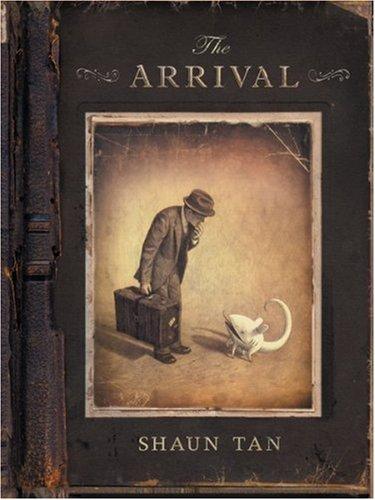
Shaun Tan · Buy on Amazon
"The Arrival was first published in 2006 and one of the amazing things about it is that although it’s been around for nearly twenty years, people are still writing about it and talking about it. It’s been done in plays in the theatre, I saw it with people using puppets, and it was a silent play by people using sign language. It has inspired a lot of different retellings — it’s a timeless book. It’s about migration, but this one very much has the faces of people. He was inspired by pictures of people who arrived in the United States, in Ellis Island. Yes, early 20th century, and his own parents’ story. His father was Malaysian, I think, and came to Australia as a young man. The book shows the way that the story usually goes, where the father arrives first and tries to find work, and sends back enough money for his wife and daughter to join him. Then at the end, his daughter is now sort of settled, and she can help other people. Along the way, he encounters different stories of migration, of people who have had to flee from their place of origin because of — some of these are quite symbolic images — giants hoovering people up, or dragons. Absolutely, and I think that’s why it works, because if it was an identifiable place then it would be too specific, whereas this way it very much gives the space for people to fill their own stories in there, or the stories of people they know. It causes a lot of conversation among the children that I’ve looked at it with. ‘What’s going on? What are those strange places? What do these machines do? What kind of food is that?’ We’ve all had that experience of being strangers in a strange land where you don’t know what the food is or how to do certain things, you can’t read the language. That’s the other clever thing about this: the words that appear are in a language that doesn’t exist, that none of us can read. Yes, although technically it’s not a graphic novel either. I would call it a visual narrative. It’s very much a thing of its own, a beautiful object that’s been made to look like an old photo album. No, absolutely not. Of course, you have to know the group that you’re working with, and The Arrival is certainly not a book to be read with early years of primary school because it’s too long and complex, and wouldn’t really be of interest. But they could read Migrants at quite a young age, and that would open up the conversation. There is a scene there of a death, but it’s done so subtly, and that’s a topic that needs to be approached, too. It’s so much fun trying to figure out what’s going on in these books. With Wave, for example, you can perform it, you can sing it. You can do so many things with these books — they are a joy to read. Visual literacy happens, but reading them is mainly about the pleasure of looking at beautiful pictures and telling a story. Yes, I think they’re great for working with all sorts of diverse learners, for being inclusive in the reading. Nobody has the upper hand, because there are no words to be read. But teachers are also quite cautious about using wordless picture books sometimes, because they feel that the children are not learning traditional literacy. Often, the teachers don’t know how to work with the books. So while some teachers have embraced them, others still need to be convinced of all their potential. Just how much I would recommend people look out for them. There are many, many wordless picture books now, and there are many that have won awards. Illustrators keep creating them, so I would invite people to enjoy them at any age and read them with others. I would also like to add that these are books that we use with our students at university level. There are students who are going to be teachers, but also publishers and authors and others who work with media. We run two programmes on children’s literature, where we look at these books as well as other picture books to learn about visual literacy but also the illustrator’s craft. One of these programmes is the MEd in Children’s Literature and Literacies . Our students enjoy wordless picture books immensely and staff never get tired of looking at them again and again!"