The Arrival
by Shaun Tan
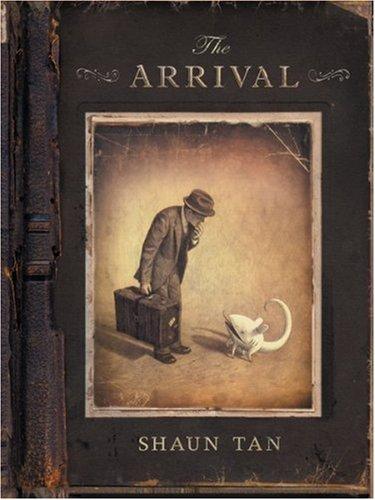
Buy on AmazonIn this wordless graphic novel, a man leaves his homeland and sets off for a new country, where he must build a new life for himself and try to support his family back home. His new country is full of strange arquitectural wonders, fantastic animals and other immigrants with stories of why they left home.
Recommended by
Patrick Collison's Bookshelf · patrickcollison.com
"I couldn’t not include this book, or graphic novel, in my choices. I particularly love the fact that such a wide range of ages can get something from reading this book. You can read it all in one go, dip in and out or just look at some of the pictures. It doesn’t matter, as there is so much to absorb or discuss on every page. Right from the beginning of this story there is a sense of creeping dread. We don’t know what this dread is. As the reader you are following the character’s journey from their familiar life to their arrival in a whole new place where life is totally different. It has a dream-like quality which captures how surreal the refugee experience must be at times. The reader is asked what it might be like to be dropped into an alien culture. The illustrations capture the subtleties as well as strangeness of the refugee experience. The illustrations draw on historic fact and familiar images and remind us that in many ways we are all immigrants. Or descended from immigrants. I read it with one of my daughters who was about nine at the time and she noticed an entirely new story in the pictures which I hadn’t spotted at all. I found this delightful. In fact, every time I look at it I notice something new. It is one of those books that grows and grows in your mind. It stays with you long after you’ve read the last page. The fact that it is only told through illustrations makes it accessible to anyone, no matter what their language or cultural background. It is. And even so, it’s a safe version. It’s not going to disturb or distress the reader. It is really brilliantly balanced in that sense."
Children's Books About the Refugee Crisis · fivebooks.com
"I did try to come up with books that have different kinds of cultural experience. Part of the reason I’d like to talk about The Arrival first is because I wanted to differentiate between children of immigrants and third culture kids, because they’re not necessarily the same. The Arrival is a graphic novel , and it’s completely wordless. It’s a big tome. You have to pay attention to follow what the story is, but anyone can read it. It can be in a library in any country in the world, and anyone who knows how to look at pictures and interpret what a picture might be telling is going to be able to read this book and make sense of it. That is really a remarkable achievement! Anybody looking for home and looking for their place in the world will relate to it. It is a fantasy kind of novel that takes place in a world that’s like ours, but it’s not quite like ours. It’s about a young father who leaves his vaguely Eastern European country in vaguely the early 20th century, to make a new home in what is vaguely New York. After he’s established himself, he sends for his wife and child. That’s pretty much the story, but there are so many other elements to it. Yes, and the incredible everyday details make the book. One of the things that the author did was to look at hundreds of photographs of people in that big wave of emigration in the late 19th and early 20th century to the US. The story he tells is about finding your place in the world. One of the images that I love from it is at the very end, where his young daughter is showing a new immigrant child how to do something, so she’s now feeling comfortable where she is. This is a book that I think any kid who does a lot of travelling will relate to, because things are so different. A lot of the content of the book is the young man listening to the stories of fellow travellers and finding out what their experiences are. Everybody has some complicated and sometimes terrifying backstory of why they had to leave their home country – war or famine or flood or whatever that has made their place of origin so hostile. Because this is a fantasy book, the country that this man comes from appears to be plagued with enormous dragons. People live with them, but they’re not nice to live with. There’s a lot of metaphor going on. Throughout all the different threads there’s plenty for different people to relate to. One of the charming things about it is that one of the features of this new world, when he finally gets there, is that everybody has a little companion, a little weird creature that’s sort of a cross between a dog and a cat and a tadpole that goes with them everywhere they go. When he gets his first apartment, his little companion is sitting on his bed when he gets there. The book is so open to interpretation, you can read into it what you want."
Third Culture Kids · fivebooks.com
"The Arrival was first published in 2006 and one of the amazing things about it is that although it’s been around for nearly twenty years, people are still writing about it and talking about it. It’s been done in plays in the theatre, I saw it with people using puppets, and it was a silent play by people using sign language. It has inspired a lot of different retellings — it’s a timeless book. It’s about migration, but this one very much has the faces of people. He was inspired by pictures of people who arrived in the United States, in Ellis Island. Yes, early 20th century, and his own parents’ story. His father was Malaysian, I think, and came to Australia as a young man. The book shows the way that the story usually goes, where the father arrives first and tries to find work, and sends back enough money for his wife and daughter to join him. Then at the end, his daughter is now sort of settled, and she can help other people. Along the way, he encounters different stories of migration, of people who have had to flee from their place of origin because of — some of these are quite symbolic images — giants hoovering people up, or dragons. Absolutely, and I think that’s why it works, because if it was an identifiable place then it would be too specific, whereas this way it very much gives the space for people to fill their own stories in there, or the stories of people they know. It causes a lot of conversation among the children that I’ve looked at it with. ‘What’s going on? What are those strange places? What do these machines do? What kind of food is that?’ We’ve all had that experience of being strangers in a strange land where you don’t know what the food is or how to do certain things, you can’t read the language. That’s the other clever thing about this: the words that appear are in a language that doesn’t exist, that none of us can read. Yes, although technically it’s not a graphic novel either. I would call it a visual narrative. It’s very much a thing of its own, a beautiful object that’s been made to look like an old photo album. No, absolutely not. Of course, you have to know the group that you’re working with, and The Arrival is certainly not a book to be read with early years of primary school because it’s too long and complex, and wouldn’t really be of interest. But they could read Migrants at quite a young age, and that would open up the conversation. There is a scene there of a death, but it’s done so subtly, and that’s a topic that needs to be approached, too. It’s so much fun trying to figure out what’s going on in these books. With Wave, for example, you can perform it, you can sing it. You can do so many things with these books — they are a joy to read. Visual literacy happens, but reading them is mainly about the pleasure of looking at beautiful pictures and telling a story. Yes, I think they’re great for working with all sorts of diverse learners, for being inclusive in the reading. Nobody has the upper hand, because there are no words to be read. But teachers are also quite cautious about using wordless picture books sometimes, because they feel that the children are not learning traditional literacy. Often, the teachers don’t know how to work with the books. So while some teachers have embraced them, others still need to be convinced of all their potential. Just how much I would recommend people look out for them. There are many, many wordless picture books now, and there are many that have won awards. Illustrators keep creating them, so I would invite people to enjoy them at any age and read them with others. I would also like to add that these are books that we use with our students at university level. There are students who are going to be teachers, but also publishers and authors and others who work with media. We run two programmes on children’s literature, where we look at these books as well as other picture books to learn about visual literacy but also the illustrator’s craft. One of these programmes is the MEd in Children’s Literature and Literacies . Our students enjoy wordless picture books immensely and staff never get tired of looking at them again and again!"
The Best Wordless Picture Books · fivebooks.com