Eleanor Janega's Reading List
Eleanor Janega is a medieval historian specialising in social history. She is a lecturer at King’s College London, runs the popular blog Going Medieval on intersections between medieval history and pop culture, and is a regular speaker, including for London Science Museum Lates.
Open in WellRead Daily app →Best Graphic Histories (2021)
Scraped from fivebooks.com (2021-08-02).
Source: fivebooks.com

Art Spiegelman · Buy on Amazon
"Eleanor: In Maus what we have is a great intergenerational narrative about the Holocaust. On the one hand, you have stories and flashbacks to the artist’s parents, who were living through the Holocaust in Europe. That’s then interspersed with his own experience of growing up Jewish in America, with the intergenerational trauma and heaviness of that. The book is also able to really unpack certain questions like identity, how one becomes Jewish and how we play with these ideas. One of the things in it that has always really stuck with me and that I thought was really affecting is he draws all of the different people’s nationalities as different animals. So Jewish people are mice and German people are cats. Polish people are pigs and French people are frogs. And there is a really lovely scene, written between him and his wife. His wife has converted to Judaism but is originally French. And he says, ‘Well, I’m not sure how I’m going to picture you in this scheme I’ve come up with.’ It’s very meta—he’s talking about the process of writing this. And she says, ‘Well, I’ve converted to Judaism, so surely I’m a mouse?’ It’s a really lovely way of talking about things like, ‘Okay, well, what is the artist’s process? What do we mean by identity? And how do we put this all out on the page?’ I think that’s one of the most effective things about Maus . It’s able to say, ‘Here are all these ways that we deal with complex issues of trauma, identity, history, how do we get through all of that?’ This is not so easy, but it is able to lay it out like that. It’s a beautiful way of showing what goes on behind the scenes, and how all of this is a constant struggle and something that has to be remade, relearned and retold. Neil: Definitely. It’s a hard thing to read for me because many of my family perished in the Holocaust. I read it when it came out. There was Maus I and Maus II . It left a real big impression. There’s notes that resonate with my grandparents, who were German, and what they had to go through. They had to flee and were caught up in the Second World War and were immigrants. It’s a hard read, a tough story to tell. It’s also about Art Spiegelman. He’s able to tell his story as well, because it’s not just about his father, it’s about his relationship with his father. This is the thing: before the Holocaust his father seemed a very different man from when he was raising his son in America. He had hopes and dreams, he had a career, he was charismatic. But you see him at the end of his life, worrying about money and very neurotic. This experience he’s undergone has changed him and there’s legacy in that. All that trauma trickles down to his son. That part of the story is quite powerful. There’s something interesting about this notion of trauma. It doesn’t have to be the Holocaust; it could be slavery . The trauma gets carried down through the generations. It’s not just the person’s story, but it’s the grandchildren’s story. The legacy that it leaves it ripples out, it doesn’t go away. This book is really good because it demonstrates that. It’s a nice way to record one story, but there’s so many different ripples. Eleanor: I think what it does is it fools people into thinking that it’s going to be lighter and easier, when what it actually does is it adds levels of complexity that wouldn’t be there otherwise. Because of the assumptions that we have about what comics are and what they mean, it brings people in. People are like, ‘Oh, it’s a comic. How hard can it be?’ It fools them into thinking that they can come and engage with it because it can’t be that bad. Obviously Maus is much heavier than the book we’ve done, but one of the things that’s really helpful about writing a medieval history comic is that people say, ‘This is not daunting. It’s in a comic form. It’s accessible. This is something that I could read.’ Same thing with Maus . If you say, ‘Oh, do you want to read an intergenerational reflection on the trauma of the Holocaust and what it does to people?’ A lot of people would be like, ‘No, I’m good. That doesn’t sound like a fun time to me’. But if you say, ‘Ahh, look at the mice!’ it makes it easier. You’re along for the ride, but you don’t realize that you’re traveling on the journey. Get the weekly Five Books newsletter Neil: I totally agree with you, Eleanor. I think the complexity comes when, as creators, you’re making a comic book, because not only are you writing something, you also have to think about visualization: How do I draw it? Do I do it in colour? What’s the linework going to be like? How am I going to do bubbles? What font should we use? There’s readability, flow of the page—the whole making of a comic. And storytelling is a component that can get forgotten. There’s writing a comic, there’s drawing a comic, but both those things are speaking to how to tell a story. That’s quite hard. It’s like asking a comedian what makes a good joke. How do you tell a good comic story? Eleanor: I love to hear that because that is exactly what we were aiming for. I do think that that is something that graphics really help—whether we’re getting people to reflect on the absolute horrors of war, or some complex ideas like monasticism, or the concept of othering. We’ve also got a pretty good breakdown of the Ottonian Renaissance, which I thought we handled nicely. I’m happy with how we’ve been able to tackle the complexity through using pictures. And I think that is one of the things that successful graphic histories do. Drawing up this list, I’m struck by how many graphic histories are personal. This is the case of Maus , of Persepolis . I was also thinking about putting Fun Home , Alison Bechdel’s book, on there which is, again, a family history. It’s almost as if one of the things that graphics are able to do is help people tell their own story in a particular way. A lot of the time, our own memories are very visual—the way that we remember things is with a little movie in our minds, almost. So it’s really easy to put that out within a picture. What Neil and I were trying to do was make a movie where there isn’t one that exists. So it’s slightly different. When I was pitching the book to Icon, there’s the bit where you say what’s comparable that’s on the market. And I was like, ‘No, sorry. That’s why it would be useful, because there isn’t anything like it out there. That’s not to say that there aren’t wonderful graphic histories, there certainly are, just not for the medieval period. Neil: Mostly, if you Google ‘Middle Ages’ and ‘book’ there are only books with just words or Horrible Histories for this particular topic, so it’s nice we’ve been able to do it. Eleanor: They’re usually for children. Neil: When friends hear I’ve done this book, they think I’ve done a children’s book because of the cover. They ask if it’s suitable for their kids. I have to ask how old they are because there is some sexual stuff in there. We talk about prostitution and sodomy. There are some things in there that aren’t really kid-friendly. Eleanor: I say 14 and up. It’s a bit frustrating, because when I get into these discussions, I do say it’s good for teenagers , but the moment someone sees pictures, they think it’s for children. I don’t want people to write it off and say, ‘Oh, it’s for teenagers, it’s not for adults.’ Eleanor: Obviously, you have to streamline things. Doing 1,100 years of history in 176 pages is not easy, it has to be said. We really worked on showing the complexity of a really long period of time with more streamlining and less simplifying, finding the right line to walk. It’s interesting, too, the difference between our book and a personal history like Maus . Of course you’re not going to show every single part of your own life. You’re only going to use the bits that are relevant to the story. Whereas if you’re doing an impersonal history, people say, ‘Why isn’t this in there? Why isn’t that? Why isn’t every single bit of everything in there?’ It’s because it’s impossible. I had to choose what I thought the largest and most important themes are. I used first-year university courses that I’ve taught as the basis for the book. We’ll have a week on iconoclasm, a week on the Vikings , a week on farming, and so I just thought about it in the same way. Then I had to get all these elements in. I wanted people to read the book and have what I’m trying to get first years to take away at the end of the year. It’s an introduction and then we’ve got a further reading list if you need more. It is funny, though, how people want more from something that’s ‘history’ than they do from a personal history, even though the same thing applies in both. Yes, we’re now almost rethinking how we use the term ‘medieval’ and saying, ‘Okay, well, maybe we do just mean this period of time.’ For something to be medieval, it’s got to be between ancient and modern—that’s what it is. And then it’s like, ‘Well, what do we mean by ancient and modern?’ That’s what we’re having to rethink. On the one hand, it’s great to bring global history in, it’s really important. I don’t think that it pays to be completely Eurocentric, even though I am a Europeanist. At the same time, maybe making the entire world go on Europe’s definition of what the medieval period is as a timeframe is better. What do we mean when we say medieval? That’s a huge question."

Marjane Satrapi · 2000 · Buy on Amazon
"Eleanor: I love Persepolis . It’s a really great memoir by Marjane Satrapi about growing up in Iran , just before and after the Iranian Revolution. It also includes her time when she moves to Europe, she lives in Vienna for a while, and grappling with her Persian-ness, how you deal with a real connection to your home and feeling a part of your culture but, at the same time, what happens when political circumstances put a stop to that. One of the things that Persepolis does really adeptly is show, over time, all the problems that Iran’s had politically. Especially in the West, we have a tendency to say, ‘It got really bad in Iran after the Islamic Revolution. That’s when things became difficult.’ But she’s able to say, ‘My family had a lot of problems with the Shah and that was also bad.’ It shows the complexity of history, that you’re dealing with different issues over time. You can have various forms of repression, but also various forms of communal joy, a real deep connection to your culture and love of that. But there are always going to be some things that are outside of your control. She shows that brilliantly. Neil: She also talks about othering a lot throughout the book, because she’s in lots of different situations. She’s on the fringes of everything. Sometimes it’s within her own family, who love her. It’s also when the Islamic laws come in and she has to conform. Then she goes to Austria to live there and is seen as an ausländer . That dovetails with the previous book, Maus , about othering. These kinds of books are really important to read because they show the human experience for people who are struggling to move between different places. Eleanor: I really love one scene, when she’s first sent to school in Austria and her German is not great. As someone who’s moved around a lot and lived in all sorts of linguistic areas, that staring like a deer in the headlights when someone explains something to you, she does such a great job of showing that process of language acquisition, how you start dealing with and living with other people. There are these small pleasures in it that are so recognizable and absolutely correct. It’s gorgeous. I love that book. Neil: Absolutely. Her artwork is incredible as well. Her use of shapes and flat blacks. It’s black and white. It’s super easy to go through. When I was reading it, I couldn’t put it down. There’s one like that out at the moment, Flamer . I thought I’d read for 10 minutes, just before going to sleep, and a couple of hours later, I’d read the whole thing. In the bargain you end up reading history vicariously."

Stan Sakai · Buy on Amazon
"Eleanor: Yes, Usagi Yojimbo. This is a delight. Neil: Here’s my first copy. I got these back in the 80s. Eleanor: That’s when I became aware of them, because there was a Teenage Mutant Ninja Turtles storyline where Usagi Yojimbo comes into it. And I was like, ‘What is this rabbit samurai? I must know more about this!’ And the comics are amazing. They’re so good. They do a great job of narrating traditional Japanese folk tales, of explaining things. You learn a lot about Tokugawa era Japan by following him around. All these little vignettes are so effective. It’s got that great first-person narrative. It’s not unlike watching a Kurosawa film—only a rabbit is the samurai. Neil: It’s very similar to Lone Wolf and Cub , which is also quite a famous manga . There are these crossovers that happen. There are magical creatures, kappas , which are turtle-like characters from folklore and myth. It all gets glommed into 16th century Japan. It’s based on Miyamoto Musashi, who was a very well-known swordsman in the Edo period. The beautiful thing is that Stan Sakai, who wrote it, his family were Japanese immigrants to America. It was his way of connecting to their culture, to tell stories that don’t get told in America. One way of doing it is to throw an anthropomorphic animal at it, so that people are willing to listen. It’s a brilliant move, because if he had just gone, ‘Here we go, I’m doing Edo period samurai’ you would have had a lot less uptake. There is something about using animals that brings people in. Then he’s able to do many different things—like a traditional Japanese ghost story as a one-off. There are all these great ways of getting folklore in there, as well as telling versions of history. It’s densely layered and very effective. Eleanor: Yes, that’s a great way of doing it. Eleanor: I believe it is. The story takes place in the Edo period which is roughly the 17th century to the 19th century, under the Tokugawa Shogunate. There was the breakdown of a more imperial, top-down structure and Japan fractured into 300 different daimyo areas—local lords controlling everything. There was a revolution at the end of the previous period and that shook things up. He’s trying to tell us the story of the battles that brought that about. It’s deftly done. It’s very smart. Neil: Usagi is a masterless samurai who walks the road of hell, basically. It’s one of those stories like Zatoichi where you’ve got this person going into a town and sorting out people’s problems. He’s kind of reluctant. It’s very Fistful of Dollars —spaghetti westerns came from these kinds of stories. Usagi always gets somehow involved in some struggle and ends up being quite pivotal in the solution to it. It’s so much fun. You don’t realize that you’re vicariously learning a) Japanese and b) history. For example, you’ll learn the word musubi which are rice balls. They eat a lot of those on their journeys. You’ll get a little asterisk which tells you what they’re referring to, and you get an illustration of it as well. Eleanor: The most recent story arc that started in 2019 is all tied to bunraku , which I was really into when I lived in Japan . It’s puppet theater and I used to go all the time. The puppets are huge, almost the size of people. You can learn all about these things that otherwise you probably wouldn’t in the West. It’s really good and useful for that. Yes, he is. Even though Usagi Yojimbo is fairly well known and pops up in Teenage Mutant Ninja Turtles , a cool thing is that Sakai owns the character exclusively. So he gets to decide what Usagi does. He can decide exactly when and where and what is going to happen. I think that’s great. I love to see more author control of characters. Neil: He’s such an amazing storyteller. He’s a classic example of a creator of comics, who does both the writing and drawing and he’s as gifted in storytelling as he is in drawing. He does both really well."
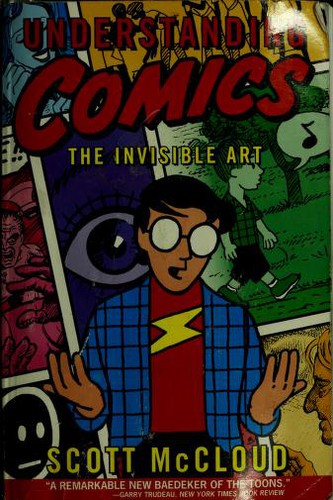
Scott McCloud · Buy on Amazon
"Eleanor: Understanding Comics is incredible. I was just talking with friends last night about how good it is because it’s one of those books that just comes up over and over again, especially with people who love comics. It explains what comics does and exactly what it is. I’ve been complaining about people not taking comics seriously and it’s lovely to see someone say, ‘It’s an art form. Can you please interface with it? Here’s how you break it down.’ That’s what Understanding Comics does so well. It’s brilliant. “People are like, ‘Oh, it’s a comic. How hard can it be?’” Neil: It’s like Scott McCloud was able to compress all of this stuff into one little package. It’s like enriched uranium in comic form—non-radioactive, good stuff, full of energy. I read it when it came out, I was at art school. It really did shape the way that I went forward and thought about sequential imagery. I still use it to this day, when teaching storyboarding. It’s about telling stories, all that stuff. It also gives you some comic theory, all distilled into one little book that you can just read, and then feel like, ‘I’ve got a PhD in understanding comics.’ It does what it says on the tin. It’s incredible. Eleanor: It’s absolutely true. Neil: We got to do a bit of the Bayeux Tapestry as well, in our book. Eleanor: One of the things that we tried to do was always find medieval examples of art and then Neil would work based off of those. Obviously we immediately went to the Bayeux Tapestry when we were talking about the Norman invasion. Neil: But when it came to representing the Bayeux tapestry, we wanted to do it in a way that wasn’t just showing it, you’ve got to do something with it. The actual page has to tell a little bit of a story and the story has got to chime but not do exactly what the words are saying. It’s like an echo. So we got this idea of an expert threading, weaving the story of the tapestry. You’re always trying to present things in an interesting, slightly different way. Eleanor: It’s really effective because everyone could understand it. It’s sequential. It’s got nice little captions that let you know exactly what’s going on and it’s got all the pictures. It’s something made for a visual world. Visual literacy was extremely high among medieval people. They might not all read, but they had a real understanding of iconography and how that works, in ways that we don’t. The Bayeux Tapestry is a great example of that. And yes, comics have always been around. Everybody loves comics."

Meg-John Barker and Jules Scheele (illustrator) · Buy on Amazon
"Eleanor: Queer: A Graphic History is incredible. It does a great job of breaking down a complex narrative and showing what you can do with pictures. This book is how I got the idea to do my own. I was walking along a canal in Oxford with friends talking about how great it was, and how it’s a really effective format for explaining ideas like this, and my husband said, ‘why don’t you do one?’ I thought, ‘that’s a great question. Why don’t I?’ So this is the graphic history that got me to do a graphic history very directly. It was the first time I’d been presented with something that was doing history in this way. We’ve named lots of personal histories, and great narrative histories from a fictional standpoint. But that’s not what I do. I can’t effectively write about myself, and I definitely am not a fiction writer. What do you do if you’re a huge fan of comics, and you don’t have any of those things in your arsenal? Queer was a great template for that, for understanding what it is that you can do, how you can get these complex ideas across to an audience and also, again, showing that there is an appetite among adult audiences for exactly what it is we’re doing here. Queer is a tour de force, one of the bestselling of any of the ‘Graphic Guides’ thus far. And there’s a reason for it. It’s really smart. Which is something I would say about Meg-John Barker, certainly. They are very smart. They know how to do this. It was a really great way of helping me to think about breaking down history for an audience and how you might do that from a visual perspective. Eleanor: Exactly. Neil: It’s an amazing tool to understand a really hard subject. There’s a lot of complexity and there’s a lot of terminology. It lays it all out, so you feel like you’re really getting an understanding, and a shaking up of taken-for-granted notions as well. It’s dispelling old stuff and really reassessing it. It’s got a real strong feminist voice in there, which is important, and social responsibility. And the art work is really good. It’s slightly different from what we were doing. It’s more Love and Rockets by the Hernandez brothers. It’s its own style of artwork, but there is that quality to it. Love and Rockets also had that rebellious edge to it, the characters in the comic weren’t conforming to norms, often. The artist and the author were a perfect coupling, for the book. Support Five Books Five Books interviews are expensive to produce. If you're enjoying this interview, please support us by donating a small amount . Kiera, our editor at Icon, gave us a couple of books to have a look at, the Marx book and this one. I used them as inspirational references, to make sure that I was not making a boring page design, to keep things a little bit on the move. Sometimes there’d be certain ideas in there that would be a reminder to keep the compositions varied. The difference is that often what we were illustrating was in the past, and I couldn’t just go off and draw stuff, because I don’t always know what the past looks like. I was having to do a lot of research. I created a database to look at lots of different manuscripts. I also did a lot of Google searches to make sure that I was historically accurate enough—unless I needed to break the rule to do some kind of joke, an anachronistic visual gag. That definitely impacted what I thought the process would be. I thought it’d be a little bit easier, actually, because a lot of the works that I’d done previously, for historical artwork, were considerably more short form. The level of research wasn’t as much. When you’re illustrating more contemporary times, it’s easier to draw people in suits and trousers and everyday things like telephones, even old-fashioned phones from 80 years ago, I could draw them without necessarily having to go to a reference. The further back you go, the more you need to make sure you’re drawing the right kind of things. Eleanor: There’s obviously a big difference in what we had to cover. Queer covers a lot of concepts or philosophy, how do you break Foucault down, and show that visually? But as you just said, Sophie, if they can do it for Foucault, surely I can do it about historical narratives that I teach all the time? There’s got to be a way. And maybe for us, because we had to show things visually, we’d say it a little more clearly and that gave us an opportunity to be creative in a totally different way. Eleanor: I am of the opinion that whatever gets people reading more is good. I’m team getting people to read more, in whatever way they like. Come to people, that’s the thing that you have to do. It’s one thing to be absolutely strict and purist and say, ‘Oh, you shouldn’t pick that up.’ But then where will you be? One of the conversations I always have with other academics is about public history. They can be snooty about it and say, ‘I don’t understand! The public could absolutely read academic books and understand them.’ And I’m like, ‘Yes, but they don’t want to.’ Neil: I’d go so far as to say that sometimes they are a little bit impenetrable, and maybe not so readable at all, if you don’t have the academic background. Eleanor: They’re readable as work. You could probably read it, paragraph by paragraph, going to Google if you don’t know something. So sure, it’s possible. But people want to read for pleasure. They want to read for fun. Even if it’s nonfiction , people want to pick up a book and know that they’re going to have a good time. So if you’ve got a popular book, and then it’s made into a graphic form for other people who might not be interested in it otherwise, then yes, I’m always team get more people reading. And maybe they’ll be so into it, they’ll want to read the original. Great. You can’t say fairer than that."