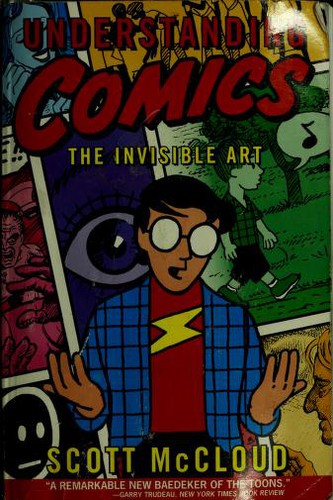
Understanding Comics
by Scott McCloud
Buy on AmazonPraised throughout the cartoon industry by such luminaries as Art Spiegelman, Matt Groening, and Will Eisner, Scott McCloud's Understanding Comics is a seminal examination of comics art: its rich history, surprising technical components, and major cultural significance. Explore the secret world between the panels, through the lines, and within the hidden symbols of a powerful but misunderstood art form.
Recommended by
"Eleanor: Understanding Comics is incredible. I was just talking with friends last night about how good it is because it’s one of those books that just comes up over and over again, especially with people who love comics. It explains what comics does and exactly what it is. I’ve been complaining about people not taking comics seriously and it’s lovely to see someone say, ‘It’s an art form. Can you please interface with it? Here’s how you break it down.’ That’s what Understanding Comics does so well. It’s brilliant. “People are like, ‘Oh, it’s a comic. How hard can it be?’” Neil: It’s like Scott McCloud was able to compress all of this stuff into one little package. It’s like enriched uranium in comic form—non-radioactive, good stuff, full of energy. I read it when it came out, I was at art school. It really did shape the way that I went forward and thought about sequential imagery. I still use it to this day, when teaching storyboarding. It’s about telling stories, all that stuff. It also gives you some comic theory, all distilled into one little book that you can just read, and then feel like, ‘I’ve got a PhD in understanding comics.’ It does what it says on the tin. It’s incredible. Eleanor: It’s absolutely true. Neil: We got to do a bit of the Bayeux Tapestry as well, in our book. Eleanor: One of the things that we tried to do was always find medieval examples of art and then Neil would work based off of those. Obviously we immediately went to the Bayeux Tapestry when we were talking about the Norman invasion. Neil: But when it came to representing the Bayeux tapestry, we wanted to do it in a way that wasn’t just showing it, you’ve got to do something with it. The actual page has to tell a little bit of a story and the story has got to chime but not do exactly what the words are saying. It’s like an echo. So we got this idea of an expert threading, weaving the story of the tapestry. You’re always trying to present things in an interesting, slightly different way. Eleanor: It’s really effective because everyone could understand it. It’s sequential. It’s got nice little captions that let you know exactly what’s going on and it’s got all the pictures. It’s something made for a visual world. Visual literacy was extremely high among medieval people. They might not all read, but they had a real understanding of iconography and how that works, in ways that we don’t. The Bayeux Tapestry is a great example of that. And yes, comics have always been around. Everybody loves comics."
Best Graphic Histories · fivebooks.com
"Understanding Comics is a book about how comics work, told in comic form. It’s very accessible, it’s for the general reader and is about comics in general, not just superhero comics. It explores areas like pacing and editing – how motion can be created through static panels on a page, and how arranging those panels in different ways, or drawing in different styles, or combining text and image, has different effects. It’s almost like a book on film study which explores the role of sound, lighting or editing. Scott McCloud is an artist himself, and he draws pastiches to show how different styles produce different effects. Well I think we can agree it sounds grander. It’s not a term I would use. I think it’s a term used by people who feel the need to validate or defend the academic study of comics. I don’t think we need to dress it up in new terms. A comic is a comic. We apply the same kind of theories to them as we do to novels, plays and films, and yield interesting results. Comics have the juxtaposition of text and image. That is something you can’t do in a novel. If a textual caption laid over an image doesn’t relate directly to the image, but seems to echo it somehow or have a metaphorical relationship to it, that is especially interesting. For example, in Watchmen there is a panel of a character straightening his cufflinks, and over that is the text “Every damn link” as spoken by another character from a previous panel. It’s a transition that you also see in films, but which works differently in a comic because we read them at our own pace. The images aren’t put in front of us and then taken away. We can linger for longer on an image, and we determine the speed at which the comic goes. Alan Moore in particular split up word and image, and experimented with juxtaposing them to suggest metaphorical links and symbolic echoes between word and image. So you can use word and image in imaginative ways, or in simple and unimaginative ways. There are bad comics just like there are bad books."
The Best Comics · fivebooks.com
Patrick Collison's Bookshelf · patrickcollison.com