Dennis Rasmussen's Reading List
Dennis Rasmussen is Professor of Political Science at the Maxwell School of Citizenship and Public Affairs at Syracuse University. His research interests centre on the Enlightenment and on the virtues and shortcomings of liberal democracy and market capitalism. His book, The Infidel and the Philosopher , was chosen as one of our best philosophy books of 2017.
Open in WellRead Daily app →The Best Adam Smith Books (2017)
Scraped from fivebooks.com (2017-02-12).
Source: fivebooks.com
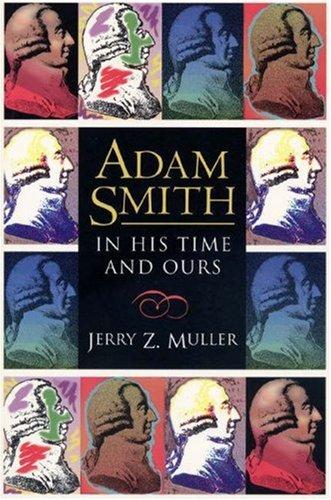
Jerry Muller · Buy on Amazon
"Let me say, first of all, how hard it was to decide on just five books on Smith. The scholarly literature on Smith is vast and it’s growing vaster by the day, it seems. Much of it’s quite good. Muller’s book is 25 years old now, but I chose to start with it because it still may be the best introduction to Smith for those coming to him for the first time. As its title implies, the book looks at Smith’s life and thought, along with the context in which he lived and wrote, and relates his ideas to our own time. As Muller himself puts it, he considers both what’s ‘timeless’ and what’s ‘timely’ in Smith. He presents all of this in an accessible, straightforward way, without pushing any particular interpretive agenda. For those coming to Smith for the first time, it gives some useful background and a good general sense of what Smith was about. Yes, that’s a big part of what he’s doing. Muller was one of the first to do this. It actually becomes kind of tedious when you read all the Adam Smith literature. Every single book has to start by saying, ‘Well, Smith isn’t who you think he is. He’s actually a far more interesting, nuanced thinker. He’s not an unapologetic apostle of selfishness and greed. In fact, lo and behold, he was a moral philosopher. He cared about virtue. His whole first book is about morality and sympathy and building a healthy community, so he was not this radical individualist.’ In 1995, when this book came out, that wasn’t as well-known, even among academics. Muller did a great service in helping to alert everybody to that fact. But now it’s quite well-known, among academics at least, that Smith wasn’t who he’s popularly taken to be. Muller rightly recognises that Smith was doing both, meaning he was both defending commercial society in the broadest sense and trying to suggest reforms to it. Smith sees commercial society as an unquestioned improvement over what had preceded it—the feudal age, which wasn’t in the too-far-distant past in Scotland, in the Highlands. He’s not just defending the status quo. He’s taking on mercantilism and arguing for free trade. But he’s not a free market absolutist by any means. He recognises the need for government action for the sake of national defence and the administration of justice and the provision of certain public works, at the very least. In fact, he emphasised the need for government to be strong enough to enforce order and rules of fair play. “He argues for free trade not just because it’s the most efficient, but because it helps to improve the lot of the poor—it’s also more just” But he did think that most attempts by politicians to guide or control people’s economic choices would be either futile or positively counterproductive, and that it’s impossible to attain prosperity by beggaring neighbouring countries, as he thought the mercantilists were seeking to do. Smith actually isn’t all that nice about merchants. Hume was. Hume really saw merchants as an amazingly useful class and, in some ways, he fits the mould of what we think of as Smith better than Smith himself does. Smith saw wealthy merchants as constantly conspiring against the public interest and trying to create monopolies, engaging in what economists today would call rent-seeking. They’re constantly out to make a buck and hurt everyone else, especially the poor."

Adam Smith · Buy on Amazon
"That’s right. It wasn’t published until he’d been a professor for about seven years. So the first edition of The Theory of Moral Sentiments was published in 1759. It went through six editions during his lifetime, the last and most substantial revision appearing in 1790, just before he died. This was one of the only two books he published during his lifetime. If his contemporaries are to be believed, he always thought that this was the better, more important of the two books, despite the fact that The Wealth of Nations eventually became so much more famous. The Theory of Moral Sentiments is a book of moral theory, looking at where our sense of morality comes from and what morality consists of. Throughout, Smith treats morality as an eminently practical, human phenomenon, rather than one based on any kind of sacred, mysterious, or other worldly authority. He argues, as Hume had before him, that morality comes from us, from human sentiments, above all our feelings of approval and disapproval, and that right and wrong are established by the sentiments that we feel when we adopt the proper perspective, one that corrects for personal biases and misinformation. “ The Theory of Moral Sentiments is a book of moral theory, looking at where our sense of morality comes from and what morality consists of ” This is, in many ways, Smith’s fundamental claim in the book, that the ultimate standard of moral judgement is set by what he calls an ‘impartial spectator’— meaning a spectator who’s both fully informed and disinterested. So, actions and character traits that would earn an impartial spectator’s approval are morally right, according to Smith, and those that would earn such a spectator’s disapproval are morally wrong. I think it is more an apparent than a real contradiction, but certainly The Theory of Moral Sentiments highlights human sociability from the very first sentence of the book. He talks about the fact that we, as he calls it, ‘sympathise’ with others, we identify with others, we put ourselves in their shoes. He sees people as social to the core. One of his main opponents in the book is what he calls the ‘selfish system’ of morals, which he associates with people like Thomas Hobbes and Bernard Mandeville. They say all sentiments come from self-love and we shouldn’t fool ourselves into thinking that people truly have any other regarding sentiments. Smith thinks, ‘Well of course we do.’ We genuinely care about other people, especially family, friends, those who are close to us, but even others more generally. To me, it’s a strikingly modern moral theory in that it doesn’t—like many moral theories of Smith’s time—rely on God or principles written into the fabric of the cosmos. Nor, like Kant and Kant’s followers, does he say that morality comes from reason. That it comes from the sentiments is, in some ways, a strikingly modern thing to say. Of course, there are many Kantians in the academy today who see this as utterly ridiculous and unhelpful, but I find it to be quite compelling. Maybe not in all the details, but the broad gist of it. Wow! Karl and me, on the same page. In some ways, Smith’s moral theory is a revision of Hume’s moral theory. Hume, too, takes a human rather than transcendent view of morality. He, too, says that it comes from the sentiments. Hume also says that right and wrong are established by the right kinds of sentiments. He calls it the ‘general point of view’ or the ‘common point of view,’ instead of the impartial spectator, but the basic idea is the same. Get the weekly Five Books newsletter For much of the 20th century, Smith’s moral theory was seen as little more than a series of footnotes to Hume, but I’d argue that, in several respects, Smith’s theory is more nuanced and more sophisticated than Hume’s. He has, I think, a richer conception of sympathy, which is the central concept for both of them—it’s what allows us to transcend selfish concerns and to make our sentiments truly moral sentiments. He has a critique of what he says is Hume’s overemphasis on utility as a key source of moral norms. “For much of the 20th century, Smith’s moral theory was seen as little more than a series of footnotes to Hume, but, in several respects, Smith’s theory is more nuanced and more sophisticated than Hume’s” Smith also sees religion more positively. I don’t think Smith bases morality on religion in any way—moral right and wrong don’t come from the will or word of God—but he does seem to think that belief in God, or in an afterlife, helps to at least buttress moral norms. It helps people to follow moral norms, to regard them as sacred, whereas Hume sees it as mostly pernicious, morally speaking. So there are a number of ways in which he modifies or revises Hume’s view."

Charles Griswold · Buy on Amazon
"When I first encountered Griswold’s book in graduate school, it really helped to open my eyes to the sophistication and power and relevance of Smith’s writings, especially The Theory of Moral Sentiments . Griswold’s book is among the first of what has now become a pretty steady of stream of books on Smith by philosophers. During the 20th century there were a number of economists and intellectual historians working on Smith, maybe a political theorist or two here and there, but very, very few philosophers even read Smith, much less devoted serious attention to him. Griswold’s book was one of the big things that helped to change that, to inspire a whole new generation of philosophers and political theorists to take Smith very seriously indeed. I’ve returned to the book again and again. It remains one of the very best, most comprehensive analyses of The Theory of Moral Sentiments that I know of. Griswold not only provides an incredibly rich, careful and rigorous analysis of the text, but also puts Smith in a dialogue of sorts with ancient philosophy, especially Plato, and situates his thought within contemporary debates over the virtues and shortcomings of Enlightenment. There’s just a ton there to chew on. He frames the book around the fact that we’re all, in some respects, children of the Enlightenment. He even says that scarcely anyone would claim a different heritage. We all appreciate what the Enlightenment did, the advent of liberal democracy and market capitalism and religious toleration and all these things that we’ve come to value. But almost nobody accepts the Enlightenment in its totality, either. People find it to be overly universalist, or rationalist, or individualist, or whatever. People—especially academics—describe all kinds of problems with the Enlightenment. So Griswold holds up Smith as an exemplar of somebody who embraces the broad Enlightenment worldview but also himself sees some of the potential pitfalls and dangers associated with it and tries to find ways we might combat those. Just the nuance and subtlety of Smith’s thought alone could help us to show that the Enlightenment wasn’t the simple caricature that it’s sometimes made out to be. Well, many associate the Enlightenment with upheavals like the French Revolution, where you’re just too dogmatically attached to certain principles. You don’t recognise the need for custom and tradition and the sentiments, when you think the whole world can be ruled by reason alone. Yes, that’s right. Hume and Smith see reason as weak and fallible and a thin reed on to which to hang a social order. People are far more likely to be moved by their feelings or passions or emotions. And not just the selfish ones. We’re moved by the whole range of passions. These are the things that we really need to take into account when we’re thinking of what motivates people and how we ought to build our societies."

Adam Smith · 1776 · Buy on Amazon
"The Wealth of Nations is, of course, one of the most famous, though certainly not most read or understood, books of all time. It was first published in 1776. In fact, I was once asked on an exam in high school ‘Who invented capitalism in 1776?’ It’s obviously an overstatement to say that Smith invented capitalism. First of all, the term ‘capitalism’ didn’t even emerge until the 19th century. But there’s no question that this book marked an enormous milestone in the development of economic thought and of reflection on the moral, social and political effects of commerce. It’s a long and sprawling work, so it’s difficult to sum up, but I suppose one place to start would be with the question implied in the title: What are the chief causes of economic prosperity? Smith argues that the chief source of productivity is the division of labour, and given that the division of labour is, as he says, limited by the extent of the market, free trade both within and among nations helps to promote the prosperity of all. I’ve already suggested that he wasn’t, by any means, a free market absolutist. But he did think that free trade was generally wise policy, that politicians aren’t very good at controlling people’s behaviour, and that even when they do so with the best intentions—and they don’t always do so with the best of intentions— they’re not always effective. Yes, that’s part of what I was referring to earlier, when I said he actually wasn’t that friendly toward merchants. He thought wealthy merchants were often going to collude against the public interest. But that’s really just the tip of the iceberg. I think one of the interesting things to note in connection with The Wealth of Nations is that Smith was far more willing than one might expect, given his current reputation, to acknowledge potential dangers and drawbacks associated with commercial society. This goes back to Griswold’s point about the potential drawbacks of the Enlightenment. For instance, Smith accepts that commercial society necessarily produces great inequalities. That great as the division of labour is for productivity, an extensive division of labour can exact an immense cost in human dignity by rendering people feeble and ignorant—the idea being that if you spend your whole life working on the 18th part of a pin you have no opportunity to exercise your body or your mind. In The Theory of Moral Sentiments he worries that too great an emphasis on wealth and material goods can corrupt people’s moral sentiments. “He worries that the desire for wealth often leads people to submit to endless toil and anxiety in the pursuit of frivolous material goods that will provide, at best, only fleeting satisfaction” And, also, there are worries about happiness. He worries that the desire for wealth often leads people to submit to endless toil and anxiety in the pursuit of frivolous material goods that he thinks will provide, at best, only fleeting satisfaction. Unlike many of today’s self-proclaimed Smithians, Smith himself was far from a mere apologist for commercial society. I should also emphasise, though, that none of this is to say that Smith didn’t ultimately defend commercial society. He absolutely did. He was absolutely convinced that commercial society’s real and important faults are not as numerous, or as great, as those of other forms of society. So, at least as I read him, Smith provides a kind of historical and comparative cost-benefit analysis, and concludes that, despite its very real problems, commercial society’s overall balance sheet remains preferable to other societies. It constitutes a definite improvement over the poverty and insecurity and dependence that dominated almost all pre-commercial ages. In other words, commercial society is unequivocally preferable for Smith, even if it’s only preferable on balance. Absolutely. I think there are a number of libertarians who would say we still have quite a bit of mercantilism left over, that we haven’t got rid of farm subsidies etc. But certainly he’s writing in a world where trade is far more restricted than it is now. One of the key reasons he argues for free trade—and I think this isn’t sufficiently appreciated today—is that he thinks free trade would benefit the poor. What are most of the restrictions that are in place in the 18th century? They’re restrictions put in place by the legislature that have been, as he says, ‘extorted’ by wealthy merchants for their own interests. The East India Company has monopolies on tea and the like, whereas if you instituted free trade, you’d get rid of all this rent-seeking and the result would be cheaper goods for ordinary people. We often pit free trade against helping the poor today, but he saw the two as going hand-in-hand. That’s one of the key reasons that he liked it so much. Yes, for all goods he thought that they were just being made more expensive by the rent-seeking behaviour of the rich. Smith wrote a page-long diatribe about the division of labour and its potential ill-effects. Karl Marx loved to quote it: ‘Even Smith, the great Smith sees that capitalism is terrible!’ But that’s not Smith’s point at all. He says, in effect, ‘Look, these are the effects the division of labour is going to have, unless government takes some means to prevent it.’ The passage comes not in the context of a discussion of the division of labour, but in the context of a discussion of education. In his view, it’s the state’s duty to ensure that the children of the poor and the workers get an education. Education should be compulsory so parents don’t throw their kids into the factory to start making money when they’re eight years old. For the ill-effects of the division of labour, he thought education was a great remedy. “Commercial society’s ills are less broad and important than those in most other forms of society” With regard to rent-seeking, this is, again, a big part of why he argues for free trade. The more free trade you have, the fewer restrictions there are available for the merchants to extort from the legislature. He does offer various counter-measures for the ills that he describes. But I don’t think he would have believed that utopia is possible. There are always going to be ills. Commercial society’s ills are less broad and important than those in most other forms of society, and we should try to tackle them with the means we have at our disposal. I think Smith would have said that commercial society and the activity of commerce might not encourage us to reach the moral heights, but it would discourage us from reaching the moral depths. If you live in a commercial society, you live by exchanging with others, so you depend a great deal on your reputation. When somebody sells me a book on Amazon and says it’s in great condition and it turns out to be in terrible condition, I’m not going to buy from them again. I’m going to give them bad reviews and they’ll stop making sales. The idea is that commerce encourages the virtues of what Smith, in The Theory of Moral Sentiments , calls the ‘prudent man’: somebody who is honest and conscientious and does his duty and follows the rules of justice. Which isn’t to say that this is some moral exemplar, some heroic being whom we should all strive to emulate. I don’t think he’s under any illusions that commerce is going to make us all perfectly virtuous people, but the activity of commerce itself does restrain at least some of the worst impulses of human nature. He uses it just once in both. He also used it once in an essay that was published posthumously. So from his pen, we have a total of three uses of the phrase ‘the invisible hand.’ As far as we can tell, he didn’t attach any particular importance to that phrase—nor did any of his interpreters until the 20th century. In the 20th century, the Chicago school of economists picked it out and made it the central thing to the point where now, when people hear the name Adam Smith, the invisible hand is the first thing that they think of. I do think the idea behind the invisible hand is pretty central to his work, though. The idea that there are often unintended consequences to various policies, that a lot of times things work in a bottom-up, Hayekian way, the idea that spontaneous order creates our system of morality and our economy without individuals intending it. So it’s not entirely wrong, but it is ironic, I think, that the phrase has become so deeply attached to our understanding of Smith. Yes, many people wore Adam Smith neckties . They were very popular in the Reagan White House, as I understand it."

Samuel Fleischacker · Buy on Amazon
"Like Griswold’s book for The Theory of Moral Sentiments , Fleischacker’s book was, in many ways, the first of its kind—the first philosophical companion to The Wealth of Nations . It shows just how many deep philosophical questions Smith tackles in The Wealth of Nations , either explicitly or implicitly—not just with respect to economic and political issues, but also with respect to things like human nature, human psychology, morality and happiness. Fleischacker writes very clearly and even beautifully. He effectively brings out just how rich Smith’s political economy is. Among its many virtues, this book builds on earlier work by [the economic historian] Emma Rothschild to show that there are, in addition to the obvious aspects of Smith’s thought that would push him toward the libertarian right (like his general distrust of politicians), a number of features of his thought that would push him toward the political left, in contemporary terms. Above all, Fleischacker highlights Smith’s deep, palpable concern for the lot of the poor, and argues that his strong belief in human equality made him a forerunner of contemporary notions of distributive justice and the welfare state. Yes, and it goes well beyond political economy. For a long time, most of the books about The Wealth of Nations were just about free trade and mercantilism etc. This book helps to show how much other stuff there is in it. The Wealth of Nations is a big book, so of course there’s a lot in it, but Fleischacker brings out the richness of the discussions really nicely. Smith has a particular, 18th century writing style. It’s not always easy to pick up. The Wealth of Nations is 900 pages long. At one point, there is an 80-page digression—what Smith himself calls a digression—on the variation of the price of silver in different ages. There are aspects of it that are hard to slog through, even if you’re me and really interested in Smith and what he has to say. The Theory of Moral Sentiments has less of that, but it presents challenges of its own. Above all, it opens without any introduction or discussion of where the book is going. It almost seems as if he’s in mid-thought. He’s arguing with somebody from the very first sentence, an unnamed interlocutor. So it takes a while to get your bearings. But once you’ve got familiar with it, I do think Smith is a beautiful writer. Funny, maybe a couple funny moments, but no… Hume is a much funnier writer than Smith. Fleischacker’s previous book was on Kant, so maybe it’s about what you’re comparing it to… The Wealth of Nations is very clear, it’s very comprehensive, and it gives real, concrete policy advice. Hume’s essays had given broad reasons why what he called ‘the jealousy of trade’ is counterproductive and foolish. But Smith says, ‘Okay, here are some recommendations on tax policy, here are some recommendations on areas X, Y, and Z.’ He really gave them a blueprint. That’s one of the things that makes it so difficult to know—and why there are constant debates among Smith scholars about—where he would stand on today’s political spectrum. He gives this policy advice in the 18th century, and it’s hard to know how that would translate to today. What are the principles underlying his advice, rather than just the pieces of advice themselves, which you obviously can’t import to a totally different situation? And he, himself, was well aware that you couldn’t do such a thing. Emma Rothschild started off with an article called ‘Adam Smith and Conservative Economics’ but then built that into her book called Economic Sentiments , which came out a couple of years before Fleischacker’s book. She was really one of the pioneers in showing the left-wing side of Smith (in contemporary terms) and how Smith had been used and abused by conservative economists for their own ends. If you go back and read him, you see his deep concern for the lot of the poor, you see him saying that a degree of progressive taxation is perfectly reasonable, you see his at least implicit support for labour unions. In short, all the features of his thought that would push him toward the left in today’s terms. There’s a famous scene—that every biography of Smith includes—where he’s coming to give advice to Pitt. Pitt and all his top ministers are in a room and Smith walks in and they all stand up to greet him and he says, ‘Sit down, gentlemen.’ And they say, ‘No, we will stand till you’re first seated for we’re all your followers’—or something of the sort. So they very much saw themselves as following in his footsteps. From what I understand, many of the policies and practices of the Pitt Administration were fairly Smithian, fairly free trade oriented, until war broke out with Revolutionary France, which muddled everything. Economists tend to see Smith as a forerunner of what they’re trying to be, meaning a kind of impartial, neutral, value-free observer. I guess there are times in The Wealth of Nations when he does take that posture. Some scholars even argue that he does so in The Theory of Moral Sentiments , that he’s just describing where morality comes from and not what it actually consists of. I think that’s not terribly plausible with regard to The Theory of Moral Sentiments. There’s more of that in The Wealth of Nations , but he certainly doesn’t leave questions of morality behind. As I say, he argues for free trade not just because it’s the most efficient, but because it helps to improve the lot of the poor—it’s also more just . We know from Smith’s correspondence that he worked on a couple of other books, in addition to the two he published. But he never completed either of them to his satisfaction and he had the drafts burned. He had the great majority of his papers burned just before he died. He did allow his literary executors to posthumously release a volume of essays that were called Essays on Philosophical Subjects . We also have student notes from a couple of the courses he taught, but whether he would like us looking at them, I doubt. Support Five Books Five Books interviews are expensive to produce. If you're enjoying this interview, please support us by donating a small amount . Smith did publish one other work under his own name during his lifetime, in addition to the two books, which I find to be particularly beautiful and revealing, even if short. This was an open letter on the last days, death, and character of David Hume. It was published under the name ‘Letter from Adam Smith, LL.D. to William Strahan, Esq.’ This ended up being maybe the most controversial thing Smith ever wrote. It appeared in a highly charged atmosphere. Few in 18th century Britain were as forthright in their lack of religious faith as Hume was and, as Hume neared death, everyone wanted to know how he’d face his end. Would he show remorse, or maybe even recant his scepticism? Would he die in a state of distress, having none of the usual consolations afforded by belief in an afterlife? Smith’s letter was effectively the authorised version of the story of Hume’s death. It appeared with Hume’s advance permission as a kind of companion piece to Hume’s autobiography called My Own Life in March 1777. “Smith later proclaimed that it ‘brought upon me ten times more abuse than the very violent attack I’d made on the whole commercial system of Great Britain’” Smith doesn’t explicitly call attention to Hume’s impiety in the letter, but he does make pretty clear that Hume died with remarkable good humour and without religion. He chronicles—some would say flaunts—the cheerfulness and the equanimity of Hume’s final days, showing him telling jokes and playing cards and conversing cheerfully with his friends. He also emphasises the excellence of Hume’s character. In fact, Smith concludes the letter by declaring that Hume, his unbelieving friend, approached ‘as nearly to the idea of a perfectly wise and virtuous man as perhaps the nature of human frailty will permit.’ This work is relatively little known today, but in Smith’s day this depiction of Hume’s calm and courageous death caused an absolute uproar. Smith later proclaimed that it ‘brought upon me ten times more abuse than the very violent attack I’d made on the whole commercial system of Great Britain.’ For anyone who hasn’t read it, I really recommend it. As I say, it’s quite short, quite beautiful, and quite revealing. I discuss this letter and the fierce reaction to it in the final chapter of The Infidel and the Professor , and then the letter itself is included in the appendix. I wouldn’t say that even Hume was an atheist—he’s more what we might call an agnostic. He would say that we shouldn’t be so sure that there’s no God, atheism is a pretty strong position. But he is sceptical about it. With Smith, it’s harder to say. There’s no real consensus among Smith scholars on his religious views. Some read him as a closet atheist, some as a more or less orthodox Christian. Most come down somewhere in the middle, saying that he’s a deist of some kind. My own reading—and I think this would be somewhat controversial among Smith scholars—is that Smith’s views were substantially closer to Hume’s, which is to say substantially more sceptical, than is usually assumed. Perhaps his scepticism retained a touch of deism. I think it’s distinctly possible that Smith believed in a distant, maybe even benevolent higher power. But I think he almost certainly wasn’t a believing Christian. He seems to have been suspicious of most forms of religious devotion. But as you say, whereas Hume was fairly forthright about his lack of faith, Smith generally went to great lengths, in both his writings and his personal life, to avoid revealing his religious beliefs (or lack thereof). Contemporaries frequently noted that Smith was ‘very guarded in conversation’ when the topic of religion came up. He wrote about it a lot less than Hume did, and what little he did write is sufficiently ambiguous to leave most readers unsure of his ultimate convictions. But my reading of all the evidence—the writings, the revisions of the writings, the actions he took, and of course his friendship with Hume—was that he’s quite a bit more sceptical than has often been believed. Yes, he was always extremely close to her. This is a theory that’s been put forward by a scholar named Gavin Kennedy. He’s made the point in a number of different places that we couldn’t really expect Smith to be openly impious given his close relationship with his mother and her piety. I think that’s probably part of it. Smith also just seemed temperamentally disposed to being more circumspect than Hume. Hume gets into a quarrel with Rousseau and wants to publish it to the world, and Smith says, ‘No! Why publish all your gossiping stories for the public?’ He may have also just thought that religion was less dangerous of a phenomenon than Hume did, and that its dangers would be better combated through quiet neglect rather than open confrontation or poking the pious in the eye at every chance you get. It’s also possible that he learned a lesson from Hume. Hume’s impiety was far more open and, as a result, he was twice denied professorships. Attempts were made to excommunicate him from the Kirk. Smith wanted to be a Professor of Moral Philosophy. When he became a professor in Glasgow, one the first things he did was ask to be freed from the customary duty of opening each day’s class with a prayer, but he was turned down. So, certainly, he couldn’t have been too openly impious and still been a professor. On that note, I think it’s worth pointing out that The Theory of Moral Sentiments becomes a less religious book over time. Subsequent editions invoke providence less and less. And the first toning down comes in the third edition, which was the first one published after he left his professorship. I’m guessing there’s some kind of connection there. He was just very careful, very concerned about what he wrote. He worked it and reworked it and didn’t want to put anything in print that he hadn’t thought through and approved. There’s another contrast there. Hume wrote so much—a six-volume history of England and all these different works. Two books, plus this one letter, are the only things Smith published over the course of his life. He was never satisfied with anything he wrote and didn’t want posterity to get its hands on something that he hadn’t worked through to his satisfaction. This was one of his great worries. When he was in ill-health in 1773, and heading to London to publish The Wealth of Nations, he made Hume his literary executor. He said, ‘Okay, you’ve got to burn all these papers if I die while I’m gone.’ And then, when he was close to actual death in 1790, he called his literary executors and said, ‘I’m going to die soon. You’ve just got to burn all these while I’m still alive so I feel safe about this.’ He was always concerned to make sure all his papers were gone, much to the regret of later scholars."