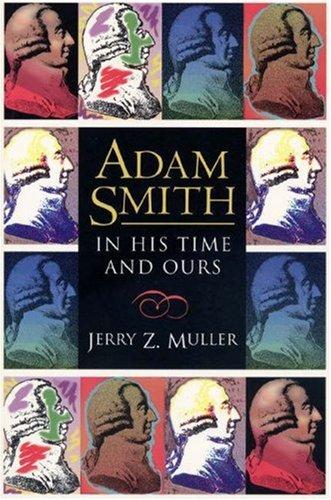
Now that the Marxist project of human transformation through the elimination of self-interest and markets stands thoroughly discredited, it is time to acknowledge Adam Smith as one of the most important social thinkers of modern times. Smith's Inquiry into the Nature and Causes of the Wealth of Nations, published in 1776, argued that a market economy was not only best able to meet the material needs of the people; it also provided a moral system which relied on human nature to create order and fairness. But Smith's intentions and conclusions, much maligned by his opponents on the left, have just as often been misunderstood by his conservative defenders. Counter to the popular impression that Smith was a champion of selfishness and greed, Jerry Z.…
"Let me say, first of all, how hard it was to decide on just five books on Smith. The scholarly literature on Smith is vast and it’s growing vaster by the day, it seems. Much of it’s quite good. Muller’s book is 25 years old now, but I chose to start with it because it still may be the best introduction to Smith for those coming to him for the first time. As its title implies, the book looks at Smith’s life and thought, along with the context in which he lived and wrote, and relates his ideas to our own time. As Muller himself puts it, he considers both what’s ‘timeless’ and what’s ‘timely’ in Smith. He presents all of this in an accessible, straightforward way, without pushing any particular interpretive agenda. For those coming to Smith for the first time, it gives some useful background and a good general sense of what Smith was about. Yes, that’s a big part of what he’s doing. Muller was one of the first to do this. It actually becomes kind of tedious when you read all the Adam Smith literature. Every single book has to start by saying, ‘Well, Smith isn’t who you think he is. He’s actually a far more interesting, nuanced thinker. He’s not an unapologetic apostle of selfishness and greed. In fact, lo and behold, he was a moral philosopher. He cared about virtue. His whole first book is about morality and sympathy and building a healthy community, so he was not this radical individualist.’ In 1995, when this book came out, that wasn’t as well-known, even among academics. Muller did a great service in helping to alert everybody to that fact. But now it’s quite well-known, among academics at least, that Smith wasn’t who he’s popularly taken to be. Muller rightly recognises that Smith was doing both, meaning he was both defending commercial society in the broadest sense and trying to suggest reforms to it. Smith sees commercial society as an unquestioned improvement over what had preceded it—the feudal age, which wasn’t in the too-far-distant past in Scotland, in the Highlands. He’s not just defending the status quo. He’s taking on mercantilism and arguing for free trade. But he’s not a free market absolutist by any means. He recognises the need for government action for the sake of national defence and the administration of justice and the provision of certain public works, at the very least. In fact, he emphasised the need for government to be strong enough to enforce order and rules of fair play. “He argues for free trade not just because it’s the most efficient, but because it helps to improve the lot of the poor—it’s also more just” But he did think that most attempts by politicians to guide or control people’s economic choices would be either futile or positively counterproductive, and that it’s impossible to attain prosperity by beggaring neighbouring countries, as he thought the mercantilists were seeking to do. Smith actually isn’t all that nice about merchants. Hume was. Hume really saw merchants as an amazingly useful class and, in some ways, he fits the mould of what we think of as Smith better than Smith himself does. Smith saw wealthy merchants as constantly conspiring against the public interest and trying to create monopolies, engaging in what economists today would call rent-seeking. They’re constantly out to make a buck and hurt everyone else, especially the poor."