Chigozie Obioma's Reading List
Chigozie Obioma is an Assistant Professor of literature and creative writing at the University of Nebraska-Lincoln. His first novel, The Fishermen , won the FT/OppenheimerFunds Emerging Voices Award and the 2016 NAACP Image Award for outstanding literary debut, it was shortlisted for the 2015 Man Booker Prize, the Edinburgh Festival First Book Award, and The Guardian First Book Award. His second book The Orchestra of Minorities has been shortlisted for the 2019 Booker Prize. He has spoken to Five Books about his writing and recommended books on Boyhood and Growing up .
Open in WellRead Daily app →Boyhood and Growing Up (2016)
Scraped from fivebooks.com (2016-03-04).
Source: fivebooks.com
William Golding, with a foreword by Stephen King · Buy on Amazon
"William Golding imbues some of these children with wisdom that would read, in the hands of a lesser author, as implausibly knowing. In the context, in the way that the novel strips these boys of known civilisation to create their own, which is a facsimile of what they are used to, it is believable. That kind of thing that Simon says, for example, about the beast being in all of them, I think can be tied to what I am trying to say. I think our sense of good and bad—the idea of a civilised person—tends to depend on community. So what happens when you are thrown into a desert on your own? When you become Robinson Crusoe, for example, what do you do? That is when your integrity is tested, when nobody is looking."
Charles Dickens · Buy on Amazon
"You are right. In the case of Oliver Twist , I love the book mostly because of how he discovers himself—the discovery of inner strength, let’s say. He’s an orphan, he becomes used to suffering, being passed from hand to hand. There is a pivotal moment, when he is fourteen or so, and he’s taken to his orphanage, and the meal is so meagre that he’s eternally hungry. All he thinks about is food, “How can I get more food?” And then one day he had this radical idea, “How about I ask for more?” He has the idea that, if you want something, you can actually make a demand on life. That was what turned Oliver around, that is what makes him the interesting character he becomes: that discovery that he can make an enquiry into something. I believe that for a work of fiction to really succeed, it has to be based on a philosophy, or a couple of them. There has to be something about the deeper, subterranean knowledge of human life that the novel will explore. So what I wanted to do with The Fishermen was explore the idea that we can understand human beings through other creatures. I can tell you a story of a family, through the prism of how animals relate to each other, or from the bodies of other creatures. I also wanted to work on how I think children sometimes see the world—at least how I did when I was growing up—by associations. So Benjamin would see a bully at school as a lion. When I was a child, I’d tell my Mum, “This guy who beat me up was as ferocious as a tiger.” Or you see some teacher and you think, “This guy is a Super Man, this guy is a Robocop, or Batman.” That’s where the metaphors come from. I wanted Ben to be able to understand the world and rationalise things through the bodies of these creatures he’s fascinated about. “For a work of fiction to really succeed, it has to be based on a philosophy, or a couple of them.” Of course there are some deeper things that I do with it, like the metaphor of the father being the eagle. There’s actually a phenomenon with eagles: a mother eagle always gives birth to twins, and then she can only bring so much food back to the nest. So what happens is that there is a fight, a strife that happens in the nest, and 97% of the times, one eaglet kills the other, so that he alone can have the food. It’s called Cain and Abel syndrome. In my book, the father is the eagle who leaves to get food for the family, and the children kill each other by the time he’s back."
Chinua Achebe · Buy on Amazon
"Chike and the River is about a boy who discovers his dreams. It’s like Oliver Twist . He is used to being pampered and being kept within the house, and then he goes and discovers the river on a trip to the city. That wakes up this taste, or quest, for a deeper understanding of life. I think the encounter with that element, water, actually opens the window to him developing a kind of internal philosophy of life. That is what the book is about. It’s a coming-of-age story. I think it depends. Books like Chike and the River are aimed primarily at children. The language is so plain and its probe into life is not adult-deep. It’s so on-the-surface that I think an adult might find it almost laughable. You will have already seen all of these things, but to a child it will be new knowledge, “Oh, so this is how a house is built—by many people. It’s a division of labour.” This is the first time a child understands that kind of thing, “There’s an architect who comes and draws the house, and then the builder who moulds the bricks.” That is the first time a child knows how it’s done. This would be my idea of a children’s book that is meant for kids. Get the weekly Five Books newsletter But I cannot call William Golding’s book a children’s book, although there are children characters, nor will I call Salinger’s a children’s book, nor even my own. These are different books, because of the depth of analysis of what it means to be human."
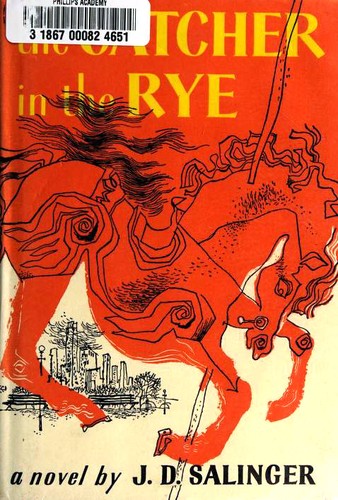
J D Salinger · 1951 · Buy on Amazon
"I’m drawn mostly to books about boys of that age, and I think The Catcher in the Rye is unsurpassed. What I love about it is just how carefree this boy is about life. He has reached the point that Oliver Twist reaches in his pivotal moment, the point that the boys in Lord of the Flies reach when Simon makes the declaration we talked about. Holden Caulfield reaches this point at the very end, but he refuses to acknowledge that he has done that. Yes, but this only comes at the end. So in the book, he sees life as nothing, he’s fairly depressed about his failure. But he’s trying to tell us, “Look, this does not mean anything, the world is bigger than flunking an exam.” So he makes jokes out of everything. He sees everybody as phony because they take life too seriously. “Why do you care so much about your mortgage, or your wife, or school, even?” So, I find that very interesting, especially the way Salinger puts it together, how funny it is, and how almost satirical the piece is, coming from a child’s perspective."
Benjamin Percy · Buy on Amazon
"The title story is the most successful one. The fight scene in that short story was one of the things that helped me when I was writing my novel and thinking about the violence boys do to each other. It’s a collection featuring a recurrent main protagonist, whose father has gone to the Iraq war, and it is about trying to understand what it means to be without the father figure. There are maybe two stories that look at this boy’s life when he’s much older, but most of them are within that boundary of adolescence and growing up. I think the violence of the Iraq war pushes the violence of boyhood to be more. When boys are growing up, there’s something that happens with the discovery of their identity. Boys always have an interest in the sense of masculinity which is tied to force, to violence, to domination. They bully each other, they fight; there’s often a tendency to exert some kind of force on the other. That’s their understanding of masculinity at the time. Some boys develop a machismo at that age, which they begin to let go of as they grow older and become more responsible human beings. “Boys always have an interest in the sense of masculinity which is tied to force, to violence, to domination.” The entire town in Oregon, where the book is set, is in a kind of US military zone, so most of the kids’ fathers are in the army. Again and again, they see people bringing letters that say so-and-so boy’s father is dead. So the fear, the anger, and the anxiety that maybe one day this military guy with a bag will come and give the message to their mum, helps the boys grow up quickly. The boys are always fighting with each other. They have this fighting competition where they buy Coca-Cola and then drink it and fight each other until they bleed. They want to build up this internal strength so that when eventually they hear that their fathers are dead, they will be able to withstand it. I think, in the West—I’ve been living in America for three and a half years—I think boyhood is changing here of course. Boys tend to develop an almost violent perception of the self while growing up, but the Millennials’ outlook on life is different. The society of today is much more aware of violence and the repercussions of these things, and is much more vocal about it. There is, like never before, awareness about feminism and women’s rights, for example, and what it means to be respectful of one another. Some of those concerns were not there a hundred years ago, and they aren’t even there today in most parts of Africa. So I think in that sense, in the moral sense, there’s a difference in boyhood today in the West. My family was much like the boys in The Fishermen , we were regarded as middle class. But our neighbours and the rest of the people I knew at the time struggled. Their idea of boyhood was much more focussed on the future, rather than the now: “When I grow up, I want to be this.” Even middle class people, like my father, kept saying, “You boys have to be better than me when you grow up, you must be this…” There’s always more of an upward look to the future there than you would have in America—where it seems like you don’t have any problems, you are enjoying the now and the future will come at its own time. In America there is much more satisfaction, most people have enough. When I was growing up there was a palpable anxiety, there was a rush. You wanted to leave that place, that state of development, and become a pilot, and have money, and to be able to buy as many things as you wanted. That anxiety—the wish to own a life of your own, a world of your own—is always resident in people from that part of the world. But I would suppose that a child in suburban America today would not be thinking like that because they mostly live in a more affluent society where most of their needs are more easily catered for. So the anxiety to leave boyhood is not there, in fact, they would want to stay in boyhood for as long as possible."