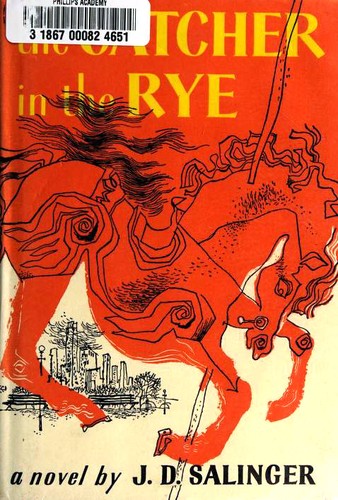
The Catcher in the Rye
by J. D. Salinger · 1951
Buy on AmazonStory of Holden Caufield with his idiosyncrasies, penetrating insight, confusion, sensitivity and negativism. Holden, knowing he is to be expelled from school, decides to leave early. He spends three days in New York City and tells the story of what he did and suffered there.
Recommended by
"I’m drawn mostly to books about boys of that age, and I think The Catcher in the Rye is unsurpassed. What I love about it is just how carefree this boy is about life. He has reached the point that Oliver Twist reaches in his pivotal moment, the point that the boys in Lord of the Flies reach when Simon makes the declaration we talked about. Holden Caulfield reaches this point at the very end, but he refuses to acknowledge that he has done that. Yes, but this only comes at the end. So in the book, he sees life as nothing, he’s fairly depressed about his failure. But he’s trying to tell us, “Look, this does not mean anything, the world is bigger than flunking an exam.” So he makes jokes out of everything. He sees everybody as phony because they take life too seriously. “Why do you care so much about your mortgage, or your wife, or school, even?” So, I find that very interesting, especially the way Salinger puts it together, how funny it is, and how almost satirical the piece is, coming from a child’s perspective."
Boyhood and Growing Up · fivebooks.com
"Catcher in the Rye injected a fresh idiom into American literature . This happened several times in our literary history. Mark Twain in Huckleberry Finn and Ernest Hemingway in The Sun Also Rises did the same – they brought the contemporary spoken language into literature. When Salinger invented Holden Caulfield he gave his voice such freshness and vibrancy. Salinger also almost invented the concept of teenage angst – Salinger’s was the first voice of the youthquake that transformed our society in the 50s, 60s and 70s. That makes perfect sense to me, because it often seems that in Woody Allen’s movies he’s trying to preserve the New York of the immediate post-war years. Reading Catcher in the Rye made me want to live in New York City and go to the bars where Holden went and walk in his fictional steps through Central Park. For all of its satire, Catcher in the Rye is a very romantic portrait of New York."
Essential New York Novels · fivebooks.com
"This is the only book I read when I was a young adult. I believed it was cursed for me—it was the book I read directly before I had a breakdown. I thought that somehow reading the book had triggered my breakdown. I found Holden when I felt exactly the same as he did. When he was with his sister he wanted to be a child, but he was being thrust into this adult world. And he didn’t want to be. And that’s where so much of my anxiety came from too. I remember reading it. I’ve still got the same copy that I had then and there are little paragraphs and sentences that I’d ringed. With Holden I discovered that there were other people that felt the way I did. When I found out that it had been written so long ago, I found something comforting about that. Before I read this book, it felt to me, that I was alone and going through something unique and unknown. But apparently others, even in the far past had had the same experience. So I took from it that this was a rite of passage—this time was difficult for most people. It was a transformative book for me. And I love it for that. It explained things for me at a time when I couldn’t have explained them myself. “When you’re young, it’s like the words are on the top shelf and you have to go on tip-toe to get them down” Conditions like anxiety and depression—and their prescribed medications—cause you to feel jumbled in the head. You can’t reach for the words you need. You somehow haven’t got the words. It’s like the words are on the top shelf and you have to go on tip-toe to get them down. That’s when books like this can do the talking for you. It gives you a platform to express yourself. And that’s really the important part. The sex thing is very important. I was a very innocent teenager (until I wasn’t), yet desperate to experience the adult world of sensuality and sexuality. This sense that getting yourself into a situation that you want to get out of almost immediately. I could identify with that. You just feel less of a freak. When you are a teenager there is a temptation for bravado—to show off about losing your virginity or other such initiations. No one talks about the uncomfortable bits of growing up. So it’s a relief in Catcher in the Rye to read about the prickly discomforts of growing up. These run vividly all through the book."
Teenage Mental Health · fivebooks.com
The Atlantic's The Great American Novels · theatlantic.com
"It wasn’t till early adolescence that I saw the point of books and then it was the old stalwart, “The Catcher in the Rye,” that got me going."
By the Book: Alain de Botton · nytimes.com
"both feel that you are inside someone's head and so I think that idea of being completely lost, completely overwhelmed and immersed in a role was fueled very much by reading them."
By the Book: Alan Cumming · nytimes.com
"I waited way too long. I wish I'd found Holden Caulfield when I was an angsty teenager and really needed this character to show me that feeling out of place is actually pretty normal."
By the Book: Gabourey Sidibe · nytimes.com
""The Catcher in the Rye," by J. D. Salinger, or "A Midsummer Night's Dream," by William Shakespeare. The former taught me how powerful a single voice can be."
By the Book: Gwyneth Paltrow · nytimes.com
"Though the latter is not disappointing at 30 or 40, I think."
By the Book: Javier Marias · nytimes.com
"I read it again as an adult and was astounded at how hilarious and powerful it still was to me. It might be perfect."
By the Book: Judd Apatow · nytimes.com
"For my ’50s generation, Salinger was an addiction, and dominated much of our conversations, and even our ambitions."
By the Book: Jules Feiffer · nytimes.com
"I love the voice Holden Caulfield spoke in and the way he described what he was feeling and what was going on in his mind."
By the Book: Lenny Kravitz · nytimes.com
""The Catcher in the Rye" and "Nine Stories" had a profound impact on me. His humor and darkness and use of language to convey character just killed me."
By the Book: Nathan Lane · nytimes.com
"Salinger was not taught at school then, so I read "The Catcher in the Rye" as a subversive book in high school years."
By the Book: Orhan Pamuk · nytimes.com
"The other books I read at the same time that made me want to write were “David Copperfield,” the essays of George Orwell and “The Catcher in the Rye.”"
By the Book: Sebastian Faulks · nytimes.com