Carolyn Steel's Reading List
Carolyn Steel is a practicing architect, she joined Kilburn Nightingale Architects in 1989 and has run successful design units at Cambridge, The University of North London (now London Metropolitan University), and at the London School of Economics. Her 2008 book Hungry City: How Food Shapes Our Lives won the Jerwood Award for Non-Fiction.
Open in WellRead Daily app →Food and the City (2010)
Scraped from fivebooks.com (2010-04-17).
Source: fivebooks.com

Massimo Montanari · Buy on Amazon
"This was the first book I read, and it’s a summary of European food culture; what these cultures are, and where they came from. An example of the kind of thing Massimo Montanari talks about is how the Romans became farmers. Because they had an urban civilisation, and a lot of urban ideas, they were forced into creating an agricultural economy because that’s the only way you can really feed a city. They couldn’t understand why the Germans in the north of Europe didn’t become farmers. “The profound separation between man and the natural environment comes with industrialisation, when it becomes clear that we are actually destroying nature.” Montanari explains that this is because the Germans were forest dwellers who prioritised hunting, and therefore meat eating. This difference generated profound cultural differences. For the Romans the cultivated land around the city, the ‘Ager’, was seen as sacred, and also a part of the city, and they saw the wilderness as a bit dangerous and basically useless. The reverse is true of the Germans, who saw the wilderness as their home: they lived there. There was a complete clash of conceptions of land, identity and even gods. It’s just such a fascinating thing that there are these extraordinarily powerful, deeply buried understandings of who we are and what we are that can be understood through how we feed ourselves. I was unbelievably lucky to have come across this book first."

Keith Thomas · Buy on Amazon
"Having read a huge number of books for my research, I find that some books just stand out as just being beautifully researched, or so scholarly that they are revelatory. Man and the Natural World is one of those books. It’s written in that level voice of someone who really knows what they are talking about. The book deals with what it says on the tin: the relationship between man and nature. He actually focuses on a particular period of English history, from 1500-1800, a period which is particularly interesting for me, since it deals with the rise of urbanism, the agricultural revolution, and shifting perceptions of people’s relationship with the land. The way he describes the rise of vegetarianism as a movement which arises when people start to question their relationship with the natural world, is particularly interesting. The view in early modern England, before the agricultural revolution, was that cultivated land was beautiful and that the transformation of the landscape that was taking place in order to feed cities was a good thing. But as the agricultural revolution kicked off, people began to see the encroachment of urban influence on to the natural landscape as a bad thing. He talks about the rise of pastoralism, which is this extraordinary movement that extols the virtues of the countryside, something better and purer than cities. Vegetarianism and early environmentalism are the implications of this. Well, I do think it’s incredibly important that we retain a sense of being part of nature. But I’m interested in why it is that living in cities has been associated with distancing ourselves from nature. It’s not a new thing, if you go back to the Romans, they are already projecting a judgmental view of what kind of natural form is good or bad, projecting an urban view on to the natural environment and setting themselves as something separate from it. And yet they still saw themselves as part of the natural world: that’s what making sacrifices to the god of the underworld was all about. The profound separation between man and the natural environment comes with industrialisation, when it becomes clear that we are actually destroying nature. People then start seeing nature as something which needs to be saved, although this still means we are seeing ourselves as something apart from nature. Where we’ve got to now with environmentalism is good. We have realised that we can’t see ourselves as disassociated from nature because we are part of it. There is this growing consensus in the green movement, which I support, that we have to rethink the city as an organic ecology. It will be interesting to see how this develops in the next few years."
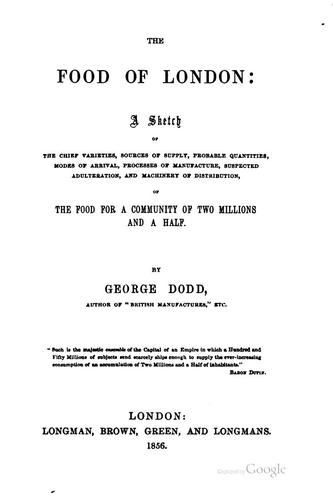
George Dodd · Buy on Amazon
"This is probably my favourite. It was written in 1856 by George Dodd, a Victorian historian, and is about how the London of his day was fed. The extraordinary thing about The Food of London is that when it was written London was on the cusp of changing. He was observing all the ancient traditions, which came from London feeding itself as a pre-industrial city, coming to an end. For instance, he talks about the piggery in Kensington where pigs were still being bred in the city: there were two pigs to every human! The piggery was only closed down two years before he wrote his book. Likewise, there is this amazing description of the livestock market. He describes the ‘Great Day’, where all the cattle which were being fattened in Islington were driven down St John Street to Smithfield to be sold in the Christmas market. It’s such a strong image; 10,000 livestock in one space in the centre of London – people got trampled because there was no space."

Steven Kaplan · Buy on Amazon
"Yes and no. Provisioning Paris is a book as long as The Lord of the Rings – it’s over 1000 pages long. Similarly to The Food of London Steven Kaplan is writing about how Paris is fed. However, Provisioning Paris has a sharper focus: he is interested in the supply of grain to Paris in the period just before the French Revolution. I found that Paris makes an interesting contrast to London. For example, the London of George Dodd’s time finds it much easier to feed itself than Paris: London is on a navigable river, which made international trade much easier, and it was also the capital of an empire. Paris, in contrast, is about 170 miles from the sea, which limits the scale of importation. Steven Kaplan spends a great deal of time on how in Paris, the king was known as the ‘baker of last resort’. In the minds of the people he was responsible for feeding the city. This put the king in a very difficult position: the problem is not only whether you can grow enough food, but also whether you can transport it and so on. This pressure crippled the city: Paris had this enormous ‘grain police’, made up of thousands of officials whose job it was to make sure that all the surrounding countryside was only growing grain for the city. As roughly one harvest in every three failed, this meant that the countryside didn’t have enough grain to feed the city, and the king, ‘the baker of last resort’, was forced to go further afield. When the city imposed, with force, this demand on the wider countryside, it caused huge physical and social tensions."

Harvey Levenstein · Buy on Amazon
"This is the book that you should read if you want to understand where modern American food came from – how hamburgers and McDonald’s came about – and why the rest of the world is now eating it. His argument is based upon the fact that in America in the 19th century, waves of immigrants were coming from all over the world, arriving with their own food cultures intact. If you look at food culture anywhere, what you find is that recipes are based usually on locally sourced ingredients and so national tastes develop. In Italy it might be garlic, and in Hungary paprika, in Mexico chilli and so on, flavours which make food interesting and tasty. When you put these different food cultures together you get a clash of tastes. The Italian immigrants in America found that if they invited their Lithuanian neighbours over for dinner, the Lithuanians couldn’t stand the garlic, and if the Lithuanians invited the Italians, they found the blood sausage disgusting. In order to get on with their neighbours, these different food cultures began to take out the elements of the food which were offensive. What you ended up with was bland food. Now what are the three flavour enhancing elements of food which nobody finds offensive? Salt, fat and sugar, and it was these that were used to compensate. In order to make up for the fact that food which is bland doesn’t fill you up as fast, they made the portions bigger. And there were vast quantities of meat available as well, of course, due to the extensive land available. So there you have it: Harvey Levenstein’s explanation of how the American diet came to be!"