Bunkobons

← All curators

Andrew Hill's Reading List

Andrew Hill is senior business writer at the Financial Times, consulting editor of FT Live and organiser of the Financial Times and Schroders Business Book of the Year Award . He is a former management editor, City editor, financial editor and comment and analysis editor. Andrew was named Business Commentator of the Year at the 2016 Comment Awards and Commentator of the Year at the 2009 Business Journalist of the Year Awards, where he also received a Decade of Excellence award. He is the author of Ruskinland: How John Ruskin Shapes Our World .

Open in WellRead Daily app →

The Best Business Books: the 2021 FT & McKinsey Book Award (2021)

Scraped from fivebooks.com (2021-11-28).

Source: fivebooks.com

Robert Livingston · Buy on Amazon
"Yes, Robert Livingston. We may have spoken about this in previous years, but often core management books don’t win through to the longlist of the FT book prize, let alone the shortlist. The Conversation is, in many ways, a core management book. It’s about how to have ‘the conversation’, that difficult discussion about race, but also how to turn that discussion into meaningful change at work and in society. “It has to be a good story” What I liked—and what our judges liked—about this book was that not only was it practical, but it also treated the reader as a grown-up. It’s saying, ‘There is research on this, here’s the research, here’s the advice, here are the pitfalls.’ It takes on some of the practical challenges that a lot of organizations and managers are facing. It’s really a book for managers, I think, probably more than some of the books out there that are more about how individuals might think about race. Yes, it’s saying, ‘Look, this is a conversation that we’re going to have, that we want to have, but there’s no need to come at it from a position of fear.’ The tone of it is such that it is the kind of book you can hand out easily without anyone thinking you’re trying to make some special point, other than this is a useful, practical way of thinking about an issue that is important to anyone in management."
Jack Farchy & Javier Blas · Buy on Amazon
"One of the reasons it made the shortlist is because it absolutely fulfils that criteria of the award, going back to when we started it in 2005, that it’s compelling and enjoyable to read. The episode you just described is typical. It’s by two former FT journalists, now working for Bloomberg , who have used their knowledge of the commodity world to tell a story. It’s not only a very useful history of what has happened in commodities markets since World War II , but it also unearths some of the extraordinary stories and figures that worked at or led some of these big commodity trading houses. Their underlying point is that there’s a reason why these big commodities houses have minted so many billionaires and multimillionaires. It’s not only that commodities were in an extraordinary boom at a critical point after the 1970s into the early 2000s, but also that these figures were extraordinary. They were massive risk-takers, amoral people prepared to do deals with baddies to turn a commodity—be it oil, gas, coal or precious metals—into cash, and adopting the most extraordinary strategies to do so. Get the weekly Five Books newsletter That includes the ones who weren’t prepared to fly into war zones. I love the story of the guy who ran Phibro Energy, who was essentially working from a screen in Connecticut, but managed to see that there was a way of stocking oil in oil tankers. He bought up extraordinary amounts of oil—waiting for what he correctly predicted: war in the Middle East in 1990 and a sudden supply squeeze when he could offload it all—and stored the oil in tankers around the world. It requires a certain risk-taking chutzpah to do that. This book paints that rollercoaster world of commodity trading rather brilliantly, I think. Yes. There are things going on in Congo. The famous oil-for-food scandal in Iraq is touched on. It’s a question of spotting an opportunity and not actually caring much about what the politics might be or the people you might have to deal with. Right at the beginning, the authors point out that of course nobody really wanted to talk to them. Most of these companies are privately held or were when they started their work. Nobody really wanted to talk about what goes on. It was quite a job of investigation."
Patrick Radden Keefe · Buy on Amazon
"It’s worth saying at the outset that one has to tread with care here because not all the Sacklers accept the allegations. I don’t think any of them would accept the full allegations, which are drawn rather well in this book. There are at least three strands of the family involved, one of which – headed by Arthur Sackler – was there at the outset, but who are no longer involved in ownership of Purdue Pharma, which belonged to his brothers Mortimer and Raymond Sackler and relatives. One of the things that Patrick Radden Keefe has managed to do with this book is somehow weave his way through the legal jeopardy, helped by the extraordinary disgorging of documents from court cases in the United States in relation to Purdue Pharma’s bankruptcy and other elements of the story. That allowed him to trace the story of how the Sacklers created this company, and also the techniques used to market the drugs, going back many decades. There were lots of internal memos and things that were unearthed by the legal process. “It’s quite hard to find a book that brings a positive view of business that doesn’t fall over into boosterism” In parallel, as you’ve mentioned, the Sacklers were building a reputation as these extraordinary philanthropists, with art gallery and museum extensions and other things named after them. We could probably all come up with at least one example. Few people made the link between the family name and the pharmaceutical company that, ultimately, has been held responsible for encouraging the epidemic of opioid abuse. It’s a brilliantly told story and, again, fits into the compelling and enjoyable category very, very well. It’s also enraging for the reader. Radden Keefe has done a great job of maintaining objectivity while painting a picture of the way in which people connected to Purdue seemingly evaded responsibility for the problems it allegedly triggered."
Michael E Mann · Buy on Amazon
"I think this one got through—and I think some of my colleagues were surprised that it made it onto the shortlist—because it’s a very polemical book. Michael Mann is a well-known climatologist; he has been involved in this area for years and was one of the people behind the hockey stick graph that shows the extraordinary take-off of global temperatures caused by fossil-fuel burning after the Industrial Revolution . He is firmly on the side of those warning of the dangers of climate change, and this is a book that really takes it to those who think that simply delaying action and deflecting responsibility are ways to deal with it. He’s got quite a lot to say about the systemic measures that should be taken—like carbon pricing or an end to subsidies for fossil fuel. That’s where he thinks the real action should be taken. Personal actions can’t do any harm, but he says that focusing on individual behaviour—have you lagged your loft or stopped eating meat—is a rather devious deflection tactic. He’s unhappy with it being the major focus of attention, and actually thinks it’s a new form of climate denialism. So it’s a strong book and I think that as well as the very pressing urgency of the problem, it gets on the shortlist because it’s written in a way that does generate some feeling. It’s probably one of the strongest polemics to make the list since we started the prize."
Nicole Perlroth · Buy on Amazon
"This is a heavy book, it’s one of the bigger ones on the list. Her take is that we have ignored what’s going on behind the scenes in the world of cybersecurity . She takes on the question of the dark web, where a lot of really devious and dark stuff is happening in an arms race between cybercriminals, hackers and spies for national governments. They’re fighting to infiltrate different essential computer systems and exploiting vulnerabilities that exist in cyberspace. Support Five Books Five Books interviews are expensive to produce. If you're enjoying this interview, please support us by donating a small amount . The whole premise is that we’re on the precipice of catastrophe as far as the cyberweapons arms race is concerned. One particularly worrying part of it is that US security officials have essentially been rewarding cybercriminals for finding vulnerabilities in computer systems that they can use against their opponents. That obviously then creates a market for these vulnerabilities that could be used by unscrupulous hackers in the community to break through our defences. It’s a frightening book. Perlroth doesn’t pull any punches, and I don’t think I’m misrepresenting the judges when I say that they were all bug-eyed with fear after reading it. It’s a big, jolting call to the world to wake up to something that might turn into disaster. Yes, she’s another journalist. There’s a predominance of journalists on our shortlist, going back a few years. It’s partly because journalists are trained to tell a story. This Is How They Tell Me the World Ends is a pretty good one, if a gloomy one. That is an occasional criticism. I tend not to worry about comments about the shortlist because, by that stage, it’s the judges who have chosen the books and our judging panel is pretty diverse. It includes people who are and have been very prominent in business and it probably includes all shades of politics . If the judges decide from the longlist that they don’t want books that paint a more positive picture of business, there’s not much I can do about that. It’s a comment worth reflecting on, though, every year. It comes down to the fact that it’s quite hard to find a book that brings a positive view of business that doesn’t then fall over into boosterism. We’re often looking at books by CEOs, a genre that is 99% poor and less than compelling. That’s partly because chief executives rarely admit that they have failed and if they’ve succeeded, they’re usually talking up their own successes. There are a few exceptions. Ed Catmull’s book about Pixar, Creativity, Inc . , from a few years back, is still one I recommend. I think Net Positive , the longlisted book that I mentioned by Paul Polman and Andrew Winston, is one that does cast business as being in a position to lead positive change. So books like this do make it to the longlist, but sometimes they get left on the shelf at the point where the shortlist is chosen. Yes. The other thing is it has to be a good story. Sometimes we do have to stay our hand a little with books on scandals and make sure we’re also considering and longlisting books that explain how business is done. For example, I would say The World for Sale is not necessarily an anti-business book. It’s a book that actually tells us how quite a lot of people are doing business, albeit in the very extreme world of commodities trading."
Adrian Wooldridge · Buy on Amazon
"Adrian Wooldridge is an Economist journalist who has been on the shortlist before, with a book that he co-authored with Alan Greenspan, Capitalism in America . He writes the “Bagehot” column in the Economist. If you follow that, you will recognize his very keenly argued, Economist style. His concern in this book is about what he sees as a backlash against meritocracy. It’s his pushback against those who blame meritocracy for a lack of social mobility, for highly educated, highly paid people monopolizing top positions and being the dominant class across a range of areas, from journalism to economics to politics. He’s putting forward a view that­—perhaps surprisingly—is a controversial one now: that meritocracy is the way forward. It’s going to stir the waters for those who think that meritocracy has become a way of promoting the elite and keeping them there. As Wooldridge points out in the book, until relatively recently, meritocracy was considered the principal way to overcome elitism. He paints a beautifully written picture of the history of merit and meritocracy, the ways in which it has succeeded in bringing a wider range of people to the top and encouraged prosperity by ensuring that the best people are doing the most important jobs. The whole book is really a plea to restore meritocracy and to use that as the main tool of encouraging social mobility rather than an anti-elitist approach. The book covers a lot of ground. You might argue that this is not as much of a business book as some of the others, but he’s so well-read, it’s such a well-written book, and it’s such a compelling argument, that it’s a worthy part of the shortlist. Also, it does shade over into discussion of how the people who run and influence the world’s economies make it to the top which is bound to be of interest to anyone in business. In addition to the Business Book of the Year award, the FT and McKinsey also organize the Bracken Bower Prize , which encourages writers aged 35 and under to research ideas that could make the best business book of future years."

The Best Business Books of 2022: the Financial Times Business Book of the Year Award (2022)

Scraped from fivebooks.com (2022-10-23).

Source: fivebooks.com

Kit Chellel & Matthew Campbell · Buy on Amazon
"I’m not really supposed to pick favorites but as I don’t have any say in the shortlist choice or the winner, I can say that this book is one of my favorites. It’s a thriller, starting from what sounds like an unpromising premise, of an oil tanker hijacked off the coast of Yemen. David Mockett is a marine surveyor who is called in when the boat is set on fire and the crew escape. He is called in on behalf of insurers to find out what’s gone on. I won’t give away the plot, but it’s a murky tale which ultimately turns out to be fraud. The second half of the book weaves in the white-collar elements: Lloyd’s of London, insurance, lawyers fighting with the ship owners and others with an interest in the case, to prove what’s gone on. It’s very nicely done. For me, it opened the door onto a whole clubby world of insurance—which I have written about a bit—and also the much more rogue and wilder world of shipping and ship owning and everything attached to it. Then there’s the additional element of Yemeni state conflict going on. The book explains it very well and it’s worth reading for that alone, really. It’s certainly a book I might go back to, if I was writing on this topic, the whole area of flags of convenience, how Greek ship owners came to dominance (the ship is ultimately owned by a Greek tycoon), what happens in the world’s shipping lanes. There’s a lovely potted history of scuttling and why people would scuttle ships for good reasons and bad. It’s just a fascinating perspective on an area that I certainly didn’t know much about."
Lulu Chen · Buy on Amazon
"Yes, the book dives into a company that we probably should all know about because it’s so huge within China . Tencent developed the so-called everything app, WeChat. The book is about how Tencent fits into the world of Chinese technology and technology in general. It talks about the rise of Tencent’s founder, Pony Ma. He’s a very elusive figure and Lulu Chen tries to track him down in the course of the book, with limited success. Another reason for reading this book is that it sheds light on the way in which once you become successful in Chinese technology or business, you’re immediately intertwined with the Chinese Communist Party. Once you become as successful as Tencent has, you need to step a fine line between being successful and working within the system. As the book mentions early on, it’s at the point you become prominent and visible that you start to discover problems—which is what happened with Jack Ma (no relation to Pony Ma) and Alibaba. Jack Ma was squashed when he became too prominent, Pony Ma seems to have managed to fly a little bit below the radar."
Gary Gerstle · Buy on Amazon
"By contrast with the other books we’ve spoken about so far, this is a big ideas book. Gary Gerstle is an American historian based in the UK. What he’s analyzed here is what went wrong with the whole concept of free market capitalism, which he describes as neoliberalism. There’s a whole debate about the word liberal—which if you’re in the US on the right has become synonymous with a dubious social democracy—so neoliberal is the word that he applies to this, as do others. What’s interesting is that rather than confining it to Reagan, Milton Friedman, and other people you might naturally think of, he points out how neoliberalism became embedded across the political spectrum. Via Bill Clinton, it came to Tony Blair and Gordon Brown in the UK. It has left us with the consequences that we’re now facing—inequality, volatility and a certain kind of disdain for the rules-based order. This was all on the back of a legitimate desire to exploit free trade, free markets, and globalization. Get the weekly Five Books newsletter It’s a big ideas book that’s very compelling in the way he draws together all the elements. When I was Tweeting about the shortlist, I accidentally called the book The Rise and Fall of the Neoliberal Empire , which somebody on Twitter pointed out was actually quite an appropriate mistake to make. Gerstle is essentially saying that the neoliberal order has become the ruling principle of free market democracies, both for good and—he thinks—mainly for ill. I was listening to an interview Gerstle did recently, and he was asked about that. He believes that in some sense Trump was a consequence of the backlash against neoliberalism and the inequality it has spawned. The question, I suppose, is what comes next? Is there a way in which the good parts of neoliberalism might be redeemed in some way by successors to Trump and others? His view, at least in this interview and to some degree in the book, is that there is a proper liberal response—perhaps along the lines of FDR and the New Deal—to some of the issues that we’re facing. Clearly, that requires a lot of political consensus and certainly the US is not necessarily going to pursue that route yet. Yes, exactly. Hence the volatility. One could even say that what we’re experiencing here in the UK right now is a consequence of saying, ‘Let’s just pull the levers here and go hell for leather for whatever we can do, irrespective of the market.’"
Sebastian Mallaby · Buy on Amazon
"This is by Sebastian Mallaby who’s had a lot of success in reaching the shortlist and indeed winning the FT book prize. In 2016 he won for The Man Who Knew , which was his biography of Alan Greenspan. This book has been in the offing for a while, it’s his big study of the roots of venture capitalism, mainly in the US, and what lies behind the success of a lot of the Silicon Valley technology companies. He’s taken the history and retold it in a rather wonderful way. All the stories in the book are great, right back to Gordon Moore and those who became part of Intel. Mallaby favors the idea that venture capital has been a force for good. Ordinary finance was backing the probability of beating the market by a point or two. Venture capital, right from the beginning, was about backing 10 horses, nine of whom you know are going to fall before the final hurdle, but one is going to strike enormously rich. It was originally called ‘adventure’ capital. It’s about taking these huge risks, in the hope that at least one of them will do exceptionally well. So it requires, as he makes clear, a particular type of person, with a particular mindset, in order to make this happen. It’s a pro-venture capital book. The subtitle is ‘the art of disruption’ and there has been a lot of criticism about whether disruption is really what we want. But in the case of some of the companies backed by the venture capitalists, he’s saying it was the necessary spark for wider capitalism. It’s a very nicely told story, I think. It’s not Pollyannaish about venture capital. He points out flaws and areas for improvement. In the US, venture capital remains very male dominated; it’s got that clubbiness, to some extent. There are flaws in the model. It’d be interesting to have Gary Gerstle debate Sebastian Mallaby about how this links into the worst excesses of neoliberalism. It’s a pro-business book and that’s great to have on the shortlist, because a lot of the business books that we see are essentially about scandals, like Dead in the Water . That’s what journalists in particular like to write about. So somebody who’s done a deep analysis of what is essentially a net positive for capitalism deserves to be there."
Cover of Chip War: The Fight for the World’s Most Critical Technology
Chris Miller · Buy on Amazon
"Again, it’s a vast work of research and history that’s also highly topical. Even today, just before we were talking, I was looking at the latest skirmishes in the chip wars, with Chinese chip makers being deprived of access to the tool manufacturers that they need in order to make their semiconductors. Shortages of semiconductors have been a big issue in the news over the past couple of years. Another is concerns in the EU, US and the UK about having a native supply of semiconductors and not being over reliant on Taiwan , where Taiwan Semiconductor Manufacturing Company (TSMC), one of the biggest chip makers in the world, is mainly based. That’s where 92% of the world’s semiconductors are sourced. Support Five Books Five Books interviews are expensive to produce. If you're enjoying this interview, please support us by donating a small amount . So there’s a great topicality to this book, but it’s also about how this happened, the genesis of TSMC. It was built by a Chinese émigré who was called back to Taiwan to help build their chip business and did so, just at the moment when the rest of the world was sitting on its hands and not doing enough. I’ve written about UK chip policy—such as it is—and a lot of people use that old joke, ‘I wouldn’t start from here! If you wanted to invest, it should have been 20 years ago.’ That is when TSMC came to the fore. Chris Miller unpicks that story and examines not just the history but also the implications of this global dependency, which clearly, in the light of the chip shortages and fears about Taiwan and China, has become increasingly pressing as an industrial policy issue. Yes, the most important company you haven’t ever heard of and its role in this complex supply chain. Once you start to get into it, and Chris Miller does, you begin to realize just how many things are dependent on this particular industry. What I like about the book is the way in which it marries government policy, how can you nudge into existence something so important, the balance of foresight, money and entrepreneurial skill. Again, it’s an important book about business, showing how it can become a vital part of the geopolitics as well as an economic driver. The story today is about sanctions on the supply of semiconductor machine tools to China. But, as I discovered when I was writing about it—which the book also makes clear—the supply chain for these chips is very complex. It includes mined raw materials, many of which come from China. It’s all interwoven. In a way, any war over semiconductors ends up with everybody losing. There are plenty of entrepreneurs that I’ve spoken to who are pretty clear that we’ll all be losers if this devolves into ‘Let’s all try to be independent makers of semiconductors’ because nobody—not even the Taiwanese—has got everything in place. They need parts or tools or raw materials from other trading partners. So if globalization breaks down, we’re back to Gary Gerstle. We’ll end up with a problem we’ll all be affected by, not to be too gloomy about it. We’ll talk about the gloomiest book next."
Helen Thompson · Buy on Amazon
"This book is about energy, how energy volatility is a fact of geopolitical life and has determined how international policymakers have behaved over decades, certainly throughout the postwar period. She lays out pretty clearly why that is a problem and will continue to be a problem. It’s about how different types of energy—from oil to electricity, even renewable energy —have had the ability to create the tensions that exploded in Ukraine and elsewhere as a result of Russia cutting back gas supplies. Get the weekly Five Books newsletter This book was written before the Ukraine crisis, although things were obviously bubbling in Ukraine while she was writing. I suppose the book might have fallen down on the fact that events moved on and I’m sure if she were writing it now, adding an epilogue or a new edition, it would take into account the consequences of the Russian invasion of Ukraine. But what she’s laid out in the broad sweep of history is how the choices that companies make are related to the energy sources that they want to secure or use or on which they depend. It’s a state of the world book, in some respects, and as it says in the subtitle, these are hard problems we are now wrestling with. The book made its way onto the shortlist—and the longlist—by being one of those books that just hit the mark on timing. Of course, that’s a lottery to some degree, but she’s put a lot of work into this thesis which I think probably will also stand the test of time. Part of our best books of 2022 series."

The Best Business Books of 2024: the Financial Times Business Book of the Year Award (2024)

Scraped from fivebooks.com (2024-11-03).

Source: fivebooks.com

John Kay · Buy on Amazon
"John Kay is well known to FT readers, because for a long time he wrote a column and still is an occasional FT contributor. This book is supposedly the first in a trilogy that he’s producing. It’s looking at what has happened to the archetypal vehicle for modern capitalism: the company or corporation. What happens to it when we move, as we have moved, from a world of making mainly things, into a world where lots of products are essentially digital, immaterial or services? The book looks mainly at the history of corporate capitalism since the late 19th century, and in much more detail in the 20th century. He writes that it’s a book that you would want to read if you were learning about business. It’s not aimed at people who already know a lot about business and the corporate economy. He writes in a very witty, sometimes acerbic style about some of the scandals and setbacks of the corporate model over the years and looks at the way the change in the economic landscape is changing the way companies are run. I think possibly for later in the trilogy, we’ll want to know more from him about the future of the company. This book is sold as being about what’s going to happen, but it doesn’t touch very much on the weird models that are beginning to emerge for decentralizing management and so on. It’s more about what’s happened in the recent past. That’s a bit of publishing hyperbole. The book seems to be a straightforward analysis of how the corporate model has evolved and challenges some of the ways in which one might think about shareholder value. That’s classic John Kay but it’s also something that we know to be a challengeable fact in economics. There are plenty of books out there, and have been for some time, that take issue with shareholder value as the only way of running companies. As I say, it’s wonderfully written, quite tart in places, and very accessible—notwithstanding the fact that John Kay is a very distinguished and intellectually high-level economist."
Michael Morris · Buy on Amazon
"That’s right. The timing of this book is clever—it came out in October. That was aimed at putting it in front of people in the month before the US election where we’ve got two tribes—Trumpians and Democrats—taking each other on. We’ve seen many years of the political landscape, not only in the US but also elsewhere, dividing into bad tribalism. Morris’s point, first of all, is that tribalism is innate. Going back to the Neanderthals , he spends quite a lot of time explaining how Homo sapiens has developed these tribal instincts and how they have not only protected but also advanced humankind. There is no getting round tribal instincts. What he’s arguing for is that there are real opportunities for positive change, if leaders—and he takes leaders across the whole gamut: from politicians like Lee Kuan Yew in Singapore through to modern corporate leaders—can harness this tribal instinct. He makes a little nod at the beginning of the book to working from home, and why it’s not as good as getting together in the office. One of the reasons is that our tribal instinct looks for cues from other people in our team, and that’s harder to get when you’re on a Zoom call. I must admit, when I first saw the book, I thought, ‘This will be another of these behavioral science books that’s going to recycle some old thinking and research that we’re all familiar with’—but it has a strong spark of originality in the way he is recasting tribalism as a potential positive. At least one of the judges, when we were talking about it, said this was a book they wish they’d had when they were a CEO or leading a team, as a way of helping to interpret what you’re looking at when you’re confronted with a team management situation. It’s a genuine business book, but with a very wide brief as well, to look at things beyond business."
Parmy Olson · Buy on Amazon
"Yes, she’s a Bloomberg columnist. In her columns, she has written about the subject of this book, which is the battle between Demis Hassabis, the founder of DeepMind, now part of Google, and Sam Altman, the founder of OpenAI, which is strongly allied with Microsoft. It’s about their rivalry to find a way to apply generative AI—and AI more generally—in a world-changing way. Her line is that Altman and Hassabis had a vision of a world-altering technology, and the ability to bring it into being, but that they have been corralled by corporate interests so that it’s become a commercial product. And of course, this has been borne out with OpenAI. Last month, we had further evidence that Sam Altman and OpenAI are pushing fast down the for-profit commercial route, and that’s been the cause, certainly at OpenAI, of quite a lot of the rifts that Parmy Olson chronicles in Supremacy . So it’s a book in the moment, a journalistic investigation with a broader warning about the risk of putting AI in the service of commercial interests. In terms of lack of safeguards, it means greater risks and, overall, the loss of an idealistic vision of AI as something that can make the world a better place. Her starting point is that both Hassabis and Altman made a leap. Obviously, they had the ability to develop AI with their teams and, for a long time, they thought that it would be something that should be serving wider humanity—improving productivity, making life better, sparking creativity and so on, all those good things. But once the Googles and Microsofts of this world got their eyes on the wider commercial prize, it became harder for them to stick to that line. Now I don’t follow this closely but some of the things that have been happening in the last few months suggest that certainly Sam Altman has his eye on a commercial prize as well, and that’s been the cause of these rifts and disputes that have emerged at OpenAI. Somebody did point out to me that although Google and Microsoft are the commercial protagonists in this book, there are competitors out there. There are other gen AI models and the very speed with which AI startups are developing does offset the risk of it becoming an oligopoly ."
Andrew Scott · Buy on Amazon
"Andrew Scott is the economist who was the co-author (with Lynda Gratton) a few years ago of The 100-Year Life . This is the idea that people being born now, and indeed in the last 10 or 15 years, have a greater chance of living to 100. It’s about how that affects how they as individuals behave, as well as how companies, policymakers and society handle that. In this book, Scott takes it a step further, laying out what he calls an evergreen agenda, which is the way various institutions and individuals can improve their ability to live well into long life. One of the things that he takes on here, which was raised in the earlier book as well, is the danger that if you simply allow this demographic change to happen without taking any action, then we risk having a longer life that is actually no better, indeed worse, than the shorter, healthier life that might have gone before. What you want is to live a better life both medically, but also in the way the economics is set up so that you can continue to make a difference well into healthy old age. In that sense, it’s a policy book. I find this topic fascinating. I was always surprised that The 100-Year Life didn’t spawn lots more books about this challenge. There are some, and there’s a lot of work to which he refers—of people trying to live forever: this whole obsession with immortality is still out there, and he cites some of the more eccentric examples. But he points out that there’s a risk that you simply live forever as an invalid, unable to do anything, which is not a great outcome. He’s pointing to a more realistic option, which policymakers might be able to help shape. There’s lots of practical stuff in there, including suggestions about how you deal with this overhang. We’ve already got situations like Japan, a top-heavy society with older people whose retirement is not going to be funded by a relatively dwindling number of younger people. Those are issues that he addresses in the book. It’s ultimately optimistic, because he’s saying this is within reach, but we have to start acting now."
Christopher Kirchhoff & Raj Shah · Buy on Amazon
"Unit X is a book by people who were doing the things that they describe. So Raj Shah and Christopher Kirchhoff, the authors, ran Unit X, which was a specially set up unit of the Pentagon that was going to take ideas from Silicon Valley that could be useful for defence purposes. They were brought in to revive it, after the original team started to struggle. For me, as the former management editor of the FT , it’s a fascinating book about ‘How do you bring together a gigantic, powerful, but bureaucratic organism like the Pentagon with fast-moving startups impatient to get their inventions out into the world?’ Quite a lot of the book is about the navigation, literally, of the corridors of the Pentagon in order to make this happen. That, in itself, is interesting. It also ticks the box of being a technology book : it’s about what’s happening at the cutting edge of technology. Then the third part of the book is about the military-industrial complex in the 21st century. It puts us in the heart of this question of, ‘What is the moral value of defence in a world where there are actual hot wars out there, into which the Pentagon and other allies of the US are feeding their materiel ?’ It’s right up to date. It only touches on Israel-Iran obliquely, but it covers Ukraine and the Gaza conflict . For me, it’s a fascinating book because it makes you think about the value of these companies and what the crossover is between money making and war making, which is one of the things that they have to broker. How do we make sure that we are harnessing the innate desire of startups to make money to a wider strategic effort? That’s right. He ends up repurposing his $300 hand-held device to give him a more accurate readout. That comes full circle at the end of the book, where they go to Ukraine. We know the Ukrainians have been ingeniously repurposing ordinary kit in order to make more effective defences against the Russians and vice versa. The point the authors make is that the very cheap drones repurposed by the Ukrainians turn out to be far more effective than the very expensive, high spec drones supplied by the Pentagon. It’s that contradiction—we’re not getting the technology that is useful on the battlefield, except by workarounds. It’s a very topical look at this particular kind of crossover."
Daniel Susskind · Buy on Amazon
"Daniel Susskind has been on the prize’s longlist before—with a book on the future of work a few years ago. He’s part of the Susskind clan that has looked at everything from artificial intelligence in the professions through to the impact of tech on democracy. Growth is a big thinking book. It’s an economics book . It’s his look at how you resolve the dilemma that has emerged in the last 200 years of economic growth being both the most potent way of increasing prosperity and reducing poverty, while at the same time a catalyst for widening inequality and environmental depredation. So the good and the bad of growth: what is the solution to the tension between the two? He takes on some of the solutions. A traditional one is, ‘We just go for more growth. If we make that the objective, eventually these other problems fall away.’ He says that’s just going to lead to greater inequality and more environmental destruction. But he also takes on the counter view, that says we have to stop growing. He dismantles the degrowth argument quite effectively. What he lights on is the idea of human ingenuity. There’s a bit of a read across here, actually, to Tribal . Both these books talk about the pre-history of Homo sapiens and how hunter gatherers developed ways of using tools and so on. Susskind puts a lot of emphasis on the optimism inherent in human ingenuity. He is also keen—and this is where he argues against the degrowthers—that we shouldn’t be pulling in our horns on this, that it does involve taking risk. The one thing that we shouldn’t be doing is hampering our yearning for more prosperity and better lives by putting an artificial cap on it, as the degrowthers might argue. There’s certainly a lot of discussion of it in the bien pensant circles of academia. He doesn’t destroy degrowth—one of the things I like about the book is that it does examine arguments. Quite a lot of the first half of the book is about how growth emerged to be the one objective. GDP growth is the thing that most economies are measuring themselves by. How did that happen? He writes about the wars between various schools of economics in developing that. For a non-economist like me, there’s a lot of useful history of economics. I would certainly turn back to this book if I heard mention of a particular school of economics. There are some nice thumbnail sketches of where they went wrong, what happened when the next set of schools of economics took over and corrected the errors of the previous one. So he’s not positive about degrowth as a solution to this difficult dilemma that everyone wrestles with, but he is positive about economics, provided the key moral questions of how to tackle the trade-offs of growth are part of a political discussion between citizens. The other interesting thing, again, from a non-economist point of view, was his reminder that for most of human history, there was no growth. Often, depending on where you were born, you just stayed the same. Only in 1800 do all the charts—and he has many of them—suddenly show this hockey stick take-off in growth, with the Industrial Revolution fueling that. The winner of the 2024 Business Book of the Year Award will be announced on December 9th ."

The Best Business Books of 2025: the Financial Times Business Book of the Year Award (2025)

Scraped from fivebooks.com (2025-11-26).

Source: fivebooks.com

Eva Dou · Buy on Amazon
"As many will know, Huawei is a vast Chinese technology and telecoms company which has come to prominence in the last 20 or so years. Despite the fact that its products have traditionally competed with those of Western firms, it’s probably more of a mystery to the outsider than even the quite secretive Apple or Samsung. There is also a crossover with the Chinese state. There have been suggestions that the founder of Huawei, Ren Zhengfei, had links with the Chinese military, which Huawei denies. But clearly there is a story to unravel there. Eva Dou does a great job of looking at all the available evidence of what’s to be said about Huawei. She’s done countless interviews and a lot of archival research. As our Financial Times reviewer wrote at the time, it’s probably the best version that you can get of what we know about Huawei, even if it leaves some of it still seeming rather mysterious. And, of course, as the book points out, in the last four or five years, Huawei has become much more of a tool of China’s relations with the US and the West. There’s lots of pressure on Western countries not to use Huawei equipment because of fears of espionage and there has also been a lot of pushback from the Chinese. So it’s a fascinating story that brings together the geopolitics as well as the microeconomics and commercial success of this company. Yes absolutely, and that makes it similar to another book on the shortlist that we’ll talk about in minute, The Thinking Machine . Mr. Ren is very much the front man, but also the mystery at the heart of Huawei. The book goes back and looks at how he put together this empire. Also, from my point of view—as a writer interested in management and leadership—you get a fascinating insight into how a company that was nothing becomes something. I’ve actually visited Huawei in Shenzhen, and I remember thinking at the time—long before it became more controversial—that it had done a very good job of milking Western expertise and engineering excellence by employing Western consulting firms and so on to advise it, which then allowed it to build its own brand and power on those foundations."
Edward Fishman · Buy on Amazon
"I think you’re starting to get the picture that a lot of the books on this year’s shortlist are about the current global geo-economic tensions. This book goes right to the heart of economics as a weapon and sanctions in particular. Eddie Fishman worked in the US State Department and helped to shape some of the policies that we’ve seen unfolding and being used against Russia, for example, over the Ukraine war. And although it sounds like a potentially rather dry tale, it’s enlivened by the way he takes you into the human side of it. People are trying to think creatively about ways in which they can apply the tools of economics to some pretty tense geopolitical confrontations. Fishman has really captured the zeitgeist of the moment. I was talking recently to one of my colleagues, who said that the word ‘chokepoints’ has become part of the language in which people talk about sanctions, tariffs etc. It’s obviously front and center as a subject for the FT. He finds ways to shed light on it which I think are pretty valuable. Yes, absolutely. That’s common to a couple of the books on the list. We like a nice history lesson for this award."
Carl Benedikt Frey · Buy on Amazon
"Yes, he is a Swedish academic who’s written a lot not only about the history but also the future of technology, in particular AI. What Frey does in the book is challenge the idea that progress is inevitable. He looks back to civilizations over the last millennium and examines why they have stalled when it comes to progress. For example, he writes about China losing its way after the Song Dynasty. Having been a great, inventive nation, it becomes bogged down in bureaucracy. On a giant macroeconomic and historical scale, it’s about finding the balance between the necessary structure and bureaucracy that you need in order to build and the decentralized, innovative spirit that you need to keep going. As he points out, when that gets out of kilter, you get stuck. This has huge lessons that he draws for both the US and China. Again, this is something that’s taken up by one of the other books, Breakneck , we’ll talk about shortly. There’s a failure to adapt to technology, which inevitably dooms a civilization if it can’t find a way through it. So it’s a heavyweight book that gives you a grand historical perspective on the key question of how to guarantee growth and continued technological advance. It’s inevitably pretty sweeping. Ancient China did it wrong, so we can do it differently’ is probably not the conclusion that you draw. But I’m a great believer in the dangers of repeating the mistakes of the past (to misquote George Santayana). As a cautionary tale, the book is pretty good in saying, ‘This needs to be thought through.’"
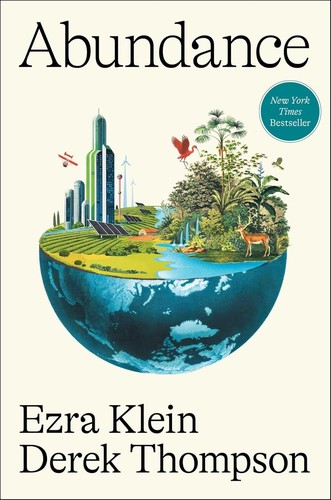
Ezra Klein and Derek Thompson · Buy on Amazon
"Abundance is the book that is probably the most prominent of the six on the shortlist, in the sense that Ezra Klein is a well-known commentator, and the book has already been widely reviewed and talked about. He and Derek Thompson, his co-author, have picked up an element of the danger that is posed to America if it continues to tie itself up in bureaucratic and regulatory mechanisms. It’s essentially a message to what you might call the US opposition, the center-left, that by layering on regulation, legislation, and various bits of friction, you prevent the prosperity and growth and invention that built the American way. They point to the danger that you never remove any of the legislative and regulatory measures that you’ve put in place. They’re quite critical of the government, which in the US in the past has been able to ignite innovation. They argue it’s no longer doing that job properly, and sound the warning that China, in particular, is doing some of these things better. So it goes to the heart of some of the things that the Trump administration has tried to solve with a sledgehammer—through tariffs etc. The book speaks to the fear that Americans have of being left behind, I think, and it’s attempting to address that in a quite polemical way. They don’t pull their punches. Yes, but it’s coming from the left and it’s directed to the left. They aren’t preaching to the converted. They’re saying, ‘There are some things that were well intentioned but have held back American prosperity and growth and risk holding it back in future if we’re not careful.’ There’s a clear idea that there’s a path towards a progressive future that can still encourage prosperity. So I think it’s an interesting and provocative take from people who are actually talking to their own tribe to some extent, and pointing out errors that have been made in the past. When we reviewed it, our reviewer, who had been part of the Biden administration, pointed out that Biden himself did try and do some of these things. She also made it clear that there are darker forces, if you like, that might be working on the American economy in the meantime. So it may look a bit pie in the sky in the end, these prescriptions."
Dan Wang · Buy on Amazon
"Yes, it’s a play on words. Dan Wang’s big conceit here is that China is an engineering economy, and America an economy dominated by lawyers. The book actually echoes some of the Abundance themes, because he, like Klein and Thompson, is arguing that America is stuck and China is building the future. So that’s the broad framing. As I’ve described it, it sounds as though he’s saying China has won this, but it’s more interesting than that. He also points out the risk that China is going to kill off its own ambition with its social engineering. Ensuring that people are monitored and their political views are kept under control risks undermining the Chinese advantage that it might have earned through being an ambitious engineering state. In a sense, Dan Wang’s conclusion is that China needs some of America’s respect for freedom of political expression and America needs quite a lot of China’s engineering ambition. Both countries risk killing off the best of themselves if they overdo one or other of those particular tendencies. That’s fascinating and it speaks to Wang’s warning to China. Things like the dreadful, full lockdown on Covid—that they continued pursuing long after others had lifted it—and the one child policy: these are all things that can potentially hold back China. In some respects, they’re realizing that now. In the meantime—back to the Huawei book—they’ve built a lot of very fine commercial and engineering-based enterprises. So he frames this very nicely, I think, as a battle between two cultures, if you like, as much as anything else."
Stephen Witt · Buy on Amazon
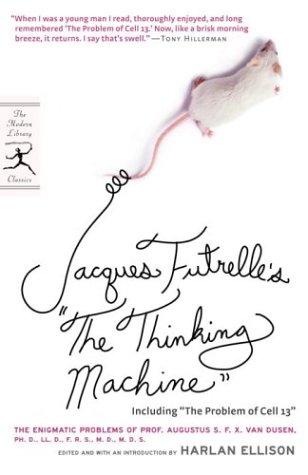
"So this is a super timely book because Nvidia, the company at the center of it, is the world’s most valuable company. Stephen Witt is a former longlisted author for the prize—he wrote a book about music sharing, How Music Got Free, shortlisted in 2015. In The Thinking Machine , he has done a brilliant job of delving into the origins of Nvidia. And just as the House of Huawei book is about the founder, Mr. Ren, this book is very much built around Jensen Huang, the extraordinary, charismatic, hard-driving founder and leader of Nvidia. Huang is in the news almost daily because Nvidia is supplying a lot of the chips that are going into AI. The book paints a picture of a company that, through sheer drive—and also a lot of luck—has managed to put itself in a position to catch this vast wave of AI development. Only a few years ago, the idea of neural networks and generative AI was considered to be a bit hopeless—both in academic and engineering circles. And the origin of Nvidia’s microchips was in gaming, another area that was somewhat neglected. The chips were put together into these vast arrays. By linking together chips that had originally been designed for video games, they could do much more. So Huang’s vision and his drive and his eccentricities—he was a champion table tennis player, for example, at one point—come across very strongly in this book. It’s a really great read. I don’t have any judging influence, but it’s one of my favorites this year. They are absolutely crucial and he’s got a lock hold on the market at the moment. He’s not the only person who’s supplying chips, and everyone is racing to catch up. But Nvidia is in a pretty critical position, and that’s why it has become, latterly, part of US-China tensions. Should Nvidia be allowed to send its most advanced chips to its Chinese customers? And vice versa, are enough rare earths going to be made available by China for supplying these chip factories? These are the things on which future global economic prosperity and peace depend and this book is right at the heart of that. The winner of the 2025 Business Book of the Year Award will be announced on December 3rd ."

The Best Business Books of 2019: the Financial Times & McKinsey Book of the Year Award (2019)

Scraped from fivebooks.com (2019-11-25).

Source: fivebooks.com

Christopher Leonard · Buy on Amazon
"Leonard’s book is the story of Koch Industries, which is the little known and rather secretive private conglomerate owned by the Koch family. It’s had a big influence as a business, but the Koch brothers, who own it, have also had a lot of political influence. Christopher Leonard, the author, is a journalist and one of the most interesting things about the book for me is that he gets you inside a business that is notoriously secretive. He does an incredible job of painting the picture of how Koch Industries was born and how it developed. Also, as the FT’s management editor, I find the book very interesting on the methods that Koch Industries use. They have their own internal management process to keep themselves consistent and keep standards up. The book also shows how Koch Industries exerted its power in the US during successive administrations on how certain things, like climate change, were regulated and governed. It has got that sense of a thriller, as Leonard digs deeper into what Koch Industries is doing. Yes, Leonard illustrates the book with compelling stories about the way in which Koch Industries has operated across a whole range of different sectors. He does a good job. As a side note, we did actually have another book about Koch Industries, Sons of Wichita , on the longlist of the prize a few years ago. That was also about the Koch brothers, one of whom died recently. So this book is, weirdly, the second book about Koch Industries that has featured on the business book award longlist."
Raghuram G Rajan · Buy on Amazon
"Raghuram Rajan is a very distinguished economist and was governor of India’s central bank until recently. His book, Fault Lines , won the prize back in 2010. This book is really an analysis of the populist backlash against globalization. It’s called The Third Pillar because that’s essentially the community that we all live in. The other pillars are markets and the state. It’s an interesting ideological book, really, with a way of explaining how the balance between market, state and community can be restored. He’s making the case that community and civil society need to be put back into this relationship with the market. Local communities are the antidote to the populist unrest that we’re seeing around the world at the moment. If you’re looking at the shift in the attitudes to capitalism, they are triggered at the extreme end, and this is where populism also comes from, by a lack of trust in business in particular. That has continued since the financial crisis of 2008-9. It’s also fuelled by concerns about climate change, by demographic change—with young people being particularly angry about issues that haven’t been resolved—and also by technology. But while it may be difficult to get agreement on the fine detail, there is more consensus than there has been for a while about the broad need to do something . Rajan’s book, The Third Pillar, is a contribution to that debate and he comes at it, interestingly, as an orthodox economist. He’s exactly the kind of person that the Financial Times writes about and he has himself written for the FT in the past, about competition. He’s not a radical revolutionary on economics and that probably gives his prescription more power."
Gregory Zuckerman · Buy on Amazon
"Jim Simons is the hedge fund manager who created one of the biggest and most successful quant funds, Renaissance Technologies. The book is written by a journalist from the Wall Street Journal , Gregory Zuckerman. Again, this book gets my admiration as a journalist, because he succeeds in opening up an industry, a company and a person that are notoriously private. Simons’s own story is pretty extraordinary. He was a gifted mathematician and a codebreaker. His talent appears to have been in finding people from a range of places outside the finance industry—mathematicians, computer scientists and physicists—who would contribute as a team to building these algorithms and codes that would allow them to crack open the global markets and make a vast amount of money. Within fund management, there’s the active stock picking and analyzing of stocks done by human beings. The quantitative revolution was about hedge funds putting computers to work, spotting the patterns, creating the models, analyzing the data automatically and making the fund money. “It’s quite a rich prize. Each of the finalists gets £10,000 just for being on the shortlist ” It’s an area that’s controversial because sometimes all quant funds suddenly end up doing the same thing and you end up triggering automatic crashes. There are problems and volatility. But it’s also been revolutionary in producing results that make money for people at a lower cost, probably, than having a lot of human fund managers doing the same job. Yes, I don’t have a figure in front of me, but we don’t need to know the precise dollars and cents: he’s a billionaire. He’s also established a reputation as a genuinely high intellect investor. He’s not somebody who’s simply taken risks and run with them. He’s somebody who’s actually done the science behind this, which makes him more interesting. Zuckerman has been diligent in tracking him down, to the admiration certainly of colleagues of mine who have read the book. They’re amazed by the amount of access and inside intelligence he’s managed to accumulate. Indeed. I read a book—that isn’t on the list—earlier this year, about people starting their careers late in life. He’s one example of that."
Shoshana Zuboff · Buy on Amazon
"She’d probably describe herself in part as an activist now. The book has made a big splash in the area of criticism of the digital economy. Lots of books have come out this year on this topic, looking at the way in which particularly the biggest US technology companies—Google, Facebook and others—have accumulated our private data. Zuboff calls this surveillance capitalism. She’s really criticizing this land grab for data. Google is the central company that she attacks, but she also takes it to Facebook and Microsoft. She makes the case that even if the companies themselves aren’t evil (and she doesn’t necessarily agree that they aren’t), they are accumulating a large amount of unaccountable power through the data that they gather. It’s not only about the raw data, but also about the way in which they can take various types of data and marry them together. We have smart devices—not just our smart phones, but also the digital devices in our homes, self-driving cars, healthcare tools. Together these provide a way for companies to find out what we’re doing and, this is even more sinister, they can actually manipulate how we behave. The publishing industry has a long lead time and you could think of books as a lagging indicator of what’s happening in the world. A couple of years ago, there were a number of books that looked at the technology revolution. At that point, we were able to make the assumption that there would be problems ahead, but it was largely about the threat of automation in the workplace and indeed in 2016 we gave the prize to a book called The Rise of the Robots: Technology and the Threat of Mass Unemployment . Support Five Books Five Books interviews are expensive to produce. If you're enjoying this interview, please support us by donating a small amount . Those issues are still a theme that books pick up, but I noticed a year or so later that there was a wave of books that included the word ‘human’ in the title. They were humanizing the problem of automation and reiterating what the human beings could bring to this. Now we’ve had books that are really attacking the privacy question. They’re starting to say that Facebook, Amazon and Google are not just these great innovative companies, they’re actually a sinister force. This was triggered by things like the manipulation of elections and the Cambridge Analytica scandal at Facebook. These have prompted an upsurge in calls for greater regulation, particularly of the Silicon Valley, US tech giants. It’s unmissable in both senses, it’s unmissable in that it’s got some very important messages, and it’s also unmissably large. If it’s on your bookshelf, nobody is going to miss that you’ve got it. It’s a heavy book in every respect, but that doesn’t mute the force of the message. Kochland is a very big book as well. It’s not necessarily a disadvantage. We’ve had big books and slimmer books win in the past."
Caroline Criado Perez · Buy on Amazon
"This is by Caroline Criado-Perez who I think definitely would describe herself as an activist. Invisible Women looks at the design of products based on data, and reminds us (or tells us, if we didn’t already realize) that a lot of that data was drawn from testing or analyzing what men do. The classic example is cars being tested for crashes with dummies based on men. By suggesting that the default human is, in fact, a man, women are exposed to injury and even death. She goes through a number of examples, the ways in which design of everything from urban planning to healthcare and drug development has been based on men’s experiences. Gender bias has literally been built into the things that we use with sometimes awful effects. It is a polemical book. It’s a book that is right on message in terms of what I was describing earlier, the scepticism about technology and the way tech companies use data. The list of things she cites suggests we need to put them right, or at least take account of the fact that they may be wrong. The book is full of super quotable examples from across a whole range of sectors. It’s powerful."
David Epstein · Buy on Amazon
"This is a book that’s going to appeal to anybody like me who thinks of themselves as a generalist and a dilettante with lots of wide interests. The underlying message of the book is that generalists in certain circumstances, and particularly when dealing with complex situations and uncertainty—which we’re seeing quite a lot of in the world today—are actually better at handling these questions than specialists. He’s not saying that specialists can be done away with. Domain expertise is still vital in lots of cases. But he’s suggesting that we have been discounting the generalists. We’ve assumed that they’re just superficial, when in fact the research that he cites is pretty comprehensively in favour of the idea that generalists can move across their domains of inquiry in an ambiguous world and succeed in ways that specialists might not be able to. Yes, and of course he makes the point that Tiger Woods was also extraordinarily successful. So it’s not necessarily an either/or. He makes the wider point that if at university you’re studying some very specific subject, like neuroscience or business, you do worse than people who study a more generalist topic like economics. Economists are able to apply what they have learned beyond the domain in which they specialize. Get the weekly Five Books newsletter It’s a way of thinking about the world that he is drawing attention to. It’s a great antidote to years in which specialists have been given lots of credit. For instance, in his book Outliers , Malcolm Gladwell suggests you need to put in 10,000 hours of practice to achieve true expertise. I’m sympathetic to Epstein’s argument partly because, as I said, I’m a generalist myself. I’ve also written about polymaths and generalists—for instance in my own book, Ruskinland , about the Victorian thinker John Ruskin. I think they get dismissed too quickly as being superficial. We push people much too early down silos into very specialized areas. In the UK, for example, high school children specialize in three or possibly four subjects when they’re as young as 16. So it’s a book that appeals to me and it’s very nicely written as well. It’s in that classic genre of books that make quite detailed scientific research accessible. It’s a team effort, but I helped set it up. I was set the task of trying to work out how we could do it in 2005 and with colleagues on the commercial side of the FT and our marketing team and some of our books team we put together the prize. It has remained more or less as we conceived it. One of the central ideas was that we shouldn’t have too many prizes, but just one. It’s quite a rich prize. Each of the finalists gets £10,000 just for being on the shortlist and then there’s £30,000 for the winner. Since we started, we’ve added another prize for the best business book proposal. It’s called the Bracken Bower Prize and it runs in parallel. It’s available only to authors under 35, so the idea is we discover some new talent as well as having the prize for published books."

The Best Business Books of 2020: the Financial Times & McKinsey Business Book of the Year Award (2020)

Scraped from fivebooks.com (2020-11-18).

Source: fivebooks.com

Erin Meyer & Reed Hastings · Buy on Amazon
"No Rules Rules is about Netflix and the culture of Netflix. As you say, in being a book about corporate culture, it’s squarely in the traditional business book genre. What I liked about it was, first of all, that if you’re a serving CEO or executive writing a book about your company, it’s quite a high bar to cross because there’s a very strong tendency towards self-congratulation: you tend to gloss over the errors and big-up the successes. There is a certain amount of that in this book, but by pairing up with Erin Meyer—who is an academic writing about corporate culture and differences between corporate and indeed national cultures— the book is framed as a sort of dialogue. So Hastings will say something and then Erin Meyer will write a part that either takes issue with that or expands on it or fills in some of the intellectual and academic backing for what he has observed. And I think, for the most part, that works pretty well as a way of explaining Netflix and how it has been successful. “Once you’ve got the best team in place…then you can start to trust them with this no rules corporate culture” It clearly is a book about success. Netflix is one of the big companies that has obviously done particularly well under pandemic conditions, with people streaming boxsets and watching seasons and seasons of things via Netflix or other streaming services. But this book is less about the content—though there is a bit of that—and more about how Netflix works. Netflix, of course, was very famously a company that put its radical culture out there for scrutiny in the 2000s, when it published a slide deck—that you can still find online in its original and updated versions—explaining its culture of transparency, how it worked, why you had to behave in particular ways at Netflix. This became a sort of bible for Silicon Valley in particular. But few companies managed to match Netflix and that raises the question—which is partly what this book attempts to answer—of why it’s so difficult to replicate what Netflix does. I suppose I was saying that obviously it hasn’t been replicated. There have been very few companies that have done as well as Netflix has done. There is a certain ‘don’t try this at home’ aspect to the book. As well as having a dialogue, the book also has a progression: it shows you that you can’t do the most radical bits of the radical culture if you haven’t already done the first steps. So, critically, you have to have the right people on board in the first place. Once you’ve got the best team in place—and they talk very clearly about it being a team, not a family—then you can start to trust them with this no rules corporate culture. You can’t simply go straight to the idea that you’re going to let everybody decide their own schedule and holidays and all the radical, transparent things that they do, unless you’ve got the right people on board. I think one of the reasons this book has got through to the shortlist is that it’s not just a glib attempt to say, ‘here are all our secrets, now just put them all in place and it’ll transform your underperforming team.’ It’s saying, ‘you’re going to have to take some tough decisions before you can get to the point where you can get the most out of this radical culture.’ That’s probably true. On the longlist we did have a few more. There was another CEO- written book: Winning Now, Winning Later: How Companies Can Succeed in the Short Term While Investing for the Long Term by David Cote, who used to be the CEO of Honeywell. I quite liked that book, but it didn’t get through to the shortlist."
Angus Deaton & Anne Case · Buy on Amazon
"This book fits in the category of ‘very important economics books’, which the FT prize has identified and brought out right from the start. Angus Deaton won the Nobel Prize in economics and Anne Case is a very respected empirical economist. They’re looking at something that’s at the very core of Trumpism, the plight of white working-class Americans in the early 21st century. They’ve done a lot of digging into the data for rising suicide rates and deaths from drugs overdoses and alcohol abuse —the ‘deaths of despair’ of the title—and how and why those have gone up. It’s essentially a book about some of the human economic pain that lay behind Trump’s success. They lay the blame very strongly on the US healthcare system, particularly the way in which opioid prescription has turned into an epidemic of addiction. They also try to propose some answers that might be turned into policy. With the presidential election this year, this is a book that’s been taken up very strongly as one of the data points, if you like, for explaining what’s going on behind the extraordinary divisiveness and inequality in the United States. It’s US-specific analysis, but one that has wider implications for the way in which we think about economic and cultural divisions around the world. The book very clearly and starkly illustrates the problems in the US. Ed Luce—our Washington-based commentator, who has himself written books about the state of the US— reviewed the book for us. He took issue with the idea that discrimination against whites has become as big a problem as discrimination against Blacks and other minorities, which is what the authors say more than half of white working-class Americans believe. His view is that there is much more to the alienation of the white working class than racial envy (I’m citing Ed because I have not travelled as widely in the US as he has). “They’re looking at something that’s at the very core of Trumpism, the plight of white working-class Americans in the early 21st century” So there is some speculation in the book, an element of controversy. They’re not just using the empirical data. But, arguably, that’s what makes it a more interesting book. It’s not simply a list of the charts that they might have put out to their students and followers among economists. It is an attempt to shape and direct policy and insert that into the presidential campaigns. Yes, though I think there are elements in the policy part of the book that don’t look big enough, given the scale of the problems that they describe. Obviously, they’re working within a US system but, from the outside, a lot of the policy prescriptions that even candidates that are supposedly left-of-centre come up with look rather pallid. Also, I don’t think there’s much in their policy prescriptions that looks at the cultural elements that seem to me, as a non-economist, to be so important when you’re looking at the mudslinging that’s been going on between the two halves of the US political environment."
Daniel Susskind · Buy on Amazon
"Yes, and although it was written pre-pandemic it plays very well into the obsession that we all have now with the future of work and how it’s going to turn out for us. The book picks up on a number of themes that the FT book award has highlighted in previous years. We gave the award to Martin Ford’s book, The Rise of the Robots: Technology and the Threat of Mass Unemployment , five years ago. That was early on in the slightly dystopian discussion about what’s coming from automation. Daniel Susskind picks this up, still with a rather negative forecast—that work is going to be completely disrupted by automation and that we need to do something pretty dramatic in order to prepare for that. His prescriptions are curbs on big tech—which is one of the things that we’re already seeing with regulators and policymakers in Europe and now in the US. Perhaps a bit more idealistically, he talks about bringing back the big state. He looks at ways in which we can actually compensate or offset the likelihood that we’re going to have a world without work. Well, the title is hyperbole, it’s not a world without work. What he’s looking at is ways in which you can bring or sustain meaning for people who have got less work—or different types of work—in a future where everything is more automated. The robots are going to take our jobs and we’re going to have to shift towards a world in which we learn how to deal with the amount of time that is going to free up for us. I’m a big believer in the fact that work is useful not only because it’s productive and brings us income, but also because we find meaning in it. “Although it was written pre-pandemic it plays very well into the obsession that we all have now with the future of work and how it’s going to turn out for us” Clearly that’s one of the problems with universal basic income—which is an idea that’s discussed in this book, as it has been in various other books that we’ve looked at for the prize in the past. You need to find ways to make people still feel good about themselves, even if they’re not on the hamster wheel of work—because that hamster wheel is now occupied by robot hamsters, rather than us."
Jill Lepore · Buy on Amazon
"Well, it’s important as a symbol of where we are now—if it had truly changed our lives we would have heard of if it. What Jill Lepore has done here is unearthed a company that most people had forgotten about. Simulmatics Corporation was actively looking at and developing some of the things that we now associate with big data predictive analysis: Facebook, Cambridge Analytica, all the various scandals and worries to do with harnessing technology to predict human behaviour and indeed to win elections. So it’s a history, but one with great relevance for today. She points out that this long-forgotten technology company really pioneered using data science in politics, notably in JFK ‘s successful presidential campaign in 1960. It essentially laid the foundations for predictive analytics that we now come across—even if we don’t realize it—whenever we use an internet platform or click on an online ad or, indeed, vote for a candidate. I think one of the reasons why it’s a shortlisted book is that it is beautifully written. Jill Lepore is a wonderful writer. The book also has this nice relevance, bringing a historical fact into the new light of today and saying, ‘Look, here are some of the issues that this rather simple, early, pioneering version was raising in the 1960s and that are still relevant.’ Get the weekly Five Books newsletter Into that, she’s woven the story of a company which actually was a bit shambolic and not very successful, because it didn’t survive. It sort of imploded. She identifies some of the slightly wacky 1950s, 1960s elements of the story. There’s quite a lot about how they set up in Saigon during the Vietnam War , running an expat bubble within a chaotic, collapsing, war-torn society. That colour is what gives it a lot of vibrancy and interest as a book, rather than just as a slightly cautionary tale for today. She’s got a good sardonic, wry tone. It takes the edge off, it’s not preaching to us. It’s telling us about a company culture, and in that sense it’s a bit like the Netflix book. But, in this case, it’s a company that has these extraordinary aspirations and the technology and brain power to bring them off. But, in the end, it didn’t succeed and it disappeared. Just the fact that none of us has heard of this company is interesting, given the scale of its ambition and the things that it tried to do that are now being done. There’s a bit in the book where the chief executive, who is an academic focusing on social networks, foresees the data-mad and near-totalitarian 21st century that he was instrumental in helping to create. In the book, there is a certain amount of, ‘if only we’d gone back and been able to change history, maybe we would have been able to forestall some of the dystopia that we’re now living in.’"
Sarah Frier · Buy on Amazon
"Sarah Frier is a journalist and she’s gone deep into what happened after Facebook bought Instagram in 2012. You’ll remember that Instagram was a funky photography app with hardly any staff and Facebook paid a billion dollars for it, which shocked everyone at the time. Of course, it turned out to be a fabulous purchase, because we were just getting into the idea of images as a way of carrying our stories, and Instagram developed into a hub for influencers. Sarah Frier has gone heavily on the side of the story that is told by Instagram’s co-founder, Kevin Systrom. “We may be subject to a wave of rather bad Covid-19 books before we get to the good one” What interested me about this book—and the whole Facebook Instagram story—is the tale it tells of how difficult it is to integrate two different cultures. A bit like If Then and No Rules Rules , it’s another book about corporate cultures. It’s also quite interesting on the different personalities. So Mark Zuckerberg was worried that Instagram was going to cannibalize his own creation, Facebook, and pushed it to integrate more closely. He comes across as quite paranoid and a little bit petty. Frier implicitly suggests that Zuckerberg was jealous of Instagram’s success, even though he’d bought it. He crushed it, eventually driving out Systrom. Now, obviously he didn’t crush it completely, because Instagram is still going and we’re all using it. It’s very successful in lots of ways. It’s a great tale to tell because woven into the Instagram story are all the Kardashians, the Taylor Swifts, the influencers and Hollywood, which is the world Systrom was moving in—as opposed to the Silicon Valley world where Zuckerberg was preeminent. It’s a tale of how these two companies were only able to integrate, in a way, by sapping some of the life out of the Instagram creation. It’s a great story of the feuds of Silicon Valley, I suppose. I think it’s somewhere between the two. I haven’t used it much as a business journalist, but I do have a personal Instagram account. I set it up for the book that I published last year, which was nothing to do with the Financial Times . It was a good place for that because the book was about John Ruskin, the art critic. Promoting Ruskinland was often about images, so an image site was the ideal place to be doing that. Through Instagram, I found a lot of artists who were using it. So it’s got lots of uses. But, clearly, at another end of the scale there is that glossy magazine element, which Frier actually describes very well—the way in which influencers and travel companies and others who wanted to project an image were polishing and honing their style on Instagram in a way that, in the end, was rather hollow. But this was something that Instagram spotted and was able to capitalize on. Zuckerberg obviously spotted that success and, in the classic Silicon Valley way, decided to buy the competition in order to neutralize it and this is what the book is about. She’s value neutral on it. I suppose a question mark raised when we reviewed the book was just how important all this is, whether we’ll look back and think of this as a little blip in cultural history or whether this is an important moment, where Facebook takes out Instagram and perhaps stifles something that might have developed in a different way. I’m inclined to say, ‘Well, it may not be important and Facebook versus Instagram may just be a footnote.’ But if we’re looking at the reason why it’s on the shortlist, it’s to do with the fact that businesspeople, wherever they are, if they’re reading this book, will be able to get at least some idea of the difficulty of bringing together two diverse cultures. The fact that it happens to be Facebook and Instagram is maybe not as relevant."
Rebecca Henderson · Buy on Amazon
"This book was written before the pandemic, but its relevance has become greater since. A lot of the book is about climate change and the absolute need to respond to this emergency. In the US, the book is subtitled “in a world on fire.” The fire that she was referring to was literal there, the wildfires in Australia and California. But, in fact, that subtitle now works as a bit of a metaphor for the consequences of the Covid-19 crisis. A lot of the solutions that she puts out—the cooperation and collaboration between government, business and communities—work for the crisis we’re going through now, as well as the crisis that she was mainly writing about at the time. It’s about the challenge that crises (in the plural) pose to a capitalist world. What I like about the book is that Henderson is very clearly not an enemy of capitalism. She believes that the solutions lie in harnessing the good things about business: the entrepreneurialism, the desire and need to collaborate, the great power of consumer companies as a way of solving big problems. She looks, for example, at the way the German economy was rebuilt after the Second World War , and the forced collaboration between employers, government and trade unions. Those traditions have helped keep German factories running during the pandemic. So there are lots of lessons in here that perhaps Henderson didn’t necessarily intend. I’ve actually spoken to her since the book came out and she very clearly does see these as the sort of things that might help us in a difficult time now. But the thrust of the book is really about the far deeper crisis of the climate emergency and ways in which that can be tackled using the great power of capitalism. Yes, and she’s got plenty of examples of purpose-driven companies that are doing the right thing. One is a company I haven’t come across, a US flour company called King Arthur Flour, which is building community through baking. There are other nice examples in there, including more familiar ones, like Unilever trying to make palm oil sustainable. I wouldn’t say she’s neutral. She’s very positive about purpose-driven capitalism, but she’s also clear-eyed enough to spot where things have gone wrong, where some of the well-meaning efforts by companies decline into cynicism and scepticism and don’t work. There are some good lessons in the book. I think that sort of scepticism can be useful, but when it becomes cynicism you end up with what you were describing, people saying it’s all the fault of capitalism, tear the whole thing down. That would be throwing the baby out with the bathwater, which is what Henderson recognizes, I think. As I said, I’m a fan of Margaret Heffernan’s book Uncharted , which is not about everything going on now, but is prescient. In the book, epidemic preparedness is one of the case studies that she picked. It’s deliberately not neat solutions, but it has neat lessons about the ways in which we can prepare for future crises, including pandemics. As I’ve been reading books that are coming out in the latter part of this year—some of which weren’t entered for the prize or will now be eligible for next year—you’re beginning to see people who’ve either been adapting their ideas or using some of the early consequences of Covid-19 to shape their thoughts about what comes next. I don’t think I’ve seen anything yet that I think is original or wide-ranging enough. What I expect will happen in 2021 is that somebody will write the equivalent of Andrew Ross Sorkin’s book, Too Big to Fail , which was a minute-by-minute account of the financial crisis. He produced it at incredible speed and rooted it as the definitive account of the crisis as it happened. So I’m expecting there’ll be some books of that sort. Of course, they may not be business books. They may be science books or politics books . Support Five Books Five Books interviews are expensive to produce. If you're enjoying this interview, please support us by donating a small amount . As is often the case, we may have to wait a while for the book that tells us how the world of work has been affected or what is going to happen, because we’re still living through this. It’s going to be hard to work out what the future of work looks like, probably, until we’re part of the way into it. A lot of people will overshoot. I think there will be books that suggest we’re going further than we are. In a world which has vaccines or even just therapies and behavioural ways of returning to normal (or nearer to what used to be normal), we may find that the next normal or the new normal—or whatever horrible cliché one wants to apply to it—is actually closer to the old normal than we thought, because people will yearn to get back to some of the things that made business worth doing or work worth pursuing, faster than we think. It may not be as different as the futurologists think. These are books that will already be underway. Maybe it’s not quite fair to talk about waves these days, but we may be subject to a wave of rather bad Covid-19 books before we get to the good one."

The Best Business Books of 2023: the Financial Times Business Book of the Year Award (2023)

Scraped from fivebooks.com (2023-11-30).
Source: fivebooks.com

Ed Conway · Buy on Amazon
"What I like about this book—and he makes this point very clearly—is that this is stuff that you can see. Ed Conway is a journalist for Sky News and of course TV journalists are always looking for things that can be filmed. Our review of the book pointed out that it’s a shame that there aren’t more pictures in it. He’s trying to paint a picture, and you want to see what he’s seeing, which is the extraordinary effort that goes into mining the six vital materials that he focuses on: salt, sand, iron, copper, oil, and lithium . He doesn’t underplay the environmental risks being run in order to get the materials that make up our daily lives, but this is a book that says, ‘Yay! Capitalism does things that actually make the world work.’ He’s clearly in awe, if you like, of the extraordinary human ingenuity that goes into producing these materials and then transmuting them into the things that we use day to day. From that point of view, if there’s a book on this list that doesn’t fit the template of outright scepticism about the world of business, this is probably it. This is the one that says, ‘There are risks here, and these need to be handled, but look at human ingenuity!’"
Amy Edmondson · Buy on Amazon
"Amy Edmondson is a very distinguished Harvard researcher, best known for having explored the concept of ‘psychological safety.’ This is the idea, which she pursues further in this book, that you can only advance and become more successful if you are in an environment where you can safely admit—and indeed call out—errors and mistakes being made. She did a lot of work, which recurs in this book, in the healthcare sector. That’s where she started and where she discovered—slightly to her astonishment—that it wasn’t the teams that were making the fewest errors that were the most successful. It was the teams that were admitting to the most errors, because they were then able to correct and work together to improve. That is the fundamental underpinning of her research and that of others in this area. She bases this on a fundamental point: that if we’re not able to admit to failure and to approach failure in a constructive way, we’re never going to want to take any risks. We’re not going to be able to make the smarter and more adventurous decisions that lead us to advance. I find it a very compelling hypothesis, well backed up by research and interesting tales – everything from the Columbia shuttle disaster to open heart surgery – to show how we reached the level of sophistication that we now have in some of these vital areas. I think it’s an important book from an important researcher. Yes, but I think there are individual lessons here. There are some important workplace lessons. I interviewed Amy last year about psychological safety. I put her in touch with one of the CEOs I’d interviewed who runs a ‘failure Friday’, where you admit to what went wrong and you talk about it with your colleagues. So these sorts of ideas do have a practical, personal effect, but the book is not self-help. It’s at a more elevated level than that."
Bent Flyvbjerg & Dan Gardner · Buy on Amazon
"This book is exceptionally interesting. Bent Flyvbjerg is an Oxford-based Danish academic. He is the main writer and it’s mainly based on his work, with Dan Gardner as co-author. Flyvbjerg’s work is to look at megaprojects and he poses a law of megaprojects: that they generally go over budget and over time and why this is bad. In the current circumstances, in the UK, there’s HS2, which Flyvbjerg has written about and talked about, but there are lots of great examples. He’s very fond of the Sydney Opera House debacle because it was a Danish architect who designed it. He points out that it essentially deprived the world of this architect’s future work because he was in such despair at the portrayal of the Sydney Opera House as a failure that he didn’t design anything much after that. There is a dictum in publishing that you don’t put the word ‘failure’ into your title because people find it depressing. But what’s great about reading about failure is the schadenfreude that readers can bring to it. This book is full of things going wrong that are great to read about. Not only Sydney Opera House-sized disasters, but also some slightly more recognisable ones. There’s a great account of a kitchen refurbishment – admittedly, a high-end one in New York – that went disastrously wrong. They draw a lot of personal lessons from this that make this book a really interesting read."
Walter Isaacson · Buy on Amazon
"The first thing to mention is that this is the second Elon Musk biography that has been on the short or longlist of the award. A few years ago, Ashlee Vance’s Elon Musk biography, Elon Musk: Tesla, SpaceX, and the Quest for a Fantastic Future , was on the longlist. Everybody thought it was great, but obviously Elon Musk was in an earlier phase of his rise to multibillionaire-dom. This book is at a later phase, but it still isn’t done, as the book makes clear. Inevitably, you’ve got to put a full stop somewhere. The Steve Jobs biography came out just after Jobs had died, so, in a sense, there was a roundness to it that any Musk biography that comes out now isn’t going to achieve. Isaacson sat at the feet of Musk – literally, in the same room as Musk – for two or three years, I think. The whole second half of the book is about the last three years, so it’s very detailed. It’s very much reporting. He doesn’t step back except right at the end, and then to make a rather general point about how you need the good and the bad in order to have a genius (which was similar to the Steve Jobs conclusion, if I remember correctly). Isaacson doesn’t say, ‘I’m now going to make a judgment on what’s happened.’ It’s very much an account of being with this extraordinary, tempestuous entrepreneur. From that point of view, it fits into the historical record. Some of the things that have happened in the last few years, including the Twitter takeover, SpaceX, and Tesla — all the events that we’ve read about — are recounted from the Musk point of view in quite a lot of detail. It’s a long book with very short chapters. It’s quite punchy, in that sense of ‘OK now we’re moving on’ which gives you a bit of an impression of what it must be like to live with or work with Elon Musk. But it doesn’t then step back and say how significant it is. And, surprisingly, as somebody else pointed out recently, it’s not much about his businesses, as you might expect. There’s not a whole lot about ‘how has he managed to build this?’ It’s very much about the entrepreneurial leader. I think one of the revelations is that he has more children than we thought. Putting my management hat back on, you get a bit more of an impression of this dynamo who is driving everything. One thing that stuck with me was this idea that he’ll take what had been, until Musk came along, a bureaucratic process, like launching a rocket, a lot of which is to do with safety and protocols, and he will tear it down to its bare essentials. There’s a point where he says, ‘other than safety, I don’t want any codes or protocols or specifications that are going to get in the way of making this more efficient and simpler’, which is an interesting approach. He’s clearly a huge risk taker. That’s obvious already, but you see quite a lot of him saying, ‘We could do this quicker’ or ‘We could do this bigger.’ He takes these decisions – to the astonishment and, at times, panic of his staff – to push it to the limit."
Cover of Cobalt Red: How the Blood of the Congo Powers Our Lives
Siddharth Kara · 2023 · Buy on Amazon
"Yes. I’ve been reading it on an iPad and it does make you put down your iPad and think, ‘What is in this thing that I am reading from?’ It’s about cobalt, a vital raw material and one that probably could have made it into Ed Conway’s Material World as a seventh critical material. It’s vital, particularly for rechargeable batteries, and therefore hugely in demand. Siddharth Kara goes, literally, deep into the holes being dug, mainly in the Democratic Republic of Congo, by artisan miners who are pulling rocks from the ground in the most extraordinary circumstances. Kara interviews the workers and the traders who are buying it and, he alleges, putting it into the formal supply chain. There’s a shocking moment where he just throws in that none of them has ever held a mobile phone. And yet, they’re at the very end of the chain that leads to our iPhones and our electric cars. It is a shocking account, and he sets it in the context of the terrible history of what is now the Democratic Republic of Congo – previously Zaire, and before that the Belgian Congo – as a place that has been exploited, from the word go, for these minerals, which could have made its people wealthy and prosperous and well looked after. It’s a shocking indictment and his underlying polemical point is that there are big companies who are whitewashing this out of the record, who are claiming to have a clean supply chain. His essential contention is there is no such thing as clean cobalt. Yes, and his point is that at the top end – the bottom end, ethically speaking – of the DRC, there are people making out like bandits. There are literal bandits in this book, and there are also politicians who are creaming off an extraordinary amount of money. The other interesting point that comes out in the book is the involvement of China. These artisan miners are almost exclusively selling their product to Chinese traders. And so, clearly, the Chinese and China, as a state, are deeply embedded in this supply chain. He recounts appalling racist comments from one of the traders, talking about the unwillingness of the Congolese to work hard and organise themselves. This Chinese gentleman suggests that only the Chinese can organise them to make money. But all the money is going somewhere else. It’s pretty shocking."
Cover of The Coming Wave: Technology, Power, and the Twenty-first Century's Greatest Dilemma
Michael Bhaskar & Mustafa Suleyman · 2023 · Buy on Amazon
"The Coming Wave is in that category of books I mentioned about technological progress and its consequences. It sets the advances in automation and in synthetic biology (e.g., gene splicing and DNA printing) and in quantum computing —these current waves of technology—in the context of what happened with past waves, including the Industrial Revolution , and the Luddites, who, bizarrely, crop up in three of this year’s longlisted books. (One of the longlisted books that didn’t make the shortlist – Blood in the Machine: The Origins of the Rebellion against Big Tech , by Brian Merchant – is actually about the Luddites). In the context of the history of technological advances, it’s asking, ‘What can we expect?’ It poses the question: ‘Can we contain the bad consequences of fast-moving technological advance and if so how?’ The main author, Mustafa Suleyman, who worked with Michael Bhaskar on the book, is a co-founder of DeepMind, which is now owned by Google. Google and DeepMind are at the heart of some of the technologies mentioned here that are being developed. In the book, he points out that he started out thinking he was going to write a very optimistic book, as a techno optimist himself, and became more pessimistic. It ends with the anguished idea that we’re trying to contain the uncontainable. Suleyman thinks containment is the way to approach this. It can’t be regulated away: there isn’t enough that any individual regulator can do. But he lays out some ways in which he thinks that the potentially lethal consequences of some of these advances might be contained and channelled. He makes a lot out of the positive aspects as well, all the amazing things that you can do by combining AI, quantum computing, and synthetic biology, in terms of preserving and extending life, and making life better. But the overall impression I got from the book is that it’s a warning. We’ve got to work now to think about ways in which we can at least impose some guardrails that prevent this becoming a disaster for humanity. And that, as I say, is slightly echoed in some of the other books that made it to the longlist this year. There are various ways in which he thinks we could get this wrong. In AI, there’s the possibility that you end up with self-generating solutions that turn out not to be beneficial for wider humanity, a race to the bottom between AI-fuelled machines or the risk of weaponisation – it could be literal weaponisation – of these tools to go after somebody else or another state. Part of his warning is that accidents happen when humans are involved in doing this stuff. We do not necessarily get things right all the time, which brings us back to our books on failure. What he’s suggesting is that you need to have some context around this, involving regulators and governments and some of the private sector actors working together to prevent those things happening, or, at least, to have a game plan for if they do. I didn’t come out of this book whistling a happy tune, but it’s a contribution to the way in which that worst-case scenario can be mitigated or even avoided."

Suggest an update?