Ahmed Honeini's Reading List
Ahmed Honeini is an Honorary Research Associate in American Literature at Royal Holloway, University of London. He is the author of William Faulkner and Mortality: A Fine Dead Sound (2021) and Tennessee Williams’s America: Homes, Families, Exiles (2025). He is the founder of the Faulkner Studies in the UK Research Network and currently the co-Associate Editor of the Journal of American Studies. He is currently in the early stages of work on his third monograph, tentatively titled James Baldwin, Drama, and the Politics of Sacrifice .
Open in WellRead Daily app →The Best Tennessee Williams Books (2026)
Scraped from fivebooks.com (2026-05-05).
Source: fivebooks.com

Tennessee Williams · Buy on Amazon
"This is the play that catapulted him to fame. It was the play that brought, what he called in an essay a few years after it premiered, ‘the catastrophe of success.’ The Glass Menagerie wasn’t his debut; he’d written a few politically-charged agitprop plays for a low-key independent theatre group called the Mummers of St Louis—like Candles to the Sun and The Fugitive Kind— plays that dealt directly with the hardship and poverty of the Great Depression. But they weren’t particularly successful and weren’t really designed to be. Before The Glass Menagerie, to try for mainstream Broadway success, he wrote a play called Battle of Angels, which had a disastrous premier in Boston in 1940; there were pyrotechnics in the final scene, and the theatre in which the play was staged nearly caught fire, so the production had to be curtailed. But Williams didn’t give up, remained persistent. Battle of Angels later formed the basis of his play Orpheus Descending . Then he came to The Glass Menagerie , initially during a very brief and essentially unsuccessful period in Hollywood, where he wrote a treatment for a screenplay called The Gentleman Caller . It wasn’t produced, but the screenplay drew enough eyeballs that it got the attention of this actor-producer named Eddie Dowling, who would come to play Tom in the original Broadway production. Dowling’s attention led to the casting of Laurette Taylor as Amanda and Julie Haydon as Laura. The rest is Broadway history. The reason I’ve chosen to highlight it is because it sets up so many o fthe perennial themes that we’ve come to identify with Williams’ work. Namely, right at the top of the list is the importance of, and tensions within, families. The Glass Menagerie is a quintessential family play, and Williams comes back, repeatedly, to the centrality of the family in American life. He stages—with this triptych of Amanda, Laura and Tom—the loneliness and the alienation and the yearning that emerges from three disconnected, withdrawn, uncertain, fragile, but also beautiful characters. There’s also this blurring of fact and fiction, realism and magic, and that establishes Williams’ talent for—as Tom says in the beginning of the play—truth “in the pleasant disguise of illusion.” He wants to tell hard truths about life, but also to put them through some kind of rose-coloured filter. Not to be overly brutal, but also not to shy away from the fact it was an especially difficult time in the 1930s and early 1940s. The play shows his penchant for creating undeniably human yet profoundly flawed characters, and though we are separated now from The Glass Menagerie by a good 80 years, everybody feels that pain felt by Amanda, or the loneliness of Tom, or the alienation of Laura, because these are the bedrock of what it means to be human. I think that for anybody who wants to understand these themes—both in terms of their own humanity, and also as a way of understanding Williams’ dramaturgy— The Glass Menagerie is a perfect place to start. The memory play is, essentially, a character—in this case, Tom Wingfield—looking back on a very important moment in his life and theatricalising it. He draws the audience’s attention to this, making very clear that this is artificial, remembered, and may not be accurate or even reliable. Williams is drawing attention both to the fallibility of Tom’s memory, and also inviting us to draw our own conclusions about Tom’s relationship with his family. Vieux Carré, the next play I’ve picked, is also a memory play. I’ve always read it as a sort of sequel to The Glass Menagerie . The memory play form functions primarily as a way in which Williams’ characters can process traumatic memories. For example: Tom’s relationship with his mother is extremely strained and awkward; she calls him her “right hand bower” and says she will only allow him freedom to go “whichever way the wind blows you” after Laura gets married. That’s a tremendous amount of pressure to place on one person’s shoulders, not least because Mr Wingfield, the family patriarch, is gone. Tom, for all intents and purposes, is the man of the house. He has to do the job that his father has abandoned, and Tom doesn’t want to fill that role, frankly. The memory play functions as a way to unleash these traumas and tensions, and through that being able to reconcile the guilt of walking away from the family and the responsibilities. Whether fully relinquishing that guilt is possible for Tom, though, Williams doesn’t make clear."

Tennessee Williams · Buy on Amazon
"If The Glass Menagerie depicts Williams’ life with his family in St Louis, Vieux Carré depicts Williams’ life once he had left home and gone to New Orleans. It roughly maps onto Williams’ actual biography. The fundamental difference is that Williams did not just leave St Louis and never return; he returned several times, even after his so-called moment of liberation. In Vieux Carré, there’s a sense of romanticism and finality—the character based on Williams can never return. When Williams came to New Orleans, he stayed at a boarding house— 722 Toulouse Street —and had several run-ins with his landlady, many of which he stages in the play. This landlady was very cantankerous, very intrusive. In the play, she coerces free labour from him because she knows he doesn’t have money, so she makes him drum up an advertising campaign for her: Meals for a quarter, in the Quarter. So people are coming to the boarding house, picking up cheap meals, and going on their way. Now, the main crux of Vieux Carré is the writer’s relationship with his first lover, Nightingale. Where The Glass Menagerie has no queer sexuality to speak of, Vieux Carré is notable because there is a love scene at the heart of it. Williams, or the character based on Williams, is initiated into queer life and allowed a fleeting glimpse into queer love through this relationship with a fellow tenant. This relationship is short lived. The writer is still trying to negotiate the sense of shame and guilt associated with homosexuality in American culture in the early 1930s. There is a lot to work through in these negative emotions. But there is also the sense, at the end of the play when he leaves the boarding house, that he will be able to come to grips with his sexuality—if not now, in New Orleans, then at a point in the future. What leads to the writer, who is not named, having to leave the boarding house is the landlady, Mrs Wire, pouring boiling water through holes into the studio of a queer photographer named Biggs, because she thinks he is throwing orgies. She is completely homophobic and decides she is not going to have it, and unleashes a wave of violence onto her tenants. She’s taken to court by Biggs, found guilty of criminal negligence, is fined, and at that point the writer decides he cannot ever come to terms with his homosexuality while living in this boarding house and decides to leave. Vieux Carré was written seven years into the height of the gay liberation movement. Williams had an awkward relationship with the movement; on one hand, he made public statements to the effect of, ‘I’m not a political writer,’ or ‘I’m not going to limit my audience by just writing about queer people.’ But the fact is, the gay liberation movement gave Williams the wherewithal to come out publicly, during an appearance on the David Frost show, where Frost broached the question of Williams’ sexuality very directly. Williams said, and I’ll quote him directly: “I don’t want to cause a scandal, but I’ve covered the waterfront.” So he was outspoken about his sexuality and well-versed in queer sexual subcultures. It seems to me—and I make this case in the book I wrote about Williams—that for Williams to say that he didn’t owe at least some debt to the gay liberation movement, both personally and in terms of his career, it is a bit disingenuous. I think it’s no accident that he makes these explicit pronouncements on television during the 1970s, or that he just so happens to be staging a love scene in the middle of a late autobiographical play, after being so reticent initially. Vieux Carré is both a continuation of The Glass Menagerie but also, in several ways, much more radical than The Glass Menagerie could have ever been, because the sociopolitical climate had changed, allowed him more freedom."

Tennessee Williams · Buy on Amazon
"Yes. It’s my favourite because it is a play front-loaded with tragedy; it doesn’t at first seem to be a life-affirming play. But it is. It’s a beautiful, tender and incredibly loving play. Williams dedicated the play to his lover Frank Merlo, “in return for Sicily.” To sum up the play very briefly, our main character Serafina Delle Rose begins happily married to her husband, Rosario, has a child, Rosa, and is pregnant with her second child. Rosario is outwardly a banana truck driver, and also a drug runner. There is a car accident, Rosario dies, Serafina suffers a miscarriage as a result and she spends the next period—maybe four years—in mourning. She’s a dressmaker, so people rely on her. At the beginning of the second act, several women in her community are up in arms because she has promised them gowns for their daughters’ high school graduations and she has kept delaying them because she doesn’t want to leave the house. She’s been in seclusion, essentially. Eventually, Serafina comes to find out that her beloved Rosario had been having an affair. Right at that point, when she makes this discovery, she meets a man, Alvaro, another truck driver, who has the “face of a clown and the body of her husband.” There’s a sense that Rosario is haunting her. But he’s also come back to her in a new, improved and more tender-hearted way. Alvaro is much less stereotypically masculine. He cries. He’s put upon by family members. He doesn’t have his own independence. He wants to settle down and have a family of his own, but the circumstances aren’t ideal. Serafina and Alvaro are drawn together. They make love, and after the night of passion Serafina gets pregnant and decides to give love another chance. The reason why it’s my favourite play is because it is Williams completely undoing what he had been known for up until this point, which—by his own admission—was violent, tragic plays. He gives you that sense that Serafina’s fate was going to be very similar to Blanche DuBois, or even Laura’s. Laura doesn’t die, but she does lose her gentleman caller, and her future isn’t particularly bright. Serafina’s fate initially seems to be that she will fall victim to those same forces. Her sense of her dead husband has been shattered, she’s exiled in her own community, she’s an Italian immigrant so her relationship with the rest of America is strained and contingent. It seems she will be another of Williams’ tragic heroines. And yet, over the course of the play, you see a woman who has lost everything, very close to a Blanche DuBois figure, throw caution to the wind and embrace life. I think that’s the most beautiful thing about The Rose Tattoo . It’s a richly affirming play. Even Williams thinks that life cannot just be a series of tragedies. There has to be some kind of sweetness or succour at the end. It stands out, because Williams plays it as a kind of comedy. He plays a trick on his audience, making you think it will be a tragedy, then pulls the rug out from under you. It’s a beautiful surprise of a play. That’s why I think some critics don’t think it works. This 180º turn doesn’t convince everybody. But I love it because Williams subverts the results he has established in the middle of his own career. On top of that, it won Anna Magnani, a brilliant Italian actress known for realist cinema, an Academy Award. Again, Williams creates these masterpieces that draw equally immense talent."

Tennessee Williams · Buy on Amazon
"The Memoirs are unique in the sense that they need to be considered in context. From the 1960s onward, Williams entered what he called his ‘Stone Age.’ He was having one monumental failure after another in the theatre. His cultural stock was at an all time low. He needed a hit. So he thought, well, I’ve tried the theatre, I suppose the next logical step is to mine my own life and career for the goods, for material. So he spent a significant amount of time writing this book, out of chronological order. The Memoirs are structured so they flit back and forth, kind of like a Williams play, and the periods that he does decide to focus on are so salacious, so gossipy—he just lets it all hang out. He tells us about this lover and that lover, what he thought about this or that figure. You get the sense of a man unleashed. The American filmmaker John Waters described it as being like sitting down for drinks with an already-inebriated Williams, telling you stories. It’s incredibly brave for anybody to go so far and to be that candid about themselves. Yes, Williams was incredibly forthright in his plays, very articulate and outspoken about sexual relationships. But there is a distinct difference, I think, in what he could get away with on Broadway, which was dominated by its own very conservative rules and regulations, and what he could get away with on the printed page. This is an unparalleled frankness in a public figure. In the 21st-century, we have reality television. But if you look at the Kardashians, for example, it’s curated. Any outrage is managed outrage. Whereas with Williams, it really was a man with a talent for writing who had reached a point in his life where he had nothing left to lose. He decided to bare it all on the page. That’s what attracts me to that book. It’s just so naughty. It’s a great, page-turning read. If you know Williams for the austerity of A Streetcar Named Desire or The Glass Menagerie , then you also need to get to grips with his outrageousness and his very blunt and frank nature. That is also an undeniable facet of his talent as a playwright and also his personality as a man."
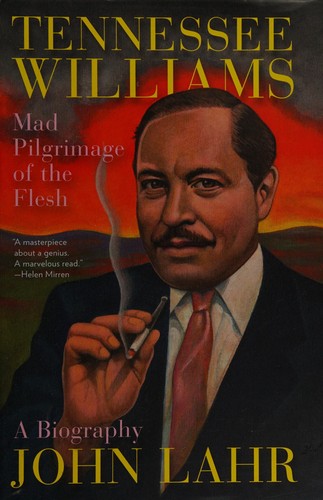
John Lahr · Buy on Amazon
"Yes, yes, yes. Lahr makes the case, and I don’t think it’s a far-fetched claim, that sexuality and human relationships were at the heart of his theatrical output. Lahr goes through Williams’s relationships with his family: his parents, his sister Rose—who we haven’t talked much about, but who was a central figure in his life and whom Blanche and Laura were directly based on. Lahr is a consummate biographer. Before this book, he had already tackled Joe Orton’s life in Prick Up Your Ears . So this book is the product of a man who is deeply ingrained in transatlantic theatrical culture. He doesn’t deliver a milquetoast, paint-by-numbers portrait, he gives a very deep, rich, well-resourced and authoritative outlook on Williams’ biography. From a purely technical level, it’s a brilliant book. You can see the mechanics of how a good biographer works, how he ties all these threads together into a grand and tightly controlled tapestry. It’s just exhaustive in the best possible sense, everything that you would want to know about Williams, his relationships, his standing in American drama and culture. The beauty of Lahr’s biography is that it doesn’t give you the sense of Williams as this perennial, untouchable, canonical playwright. It shows you Williams the man, a man who was struggling with what he termed the ‘catastrophe of success.’ He was well-travelled, a global icon, and then in the 1970s and 1980s, it just fizzled out into nothing. He died in a very indecorous, even tragic manner which mirrors his tragic characters. It’s an incredibly poignant and informative documentary. For anybody who wants to go beyond the Williams of the stage, and towards Williams as a human, you will find that in Lahr’s biography."
The Best William Faulkner Books (2021)
Scraped from fivebooks.com (2021-08-05).
Source: fivebooks.com
William Faulkner · 1930 · Buy on Amazon
"I chose As I Lay Dying because the story it tells is so entertaining and intriguing. To put it briefly, the novel depicts the struggles of the Bundrens, a poor farming family who have to go on a trip from the rural South to the cosmopolitan town of Jefferson in order to bury their mother, Addie. The novel is told through a chorus of fifteen narrative voices, including each of the Bundrens, their friends, neighbors, and the people they encounter on their trip. Faulkner does a splendid job in crafting these distinct narrative voices and perspectives. You have that tension between the older brothers Darl and Jewel Bundren, both of whom love their mother Addie, but communicate that love in profoundly contrasting ways, while also having the voices of a wider southern society being the voice of the reader and making clear just how outrageous the burial journey is. It’s a book that grabs you by the throat and refuses to let you go. By the time you get to the final sentence of the novel, one of the cruelest, most devastating punchlines in all literature, you get the sense that Faulkner achieved what he set out to accomplish with this book—a tour de force . Almost all readers of Faulkner agree that he is a notoriously difficult writer, but I’ve always felt that he is a purposefully difficult writer, too. Difficulty is part of his authorial aesthetic—he wants you to work at understanding his novels, just like James Joyce wanted you to work at understanding Ulysses or just like T. S. Eliot wanted you to follow up on all the literary allusions and references he makes in The Waste Land . As I Lay Dying mitigates that difficulty because of the novel’s clear narrative through-line: the Bundrens need to get their mother’s coffin from their farm to her burial plot in Jefferson, Mississippi, and this is how they go about doing it. As I Lay Dying affords the reader, especially a first-time reader of Faulkner, more breathing space than a lot of Faulkner’s works do, and that is why I feel it is a perfect place to start with him. Also, because of the fifteen narrative voices, if you’re struggling to understand characters such as Darl, Vardaman, or even Addie, you can pick up key narrative information and subtext from, for instance, Cash, Cora, or Anse. The first Faulkner novel I read was The Sound and the Fury , which in many ways is the best and worst introduction to his work that I could have had! The novel tells the story of the fall of the Compsons, a family of old aristocratic Southern stock, who struggle to face the demands of modernity (which, as I mentioned earlier, is a core component of Faulkner’s fiction). The novel is told across four sections from the unique perspectives of three brothers (Benjy, Quentin, and Jason Compson) and a fourth omniscient narrative voice. The Benjy and Quentin sections embody so many of the qualities that make Faulkner such a difficult writer. But, when I began the novel, I had absolutely no idea what was going on. I kept seeing this name, Caddy, on virtually every page but couldn’t understand who this person was. Why were they so important? Why should I be working so hard to understand what happened to them? Then, when I got to Jason’s section, whose voice is like a crude and cruel jackhammer that makes everything I read in the previous two sections completely clear, that was a revelation to me – the novel is about their sister Caddy, even though we never hear her voice. So, in the space of my first reading, I went from profound confusion to (relative!) clarity. Get the weekly Five Books newsletter As for advice to first-time readers of Faulkner, and particularly The Sound and the Fury : Faulkner was aware of how difficult his works could be, saying to Jean Stein in his Paris Review interview with her that one should read each of his novels four times to understand them. Faulkner was, obviously, being playful and humorous here, but there is an element of truth in his advice – works like The Sound and the Fury demand a second reading, especially so you can see how Faulkner pulls off the story of the fall of the Compsons. Imagine Faulkner as a magician: the first time you see him perform, you have no idea how he managed to pull one over on you. When you revisit his work, and you can see how he lures you in, your admiration for him does not diminish. In fact, for many of his readers, the second and subsequent readings of his works are much more rewarding, because you’re not preoccupied with uncovering or deciphering the meaning behind his work – you know what he is up to, so you can savor the profundity of his content and the gorgeousness of his prose, instead of being preoccupied with the technique."

William Faulkner · Buy on Amazon
"Yes, and, I must admit, I hated Sanctuary for a long time and only recently changed my mind. Sanctuary tells an extremely disturbing story: a young woman, Temple Drake, is held captive by a gang of bootleggers in an abandoned house known as ‘the Old Frenchman place’. The novel outlines Temple’s often futile attempts to escape the gang and find the elusive sanctuary Faulkner conjures up in the title. The reason why I’ve long been so ambivalent towards Sanctuary is because Faulkner was deliberately cruel in his depiction of Temple and, in my opinion, was too insistent upon shocking his reader; the novel has an infamous moment (which I won’t describe here) that led to Faulkner being nicknamed “the corncob man.” “Imagine Faulkner as a magician” I thought Sanctuary lacked the delicacy of more mature works like The Sound and the Fury or Absalom, Absalom! and I was baffled as to why he decided to write such a monstrous work. Recently, though, I’ve taken a different view. First, my opinion of Temple has completely changed. I was blinded by the cruelty she was subjected to in my first reading, but I overlooked the fact that she tries repeatedly to overcome and resist the abuse she suffers at the gang’s hands. Then, I was struck by how Temple seems to predict characters like Dolores Haze in Nabokov’s Lolita , a character who, like Temple, has been much maligned and misunderstood by her critics as being a willing participant in the abuse she suffers. In Sanctuary , Faulkner paved the way for authors like Nabokov to show us that, actually, characters like Temple and Dolores are resistant, they are not femme fatales that lead innocent men to their doom; they are actually icons in the fight against misogyny and patriarchal oppression. Lastly, I was astounded by the ways in which Sanctuary predates and predicts so many of the core tropes that were developed in the horror film genre: the spooky old house, the mysterious, predatory murderer, the resilient final girl. Yes, Sanctuary might outwardly appear pulp-ish and a potboiler, but there is so much more going on in the novel apart from that. Faulkner resented having to work in Hollywood, but with a family to support, he didn’t have much choice in the matter. The fact is that he made much more money as a screenwriter than as a novelist; nearly all of his books, prior to the publication of The Portable Faulkner , did not sell well and so he had to compromise by working as a screenwriter. Most of his contributions went uncredited, such as Mildred Pierce , but recent work by scholars such as Peter Lurie, Stefan Solomon, Sarah Gleeson-White, and Ben Robbins has been instrumental in uncovering the influence of Hollywood on his life and work. Plus, The Big Sleep is one of my favorite films, so when Faulkner was credited for his screenwriting work, he left a big impression!"

Malcolm Cowley (editor) & William Faulkner · Buy on Amazon
"The Portable Faulkner is composed mainly of extracts from Absalom, Absalom! , The Unvanquished, The Hamlet, The Sound and the Fury , The Wild Palms , Sanctuary , and Light in August – so, most of Faulkner’s major works prior to 1946 (the year the Portable was published) are represented here. There are also a handful of short stories, including “The Bear,” “A Rose for Emily,” and “Wash,” and, most significantly, the “Appendix Compson: 1699-1945” along with Malcolm Cowley’s extended introduction to Faulkner’s legend, in his terms. Cowley’s introduction essentially outlined what so many literary critics at the time had missed—that Faulkner was a major talent, a writer of genius whose Yoknapatawpha fiction was as major an intervention in modern literature as Joyce’s Dublin or Hardy’s Wessex. The “Appendix Compson” was, in theory, intended to explain The Sound and the Fury and settle the aforementioned concerns with the novel’s difficulty and impenetrability once and for all. While critics have debated whether Faulkner achieved what he set out to do with the “Appendix,” the fact remains that its inclusion in The Portable Faulkner afforded readers a first glimpse into Faulkner’s methods as an author."

Joseph Blotner · Buy on Amazon
"Frankly, Blotner’s biography is the original and, in my view, the best. There have been astounding contributions to biographical studies of Faulkner, including those by Frederick R. Karl, Robert W. Hamblin, and Carl Rollyson, to name only a few. However, Blotner’s account set a benchmark, a gold standard, for all the biographers who followed in his wake. The case can be made that, because of Blotner and Faulkner’s relationship, Blotner was not the best or most objective choice of a biographer for Faulkner. After all, on his deathbed, Faulkner describes Blotner as his “spiritual son.” Yet, despite their closeness, Blotner tells many uncomfortable truths about Faulkner in his biography. For me, the moment that most stands out is his account of Faulkner’s reaction to the suicide of Ernest Hemingway in 1961. Blotner reveals that Faulkner explicitly condemned Hemingway’s suicide, declaring that “‘It’s bad when a man does something like that. It’s like saying death is better than living with my wife.’…The next time Red Hanbury saw Faulkner the reaction had crystallized further. ‘I don’t like a man that takes the short way home,’ he said.” Faulkner’s reaction has always astounded and troubled me, but, if not for Blotner, his unflattering response may have been lost to history. So, Blotner’s work is an indispensable tool when trying to come to grips with Faulkner’s complexities and flaws—both as a man and as an author."

André Bleikasten · Buy on Amazon
"For me, the richness of Bleikasten’s prose and the depth and insight of his analysis is what sets him apart from Sartre, Brooks, and Millgate. To quote Arnold Bennett on Faulkner, Bleikasten “writes like an angel.” The lucidity of his critical methodology makes The Ink of Melancholy not only a masterpiece of Faulkner scholarship, but a self-contained artwork in its own right. “Faulkner resented having to work in Hollywood” I want to offer you Bleikasten’s exquisitely phrased, poignant summation of Darl’s laughter in As I Lay Dying : “Darl cannot know what he is laughing about because he is laughing at nothing in particular. And hence at everything. At the nothingness of it all. His is pure laughter, boundless, devastating, tragic laughter.” It’s gorgeous. I certainly hope so, and thank you for mentioning my work! The alternative perspective my book offers is in its argument that, although Faulkner aimed for—and, in my opinion, achieved—immortality through his writing, “saying No to death”, there are numerous characters in his novels and short stories—Quentin Compson, Addie Bundren, and Emily Grierson to name only a few—who are fixated on saying Yes to death. William Faulkner and Mortality is the first book to look at the importance of death in Faulkner’s work from this perspective, and I must say I had a marvelous time writing the book. Two of Faulkner’s most significant literary influences were William Shakespeare and John Keats. They, like Faulkner, promulgated a desire to achieve immortality through their work; Shakespeare’s sonnets and Keats’s odes make clear humanity’s need to “make war upon this bloody tyrant, Time” (Sonnet 16, l. 2). Yet, so many of Faulkner’s characters attempt to respond to and negotiate the traumas within their lives and the ambivalences which death creates, before ultimately saying Yes to death—the aesthetic of mortality I refer to in my introduction. “Saying Yes to death” enables these characters to tell their stories, and they are also relieved from the pain and suffering they experience living in these dehumanising social positions. The book’s overarching argument is a challenge to scholars like Robert W. Hamblin, who in the past has argued that “Faulkner’s heroes are more often than not those individuals who, like the artist, say No to death, who choose life even when that choice entails a considerable amount of anxiety, guilt, or pain.” Yes, we certainly do, and I believe that Faulkner wrote his novels, in part, as a way of trying to negotiate those struggles. So, to return to the idea of the Old South’s strained transition to modernity, part of the reason why a family like the Compsons in The Sound and the Fury find themselves in decline is because they remain insistent upon hanging on to the memory of the pre-Civil War, slaveholding South. They seem to exist in a kind of waking dream, a nebulous zone of nostalgia that denies societal changes, racial progress, and emancipation. There’s this brilliantly loaded moment when Dilsey, the Compsons’ long-suffering African American servant, rings a dinner bell that seems to invoke the ghosts of the dead, Southern past. So Faulkner, in a sense, is trying to wrestle with those ghosts of his region’s past as he writes his novels. I believe we should turn to it. CRT is unfairly maligned and misapprehended in mainstream thought but, fundamentally, all CRT does is champion and amplify the voices of the marginalized who have often been literally or metaphorically silenced (such as through structural inequalities, violence, under- or misrepresentation in the media, etc). As I’ve outlined above, Faulkner’s novels often deal with the South having to come to terms with societal changes regarding race. CRT allows us to see Faulkner’s works as being reparative and oftentimes philosophical ruminations on race throughout the twentieth century. Support Five Books Five Books interviews are expensive to produce. If you're enjoying this interview, please support us by donating a small amount . Ultimately, CRT allows Faulkner critics to generate anti-racist, anti-oppressive scholarship that emphasizes the inclusion of scholars reflecting the full diversity of Faulkner studies, especially in terms of race and ethnicity. The intersection between CRT and Faulkner is fundamentally important and the best step forward for our subfield and the future of our discipline."