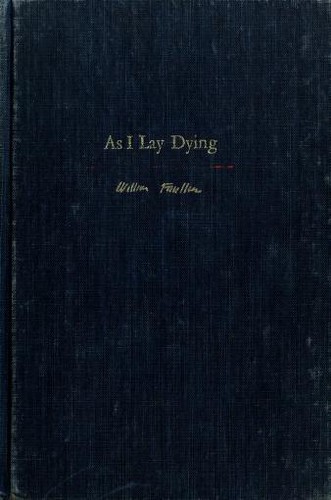
As I Lay Dying
by William Faulkner · 1930
Buy on AmazonWritten in stream-of-consciousness style with multiple narrators, the story follows a journey wherein the family of a dead woman try to transport her body to her birthplace in Mississippi in accordance with her wishes. When a ford across a river is flooded they are forced to take a roundabout route and it becomes a desperate race to complete their mission before the body begins to decompose.
Recommended by
"I chose As I Lay Dying because the story it tells is so entertaining and intriguing. To put it briefly, the novel depicts the struggles of the Bundrens, a poor farming family who have to go on a trip from the rural South to the cosmopolitan town of Jefferson in order to bury their mother, Addie. The novel is told through a chorus of fifteen narrative voices, including each of the Bundrens, their friends, neighbors, and the people they encounter on their trip. Faulkner does a splendid job in crafting these distinct narrative voices and perspectives. You have that tension between the older brothers Darl and Jewel Bundren, both of whom love their mother Addie, but communicate that love in profoundly contrasting ways, while also having the voices of a wider southern society being the voice of the reader and making clear just how outrageous the burial journey is. It’s a book that grabs you by the throat and refuses to let you go. By the time you get to the final sentence of the novel, one of the cruelest, most devastating punchlines in all literature, you get the sense that Faulkner achieved what he set out to accomplish with this book—a tour de force . Almost all readers of Faulkner agree that he is a notoriously difficult writer, but I’ve always felt that he is a purposefully difficult writer, too. Difficulty is part of his authorial aesthetic—he wants you to work at understanding his novels, just like James Joyce wanted you to work at understanding Ulysses or just like T. S. Eliot wanted you to follow up on all the literary allusions and references he makes in The Waste Land . As I Lay Dying mitigates that difficulty because of the novel’s clear narrative through-line: the Bundrens need to get their mother’s coffin from their farm to her burial plot in Jefferson, Mississippi, and this is how they go about doing it. As I Lay Dying affords the reader, especially a first-time reader of Faulkner, more breathing space than a lot of Faulkner’s works do, and that is why I feel it is a perfect place to start with him. Also, because of the fifteen narrative voices, if you’re struggling to understand characters such as Darl, Vardaman, or even Addie, you can pick up key narrative information and subtext from, for instance, Cash, Cora, or Anse. The first Faulkner novel I read was The Sound and the Fury , which in many ways is the best and worst introduction to his work that I could have had! The novel tells the story of the fall of the Compsons, a family of old aristocratic Southern stock, who struggle to face the demands of modernity (which, as I mentioned earlier, is a core component of Faulkner’s fiction). The novel is told across four sections from the unique perspectives of three brothers (Benjy, Quentin, and Jason Compson) and a fourth omniscient narrative voice. The Benjy and Quentin sections embody so many of the qualities that make Faulkner such a difficult writer. But, when I began the novel, I had absolutely no idea what was going on. I kept seeing this name, Caddy, on virtually every page but couldn’t understand who this person was. Why were they so important? Why should I be working so hard to understand what happened to them? Then, when I got to Jason’s section, whose voice is like a crude and cruel jackhammer that makes everything I read in the previous two sections completely clear, that was a revelation to me – the novel is about their sister Caddy, even though we never hear her voice. So, in the space of my first reading, I went from profound confusion to (relative!) clarity. Get the weekly Five Books newsletter As for advice to first-time readers of Faulkner, and particularly The Sound and the Fury : Faulkner was aware of how difficult his works could be, saying to Jean Stein in his Paris Review interview with her that one should read each of his novels four times to understand them. Faulkner was, obviously, being playful and humorous here, but there is an element of truth in his advice – works like The Sound and the Fury demand a second reading, especially so you can see how Faulkner pulls off the story of the fall of the Compsons. Imagine Faulkner as a magician: the first time you see him perform, you have no idea how he managed to pull one over on you. When you revisit his work, and you can see how he lures you in, your admiration for him does not diminish. In fact, for many of his readers, the second and subsequent readings of his works are much more rewarding, because you’re not preoccupied with uncovering or deciphering the meaning behind his work – you know what he is up to, so you can savor the profundity of his content and the gorgeousness of his prose, instead of being preoccupied with the technique."
The Best William Faulkner Books · fivebooks.com
"I read William Faulkner's three major novels of 1930 to 1935 to experience the image of a buzzard 'spraddle-legged, with its wings kind of hunkered out, watching me … like an old baldheaded man.'"
By the Book: Delia Owens · nytimes.com
"I remember reading a long, meandering Faulkner sentence in "As I Lay Dying" on a flight to South Africa. I paced up and down an airplane."
By the Book: Eddie Glaude Jr · nytimes.com
"I went back to old favorites — William Faulkner's "As I Lay Dying" and Toni Morrison's "Paradise.""
By the Book: Laila Lalami · nytimes.com
"The most formative books I had read by age 21 were probably Faulkner's As I Lay Dying and The Habit of Being."
By the Book: Rick Riordan · nytimes.com
"Faulkner's "As I Lay Dying." Never the same river twice, even if that river sweeps your mom's dead body and your brother's tools downstream each time you cross it."
By the Book: Samantha Hunt · nytimes.com
Favorite books · radicalreads.com