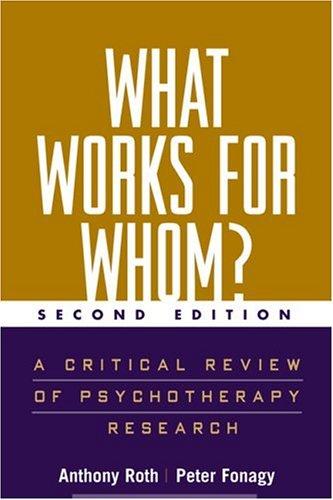
What Works for Whom: A Critical Review of Psychotherapy Research
by Anthony Roth & Peter Fonagy
Buy on AmazonAs you will have gathered, there are lots of competing ideas or competing theories in the field of clinical psychology. And what you tend to find is that if you’re in a particular school, you tend to think your ideas are the best, and that nobody else’s ideas are right. What Fonagy and Roth are doing is reviewing the effectiveness of all different therapies as fairly as they can. This was an area I worked in too, though not as effectively as they did! The question they’re trying to answer is: what is it that’s most helpful to people? Many therapists don’t use evidence; they use their own biases—which often are what you were taught first. The good news is that there’s a lot of good evidence for psychotherapy in the broadest sense, which is better than some other approaches which have been tried to reduce psychological distress including some medical approaches. But the bad news is that there’s still a lot we don’t know about what is most likely to be most helpful for any particular person with their own specific difficulty in their unique personal and social circumstances. So, we need more research. “Many therapists don’t use evidence; they use their own biases—which often are what you were taught first” This it isn’t a book to sit down and read from cover to cover. It’s more like a reference text. What it really says is: if you’re going to get help, you need to know what it is that’s most helpful for your condition, under what conditions, with what kind of therapist, with what kind of therapy, for how long, with whom. It’s a complicated thing. Compare it to medicine. You know: if you have diabetes, arthritis and a cold, you wouldn’t expect to have the same medicine prescribed for all those conditions. You’d expect there to be very fine difference in the drugs prescribed for each, depending on your age and your condition. But within psychological therapies, there was a tendency for schools to give the same treatment for everything. Which doesn’t make any sense. What Works for Whom is really saying, ‘let’s work out, given your condition, what the evidence say will be most effective for you.’ And that’s complicated. There are so many different factors involved, so it’s not surprising we don’t always get it right. But a book like this helps therapists when faced with a patient with a particular condition. So, rather than give you what I know how to do, let’s work out what the evidence shows you would be best with. It’s tricky, though, because we don’t have enough therapists—so you sometimes just end up often getting what is there. Absolutely. And that’s always difficult when you’re trying to earn a living; you’ve got set time aside to go and learn a new method. I think the interesting thing is when you look right back—and again, why I was interested in Tony Ryle’s ideas—as dispassionately you can, actually most therapies, if conducted professionally and respectfully and ethically, are reasonably effective for quite a good number of the people they treat. Even though they may have very differing—and in some ways conflicting—ideas; behaviour therapy is very different from cognitive therapy, which is different from psychoanalysis—done properly, they can all be helpful. It seems that what is necessary is the therapist having some coherent understanding—which is a little bit different from that of the patient—which allows a fruitful debate between the two of them, and allows a possibility of change to occur. So, as a therapist, you’ve got a theory, some practice which challenges and maybe helps to unstick the patient. It almost doesn’t matter which theory you’ve got. But you’ve got to believe in it. Which is a bit of a paradox.