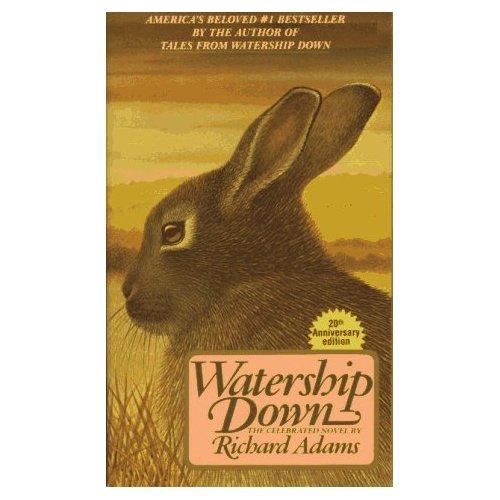
Watership Down
by Richard Adams · 1972
Buy on AmazonWatership Down is the compelling tale of a group of wild rabbits struggling to hold onto their place in the world—soon to be a BBC and Netflix animated miniseries starring James McAvoy, Nicholas Hoult, and Oscar and Grammy award-winning Sir Ben Kingsley. A phenomenal worldwide bestseller for more than forty years, Richard Adams's Watership Down is a timeless classic and one of the most beloved novels of all time. Set in England's Downs, a once idyllic rural landscape, this stirring tale of adventure, courage and survival follows a band of very special creatures on their flight from the intrusion of man and the certain destruction of their home.…
Recommended by
"This epic tale of rabbits creating their own society, facing peril and finding hope, fits Stephen King's interest in the resilience of communities and the darkness lurking beneath idyllic surfaces."
Stephen King's Top 10 Favorite Books · aerogrammestudio.com
"Watership Down is the story of some rabbits that go somewhere, and things happen to them while they go there. Richard Adams said it is a book for children, and nothing else, and don’t get excited about it. But if you look at each chapter of Watership Down , it is headed by something from classical literature, and you think, ‘You’re lying to us, aren’t you, Richard Adams? This is not just a book for children.’ Although I do believe he might have thought that when he was writing it, because I don’t think we’re necessarily in control of what we write. I love this book because every time you read it, you realize something different – it’s about something else. But I also love this book for how the society of the rabbits works, and it feels like rabbits could live in this world. It feels like a different type of civilization, the same way Adrian Tchaikovsky does it with his spiders and animals in his science fiction. They have all these rules and ways of doing things… And then later on, you realise that actually Richard Adams is talking about the British Army. And you think, ‘Oh, yeah… that makes sense.’ I think the great power of the book is how it speaks to you. When I was a kid, I was reasonably clever, but a bit odd, and I didn’t quite fit in. And when you give Hazel and Fiver to a kid like that, they think, ‘Oh, they’re me. I get that.’ Watership Down is about a better idea for a world, where the people who are genuinely trying to be good end up being the ones in charge, nominally. It has the greatest moment in all of literature, when Bigwig protects his chief Rabbit’s burrow. And if you know what happens in that, then you know, and if you don’t, then you should go and read the book, because it’s brilliant. It’s magical. When you meet the poet rabbits, there’s this whole thing about what happens when nature is disturbed that is genuinely unsettling. And you have these rabbits that are obsessed with death – why would rabbits be obsessed with death? And then you realise why: they’ve traded in being rabbits for a comfy life, but they know that the comfy life comes with a price, which is that some of them are just going to vanish some days. It’s properly creepy. What a book! I don’t know if, to me, Watership Down feels like it is set in the real world. I know Watership Down is a real place, but it doesn’t feel like it, because it’s the Elysian Fields: this mythical place that they find where they can live a perfect and happy life. I’ve never really thought about the book as being set in our world – it’s more like fairy land, in that it intersects with our world, but it’s other. It’s not part of it, and it’s quite magical. A lot of people say that Watership Down is upsetting because, at the end, the main character dies. It’s not a spoiler, because if you’ve not heard that, then where have you been? But it’s the best kind of death, because he has achieved everything. He’s happy and he’s tired, and the moment when the Black Rabbit (who’s their spirit of death) comes to him and says, ‘You’re tired, come with me, and you can run again…’ Tears! It’s fantastic."
The Best Fantasy Worlds Books · fivebooks.com
"Which brings me on to my next choice, Watership Down (1972) by Richard Adams . This book scarred me as a child. The impact it had on me when I first read it was profound. I’m not sure I knew what I was getting into when I first picked it up. It’s brutal. Richard Adams writes about all of life: hope, freedom, sex, violence, death and evil. The rabbits in Watership Down are fleeing man-made destruction and persecution by human beings, but in the rabbit world there are parallels with the human world. “As children approach adulthood, it is important that they feel empowered to protect endangered species and the environment.” The biggest impact this book had on me was that it changed the way I saw the countryside. Before reading Watership Down, my idea of the countryside was informed by Wind in the Willows and the Hundred Acre Wood in Winnie the Pooh — wonderful, benign creatures having tea. Then I was hit with Watership Down . I cared so much about those rabbits. It is one of the first books that made me think about the impact of humans. I later discovered that Richard Adams was a campaigner for animal rights. His observations of the real life of rabbits is a major part of the power of the book. In writing Beetle Boy it was important to me not to let the beetles down. I reached out to an entomologist, Dr Sarah Beynon, and before any of my books come out, she proofreads them. I try hard not to inaccurately represent the beetles. I hope that means that there is an inherent truth in there that people subconsciously recognise. I felt this inherent truth while reading Watership Down . It lends credibility to the world the author is creating. My view of the countryside changed forever after reading the book, and it is the first book that made me think about the rights of animals. We are in such a state of loss now, a time of mass extinction. As children approach adulthood, it is important that they feel empowered to protect endangered species and the environment."
The Best Nature Books for Kids · fivebooks.com
"Watership Down , which I read as a young teenager. I enjoyed it but it didn’t have a huge impact that The Lord of the Rings did. But when I read it to my son recently I was hugely impressed by it. It’s a fantastic book and it belongs next to Tolkien on the science fiction and fantasy shelves. It’s basically about this parallel civilization existing under our feet. It’s a really strange book, far stranger than people give it credit for. There are generally two ways of writing about hedgerow animals. One is the Beatrix Potter , Kenneth Grahame way where they have clothes and houses and are like little people, and then the other is the Henry Williamson, Tar ka the Otter way where you try to get yourself completely into the mind of a wild animal. Watership Down does both. The rabbits’ behaviour and their social structures are based on reality, but Richard Adams gives them a language and mythology of their own. Their thought processes are not human thought processes, so, for example, when they encounter something like a car or a boat, they’re not capable of understanding it. They have to puzzle it out, and they start to dimly perceive what it might be, but they don’t really get it. I think anybody who’s a science fiction writer should read Watership Down because it’s about alien intelligence. It’s about intelligent creatures who are not human beings and don’t think like us, and it’s got this bizarre structure. It has the scale of The Lord of the Rings and again, like Tolkien, you sense that it’s actually about the 20th century. It’s about the great disasters of the 20th century, and just as Tolkien is working through his experiences of the First World War, with the Mordor scenes and the Dead Marshes in The Lord of the Rings , I wonder if Richard Adams is doing something similar with his memories of World War Two . I don’t know exactly what his war time experiences were, but Hazel is like a young officer trying to hold together this group of disparate characters, and of course General Woundwort’s warren is a sort of rabbit version of the totalitarian states of the 20th century. So it’s real life shown through a weird, distorting mirror. Another thing that I like about it is that I don’t think Richard Adams was a good writer. If you read some of his other books, they’re very heavy going, and not many people do read them, for that reason. They’re kind of pompous and laborious. He’s really not a good writer but he created a great book, a genuinely great book. So that’s very hopeful for a writer. Even somebody who’s basically a plodder can be struck by genius. Yes, everybody talks about it as if it’s this terribly frightening and depressing book, There are terrible things that happen, but they’re in the context of the story. It’s basically quite an uplifting story and I think what happened was probably that in the late 70’s a lot of kids were taken to see the movie version by parents who were thinking that it was going to be a fluffy bunny movie, and it turned out to be quite frightening for them. I think that’s done it a terrible disservice. People think of the film rather than the book, or of their childhood response to the film, and it’s coloured their memories of the book. I was a teenager by the time the film came out, so I did see it, but it made no particular impression on me except I think I went home and then read the book."
Best Science Fiction and Fantasy for Young Adults · fivebooks.com
NPR Top 100 Science Fiction & Fantasy Books (2011) · npr.org
Favorite books · radicalreads.com
"one of my favorite books and it had a huge impression on me as a child."
By the Book: Brad Taylor · nytimes.com
"I loved Richard Adams’s “Watership Down,” an exodus story told from a rabbit’s point of view — it makes sense to me that child readers like to consider human systems from the estranged vantage point of animals."
By the Book: Karen Russell · nytimes.com