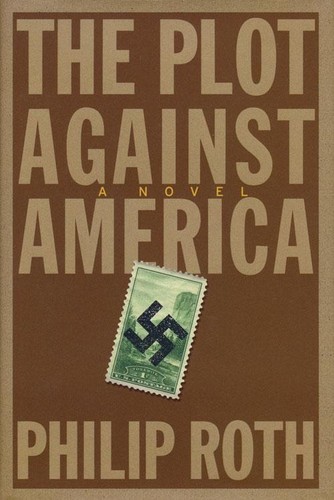
The Plot Against America
by Philip Roth
Buy on AmazonThe Plot Against America is a novel by Philip Roth published in 2004. It is an alternative history in which Franklin D. Roosevelt is defeated in the presidential election of 1940 by Charles Lindbergh. The novel follows the fortunes of the Roth family during the Lindbergh presidency, as antisemitism becomes more accepted in American life and Jewish-American families like the Roths are persecuted on various levels. The narrator and central character in the novel is the young Philip, and the care with which his confusion and terror are rendered makes the novel as much about the mysteries of growing up as about American politics.…
Recommended by
"It is a mark of Roth's skill that one can hardly detect where the facts end and the fiction begins"
By the Book: A Scott Berg · nytimes.com
"For the United States, it's Philip Roth's The Plot Against America. What better depiction of the country that has just elected — evidently without shame — the incredible Mr. Trump?"
By the Book: Bernard Henri Levy · nytimes.com
"Michael Chabon’s “Yiddish Policemen’s Union” and Philip Roth’s “Plot Against America” as alternate-history S.F. in the grandest, proudest tradition."
By the Book: David Mitchell · nytimes.com
By the Book: Gish Jen · nytimes.com
"I find the TV adaptation of Philip Roth’s “The Plot Against America” a lot more credible, complex and involving than I did the book."
By the Book: Jules Feiffer · nytimes.com
"Indeed. Critics might argue that it isn’t actually a thriller, but there certainly is a “what if?” element, and a changing of history. Philip Roth is obviously one of the world’s great literary novelists, so it is odd to call this a thriller. Nor is it one by any of the conventional definitions, because there is no solo protagonist who has to pull off some terrible feat. But it is very thrilling, and even if it doesn’t have a “man with a gun” dimension, as you have in The Day of the Jackal, it does have the “what if?” dimension and a hugely well constructed counter-factual universe, in the same spirit as Fatherland . Support Five Books Five Books interviews are expensive to produce. If you're enjoying this interview, please support us by donating a small amount . Roth’s “what if?” in this book is imagining that Roosevelt is no longer president, and Charles Lindbergh, an isolationist and anti-war politician, is president instead. So the idea is, “What if America had stayed out of the war and was morally on the wrong side?” I partly picked this because it is very much of the same period that Pantheon is set in. One of the things that writing Pantheon taught me is that the position we now take as almost a moral inevitability – that American and Britain were always destined to be on the other side, fighting the good fight against Hitler – wasn’t actually that certain at the time. It was contingent on sometimes quite marginal political calls. What got Philip Roth excited was that he read somewhere that the Republican convention in 1940 considered drafting Charles Lindbergh, the great aviation hero, as its presidential candidate. That is what gave Roth the idea. He began to think about what would have happened if the Republicans had drafted Lindbergh in. It was plausible to think that Lindbergh would have beaten Roosevelt and America would have stayed out of the war. That is what my research for Pantheon taught me – that both America and the UK were closer to making the wrong historical judgement than we like to think."
The Best Classic Thrillers · fivebooks.com
"Yes, one of the classic worries. It is more usual for the speculative to inhabit the future and meditate on all that could go wrong, but Roth goes back in time. What if Charles Lindbergh won the presidency in 1940? He didn’t have much political experience, but, hey, he was a celebrity. He could fly a plane and Roosevelt couldn’t walk. It’s not outside of the realm. What follows, politically, is utterly believable. Rather than dive into World War II, Lindbergh goes isolationist (as only an able-bodied man could). He allies the US with Germany and Japan. Yes, it’s still America, but increasingly, more fascist, more anti-Semitic. The best way to tell stories of horrific times is not through the central players amassing power, but through the lives of the people off to the side, simply trying to survive. In The Plot Against America , it’s a Jewish family from New Jersey, who happens to be the Roths, and the story is told by Philip, aged seven. The family is distressed by Lindbergh’s nomination to the Republican ticket, but it isn’t till later, after his election, that their worst nightmares get teeth. It happens during that perfectly innocuous American tradition, the family trip to Washington DC. Their hotel reservation has disappeared. A simple enough error, but we know that it’s not an error, and we know that it’s only the beginning. The book stuns through its complete plausibility from a historical angle and the prism of the seven-year-old’s youthful but (unsurprisingly) intelligent perspective. Years after reading it, the broad sweep of the book lingers in my mind as a cautionary tale, as if this was some almost-true alley of history we narrowly avoided. And retrospective speculation doesn’t normally have the force that The Plot Against America has. What gives the book its immediacy are the parallels with War on Terror mindset taking hold in the beginning of the last decade. The justifications for clamping down, for profiling, for marginalising suspect groups are all there and all well worth worrying about."
Worry · fivebooks.com