← All books
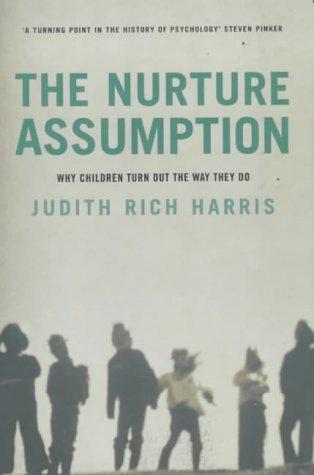
The Nurture Assumption
by Judith Rich Harris · 1998
Buy on Amazon
Overview: This groundbreaking book, a Pulitzer Prize finalist and New York Times notable pick, rattled the psychological establishment when it was first published in 1998 by claiming that parents have little impact on their children's development. In this tenth anniversary edition of The Nurture Assumption, Judith Harris has updated material throughout and provided a fresh introduction. Combining insights from psychology, sociology, anthropology, primatology, and evolutionary biology, she explains how and why the tendency of children to take cues from their peers works to their evolutionary advantage. This electrifying book explodes many of our unquestioned beliefs about children and parents and gives us a radically new view of childhood.
Recommended by
"A grandmother from New Jersey uses genetics, ethnography, and child psychology to refute the dogma that parents shape their children's intelligence and personality."
"Yes, Judith Rich Harris looks at the idea that a child who can only socialise with adults is at a disadvantage. They need to be able to socialise on their own terms and get along with their peer group. In the old days most children from three onwards would be socialised by the other kids. Judith Rich Harris makes a wonderful argument that we should be less controlling of our children when they are old enough to play with other kids because they have to learn to develop on their own terms. She thinks that when children are between two and a half to three the need for social inclusion kicks in so they cleave to their own gender group. That’s when boys’ play is different from girls’ play. I was talking to a nursery worker in Denmark who told me that the boys had made their own special area where they were the “dogs” and the girls weren’t allowed to play. Finally the girls managed to get around it by offering to help look after the “dogs”. So there are ways of working it out! Well, I don’t see it like that. I think you need to look at all these books as a whole in order to form an opinion."