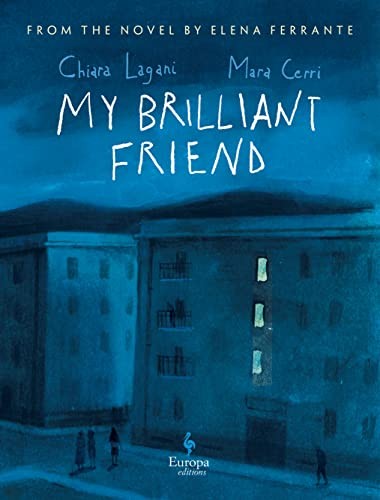
My Brilliant Friend
by Elena Ferrante · 2011
Buy on AmazonMy Brilliant Friend is a 2011 literary-fiction novel by pseudonymous Italian author Elena Ferrante. It is the first volume of a four-part series known collectively as the Neapolitan Novels. It was originally published in Italian by Edizioni e/o; an English translation by Ann Goldstein was published by Europa Editions in 2012.
Recommended by
"This saga of female friendship and ambition, set against a changing Italy, fits Hillary Clinton's interest in women's roles in society and the complexities of long-term relationships."
Hillary Clinton's O Magazine Favorites · oprah.com
"Merve Emre (ME): I’m grateful for this question, because I think it confirms something that we suspected when the four of us [Chihaya, Emre, Katherine Hill, and Jill Richards] started this co-reading and writing project in 2015, which was that the popularity of Ferrante’s books was a function of things other than the books themselves. People talked about them as if they were somehow the literary equivalents of soap operas, or a faithful transcription of the author’s life. This led us to believe that people had not done a good enough job paying attention to what we suspected was most interesting about Ferrante, which was her approach to the novel form. We wanted to find a way—a sustained and rigorous but also conversational and entertaining way—of getting at those thornier questions about form that we felt like the popular writing around Ferrante simply hadn’t addressed. And we wanted to write together about a novel or series of novels that none of us had read. Sarah Chihaya (SC): I think you’re revising history a little bit. ME: Am I? SC: You lied and said you hadn’t read them! ME: I did, it’s true. SC: But you had, and Katherine had also. I think that you two suspected that Ferrante would be a good subject for it, but Jill and I did not know. We came into it, Stephanie, the way you just described: knowing about Ferrante and knowing that she was a ‘thing’, but not knowing what that thing was, which I think is a very common experience. ME: I will say that I’d forgotten that I had lied—which happens when you lie, which is why I try not to lie. You get caught! The person who tried to get me to read it for the first time was my mother. I was at my parents’ house and my mother handed me My Brilliant Friend and said, “It’s about friendship. It’s not the kind of thing you would like.” And I remember starting to read it there to prove her wrong. I wonder how much that lie was born from a desire to read it with someone, rather than against someone. I’m not justifying it, just explaining it. SC: No, it’s sweet. You lied because you wanted to be part of the thing that we were doing together. ME: It was a white lie, as far as lies go."
The Best Elena Ferrante Books · fivebooks.com
"This brings up the question of, ‘How do you define historical fiction?’ Some people have lived through the 1950s and they wouldn’t call it historical at all. I was born in 1962 so I’m a little bit post this, but I’ve heard people call novels set in the 1970s historical, and I think ‘What?!?’ So it’s borderline, though I’ve read that anything that’s set over 50 years ago counts. It’s such an evocative novel. It sets the scene of these poor, working-class neighborhoods in Naples so well that I couldn’t not include it in this list. It’s the story of a friendship between these two girls, Elena and Lila, growing up in Naples. One of them, Elena, is a dogged student. She’s going to do well. She’s working class, but she’s going to go to university. Lila is more of a prodigy, more naturally bright, but her parents don’t want to pay for her further education, so she ends up dropping out and marrying at 16. So the two go off in different directions, even as young girls, and yet they’re so close. It’s about their interactions with the community, and how they are part of the community and yet not. I was completely entranced by two things. One is the details of life. Elena Ferrante must have lived through 1950s Naples to be able to evoke it in this way. It’s just incredible. The other thing I liked is that it’s so simply written. It’s very bare of flowery metaphors. I appreciate that in a book. I don’t think everybody should write like that. It reminds me a little bit of Elizabeth Strout , who also writes incredibly simply. It’s not fancy writing. My Brilliant Friend and all of the subsequent books are not fancy writing. There’s just something about it that draws you in, it’s almost mesmerizing. You keep reading because it’s so easy to read, so smooth, and yet…once you’re in, it feels jagged. There is this seduction, and yet there’s also a lot of darkness in it, a lot of poverty and violence. It’s an incredibly violent neighborhood and a lot of the relationships between men and women…It’s quite a read. I think it’s probably not for everybody, but it certainly was for me."
Historical Novels Set in Italy · fivebooks.com
"I loved each of the Neapolitan novels, but my favorite is this initial story of Elena and Lila as young girls on divergent paths."
By the Book: Allegra Goodman · nytimes.com
By the Book: Anand Giridharadas · nytimes.com
"I was swept up into the tenements of Naples. Devoured all four books in a long, lovely banquet."
By the Book: Lesley Stahl · nytimes.com