← All books
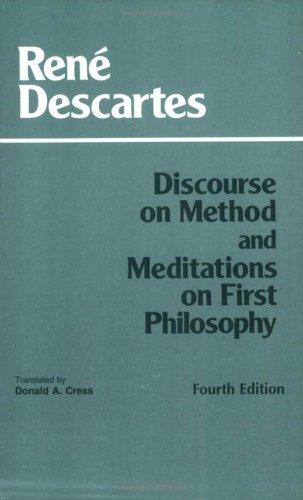
Meditations on First Philosophy
by René Descartes · 1641
Buy on Amazon
Ultimately for Descartes the soul’s presence to itself is the foundation of truth. And he uses that to convince himself that God is not a deceiver. For Descartes the challenge is that there are two ways to think about God: conceived philosophically God is eternal, perfect, unchanging, and certainly no deceiver; conceived biblically God seems rather fond of the occasional deception. Descartes is fairly clear that he really doesn’t much want to bother with the Bible, that it is not particularly relevant for the new science he hopes to establish. At the same time, he doesn’t want people to think there is anything in the Bible that undermines his new science. He adopts something of a traditional criterion for reading the Bible — the Bible speaks the language of its time. In other words, to the simpler and less educated people who lived thousands of years ago God spoke in figures and allegories, as if he were a person like the rest of us. When the Bible describes God as deceiving we’ve got to keep this sort of accommodation to the times in mind. Scripture describes God as deceiving because that’s all those poor ancient uneducated people could grasp. Up-to-date and educated as we are, we must discover what God was really up to because, whatever he was up to, it certainly wasn’t lying. Descartes, like the other bright lights of the Scientific Revolution, wants a God who is the source of order in the universe, a God who sets up a few basic laws on which the universe just operates. The ideal universe for Descartes is the one with the fewest number of laws resulting in the greatest amount of order. Get the weekly Five Books newsletter He will argue that sometimes from our perspective things might appear to have gone wrong. For example, someone suffering from dropsy retains copious amounts of liquids in their tissues while simultaneously feeling parched — should they drink, they might literally drown from within. It may seem in this case that God has set this person up to be deceived, that He has constructed their body to lie to them. This is the wrong way to consider their predicament. By and large and for the most part the system does work — when we need water, we feel thirst. God could miraculously interfere and resolve this one problem but that would clutter up the simple beauty of the overall system, it would violate the aesthetic simplicity of God’s wisdom, justice and reason. Biblical exegetes had to deal with the fact that, at the very least, God seems to interfere in the world — he talks to people, he destroys cities. Often they imagine God as a kind of super rhetorician or orator: he speaks and acts as befit the circumstances. Descartes wants a God that doesn’t speak, because speaking is tantamount to interfering with the orderly and law-like operations of the world. For Descartes, God gives up rhetoric for the ideals of philosophy. God sets up a world system and then watches it. And Descartes is not alone in this new ideal for God. We see it in Pierre Bayle’s Dictionary and in Robert Boyle’s Treatise on the Vulgarly Received Notion of Nature . Yes. It’s precisely through this problem of divine deception and biblical exegesis that you get the mechanisation of the world. The conceptual transformation of the world into a vast machine passes straight through the problem of divine deception. Maybe, maybe not. For some people, like William Paley, it becomes the greatest proof for God’s existence. If the world is a vast machine then, like any machine, it needed to be designed and created. Who could have done that other than God? Even Darwin, at the beginning of his career, supports Paley. It’s only as his career develops that he comes across a way to explain the appearance of order without having to invoke an orderer.
Recommended by
"Ultimately for Descartes the soul’s presence to itself is the foundation of truth. And he uses that to convince himself that God is not a deceiver. For Descartes the challenge is that there are two ways to think about God: conceived philosophically God is eternal, perfect, unchanging, and certainly no deceiver; conceived biblically God seems rather fond of the occasional deception. Descartes is fairly clear that he really doesn’t much want to bother with the Bible, that it is not particularly relevant for the new science he hopes to establish. At the same time, he doesn’t want people to think there is anything in the Bible that undermines his new science. He adopts something of a traditional criterion for reading the Bible — the Bible speaks the language of its time. In other words, to the simpler and less educated people who lived thousands of years ago God spoke in figures and allegories, as if he were a person like the rest of us. When the Bible describes God as deceiving we’ve got to keep this sort of accommodation to the times in mind. Scripture describes God as deceiving because that’s all those poor ancient uneducated people could grasp. Up-to-date and educated as we are, we must discover what God was really up to because, whatever he was up to, it certainly wasn’t lying. Descartes, like the other bright lights of the Scientific Revolution, wants a God who is the source of order in the universe, a God who sets up a few basic laws on which the universe just operates. The ideal universe for Descartes is the one with the fewest number of laws resulting in the greatest amount of order. Get the weekly Five Books newsletter He will argue that sometimes from our perspective things might appear to have gone wrong. For example, someone suffering from dropsy retains copious amounts of liquids in their tissues while simultaneously feeling parched — should they drink, they might literally drown from within. It may seem in this case that God has set this person up to be deceived, that He has constructed their body to lie to them. This is the wrong way to consider their predicament. By and large and for the most part the system does work — when we need water, we feel thirst. God could miraculously interfere and resolve this one problem but that would clutter up the simple beauty of the overall system, it would violate the aesthetic simplicity of God’s wisdom, justice and reason. Biblical exegetes had to deal with the fact that, at the very least, God seems to interfere in the world — he talks to people, he destroys cities. Often they imagine God as a kind of super rhetorician or orator: he speaks and acts as befit the circumstances. Descartes wants a God that doesn’t speak, because speaking is tantamount to interfering with the orderly and law-like operations of the world. For Descartes, God gives up rhetoric for the ideals of philosophy. God sets up a world system and then watches it. And Descartes is not alone in this new ideal for God. We see it in Pierre Bayle’s Dictionary and in Robert Boyle’s Treatise on the Vulgarly Received Notion of Nature . Yes. It’s precisely through this problem of divine deception and biblical exegesis that you get the mechanisation of the world. The conceptual transformation of the world into a vast machine passes straight through the problem of divine deception. Maybe, maybe not. For some people, like William Paley, it becomes the greatest proof for God’s existence. If the world is a vast machine then, like any machine, it needed to be designed and created. Who could have done that other than God? Even Darwin, at the beginning of his career, supports Paley. It’s only as his career develops that he comes across a way to explain the appearance of order without having to invoke an orderer."
"We’re jumping from the fifth century BC right forward to the first half of the 17th century. René Descartes is a superb writer who, in his first Meditation (which is the one I’m recommending) takes skepticism—which is an unwillingness to assume anything, a philosophical stance where you question everything—about as far as it can go. Meditations is written as if he is going through a process in real time, he’s imagining himself sitting by a fire taking all the thoughts that he’s had in his past, the different ways of acquiring information, cross-questioning himself about whether he could have been deceived about any of those, and employing what’s come to be known as ‘Cartesian doubt’. It’s not taking as true anything about which there is the slightest possible doubt. In ordinary life, that’s not a way to behave. If I take a step, the floor could always give way beneath me, I can’t guarantee that it won’t. But on Descartes’s view, if there’s the slightest possibility that it might give way, then I shouldn’t take that step—or at least shouldn’t treat my belief that the floor is firm as an example of a foundational belief. That’s a strategy for once in a lifetime, of reflecting on the foundations of knowledge for him. He does this beginning with the sensory inputs that he has. Should he trust his eyesight? Well, coloured things look a different colour under different lights. You make mistakes when you see things in the distance, too. Nearby a straight stick looks bent when half in water. Should he trust his hearing? That can be wrong too. Should you trust any of your senses? Maybe you should trust the sense of touch. But there are illusions with this sense too. But what about the fact that you could be deceived about just about anything in a dream? You could be dreaming. That’s an outside possibility most of the time, but still a possibility. He’s had these false awakenings in real life, he’s imagined he’s woken up when he hasn’t. And he thinks, Well, I can’t be sure I’m not dreaming now. How do I know I’m not dreaming now? Probably, I’m not dreaming now. But I could be dreaming. And he pushes and pushes with this and thinks—he’s a mathematician—‘even in dreams, two plus two equals four’. But what if there’s an evil demon that exists—it probably doesn’t—but what if there were and he is almost as powerful as God, and creates the illusion that two plus two equals four, when it actually equals five? And because it’s so powerful, how do I know that’s not going on now? “For me, when I read it as an 18-year-old, I was stunned” So he’s got this kind of progressive doubt that is actually pre-emptive. He’s not saying that you should doubt all these things. He’s pushing doubt as far as he can, then to perform a U-turn, to get beyond skepticism. He’s descended to the nadir of doubt, as it were, the lowest point he can possibly go and feels that he’s in a whirlpool of doubt. And then he finds this one thing which he thinks is impossible to doubt, which is his own existence. Because even if he doubts that, it proves that there’s a doubter. And you get this famous, “I think, therefore I am”. It’s questionable whether it’s a logical ‘therefore’. But there’s a sense that it’s impossible to doubt your own existence without certifying your own existence by the fact that you’re having a thought. And this leads him to think that he can be more certain of his own existence than he can be even of his own body, because his knowledge of the body comes from sensory information. And that’s always unreliable. But his knowledge of his own existence as a thinking thing is, he feels, the kind of groundwork or base from which he can rebuild the whole edifice of knowledge. That’s basically the first Meditation . Then, in the subsequent fives Meditations (there are six in all), by a few devious moves, he gets back to normality. These devious moves involve proving the existence of God and then a benevolent God who wouldn’t deceive him. So he ends up thinking that whatever he perceives clearly and distinctly is true, and from that point gradually rebuilds more or less everything he had believed before. Historically, the important thing is that pushing of skepticism as far as it can go. He gives us the ‘cogito’ argument and then puts forward a dualism between mind and body, because he’s certain of his own existence, whereas he can still doubt his own body. That’s one stage away from his own final position, which is that the soul is separable from the body, which was an orthodox Catholic belief. That’s an offshoot of his theory. Descartes is famous for this dualism, where he believed that the mind and body interact. They’re not the same thing. And so you have this Cartesian dualism of mind and body interacting, the mind stuff and the body stuff, the soul as it were, and the physical material body, which, in many people’s view, set philosophy off on a wrong path for hundreds of years. It’s what the Oxford philosopher Gilbert Ryle described as the myth of the ‘ghost in the machine’. But it’s an incredibly important book, not just historically, but also because it was very accessibly written and gives you the excitement of thinking things through, and makes a good starting place for studying philosophy. It’s argued, it’s not just asserted, and some of the sceptical arguments are very plausible. And if you have not come across it before, it can pull the rug from underneath your assumptions one by one. For me, when I read it as an 18-year-old, I was stunned, because I thought, ‘Could I be dreaming?’ Most of us haven’t progressively moved through those stages of doubt in that way. He gives a better description of the Cartesian method of doubt in a different work, where he talks about a barrel of apples. If you want a good barrel with no rotten apples, you have to take them out one by one, and examine them and not put any back in again until you’re absolutely sure it’s not rotten. You don’t want to take the risk of putting a rotten one in. That’s what he thinks he’s doing. He doesn’t want to put any rotten belief back into the barrel. And he’ll probably sling some good ones out as a result. But he wants to be absolutely certain about some things, he doesn’t want to just take a chance. Life is lived for us as a matter of probabilities most of the time. We don’t worry about really long odds of things possibly being misleading. But, for Descartes, this was about trying to understand the absolute basis of our human knowledge and its limitations and whether nothing could be certain, whether even the idea that nothing is certain might be uncertain. That’s the extreme Pyrrhonian skepticism after Pyrrho, the Greek philosopher, and Descartes doesn’t end up there. But he starts off by using the same kinds of arguments. It seems to me that it’s a plausible exercise, you’re trying to understand how we acquire knowledge and beliefs, and how reliable those methods are. He pushes those things to the limit, you’re testing these things to destruction. These are thought experiments, he’s not prescribing this as a way of life. It’s a once in a lifetime device. He uses the ontological argument, which is basically the idea that, by definition, God must exist. It’s like the three angles of triangles having to add up to 180 degrees by definition. From the definition of God, it must follow that there is a God because God is that entity than which nothing greater can be conceived. And there must be such an entity. To many people, that seems like a sophistical argument and totally implausible. He also uses a version of the argument from design, which is usually known as the trademark argument: if you introspect, you’ll find you have an idea of God. Everybody’s got an idea of God. Well, it must have come from somewhere, God left that stamp in your mind to find there. Where did that idea of God come from? It’s this little hint from the maker. I’m not convinced, but some people are."
"From Plato, to Descartes, to Russell — the last philosopher I know of who was good at this — philosophy has always had this valuable attitude of speaking to both sides of human interest: to the intellectual, the academic, the ivory tower; but also to the practical, ordinary aspects of the world. From Descartes, through Hume, even to Kant (not the most accessible philosopher, but at least he made an attempt), all the way down to Russell, we have this double channel of communication. It is not popularising philosophy, it is not making philosophy cheap, it is not philosophy for dummies, it is philosophy made interesting to interested people. There are different vocabularies, different ways of speaking. And that’s why Descartes wrote the Meditations in a language that was available to a well-educated person who didn’t have that much Latin. Meditations is not only a classic — it’s easy to find almost anything you want in it — but I also see it as one of the books that you could recruit into a history of the philosophy of information. Get the weekly Five Books newsletter The debate about scepticism is often misunderstood. It is not an intellectual game, it is not by someone who has time and money to waste wondering whether he exists. Anyone who tries to refute scepticism is wasting their time and no decent philosopher has taken that sort of speculation very seriously. Scepticism in the Meditations is to be understood technologically. It works in the same way that you benchmark a particular product by testing it in extreme conditions, so that, when you put the product on the market, it is robust. You test a car in extreme conditions. Nobody would dream of driving that car in those conditions. Descartes is acting like an engineer testing ideas. Descartes wants to doublecheck that the science we’re building is going to be so robust that even when you run the most insane test it will still work. It’s silly to conclude from this that the task of philosophy is to refute the sceptic! That’s not the point. Scepticism in Descartes is a matter of increasing the pressure and showing how much his ideas can actually withstand. It is about resilience. There are many ways of reading the Meditations . Today Descartes speaks more directly to us if you understand him as the equivalent of an engineer testing a product. Much better to read it that way than suggesting that we are living in The Matrix ."
"I recently loved reading René Descartes, "Meditations on First Philosophy," with my 17-year-old daughter"
"This is one of the great works of philosophy, Descartes’ Meditations on First Philosophy , published in 1641. It’s a short book and it’s a book that many people know because of the famous doctrine of the cogito, ‘I think therefore I am.’ The words don’t actually appear in the Meditations — they appear in one of Descartes’ other works — but the idea that ‘I think therefore I am’, and that thinking is his essence for each of us, is one of the core points of the book. The book is composed of six ‘meditations’, which are written rather in the style of spiritual exercises of the time. Descartes was educated by Jesuits, and it’s important that they were called meditations because they were meant to be things that people would think through themselves, they would practice these modes of thought that Descartes was recommending. So it’s written in a very personal, very intimate and slightly confiding style. In the first meditation, he raises the question of which of any of his beliefs about the world will survive scrutiny. He challenges them all. He makes up certain imaginary scenarios and says, ‘Supposing, for example, I was dreaming. Which of my beliefs would survive scrutiny under the supposition that I was dreaming?’ And so on. Get the weekly Five Books newsletter Many philosophers have thought that this book is a book about epistemology, or the theory of knowledge, and that Descartes is trying to refute scepticism, scepticism being the view that we know nothing. But if you look at the very first page of this book, he says that the book is called Meditations on First Philosophy , ‘in which the existence of God, and the distinction of the human soul from the body, are demonstrated.’ So that’s what he says he’s trying to to do: he’s trying to establish the existence of God, and he’s trying to establish the distinction between the human soul and the body. He doesn’t say, ‘in which I explore the foundations of knowledge and provide an epistemology or theory of knowledge.’ He doesn’t say anything about knowledge. This is a book of metaphysics, in my view. That’s right, I’m exaggerating a bit. He has a criterion of truth, what he calls ‘clear and distinct ideas.’ What he can clearly and distinctly perceive, that is what he thinks is true. But the rest of the book is about how that criterion is put to use, not in distinguishing different types of knowledge, or relationships between knowledge and perception. He gives up the idea that perception is the main source of knowledge. This is one of the ways he criticises his predecessors. His predecessors, the Aristotelians of the Middle Ages said ‘There’s nothing that can come to the mind that hasn’t previously been in the senses.’ Descartes dismissed all that, and replaced it with this criterion of truth. He gets onto the metaphysics by building up, first of all, what he thinks his essence is. His essence is to think, he says, in a particular sense of the word think. Then he asks himself how that thinking thing that he is is related to his body. He argues in a number of ways for the existence of God, and he argues for claims about the nature of God, for God is not a deceiver so God would not have deceived him about the existence of things outside of his mind, and then he makes claims about the nature of what the nature of that reality is, and then the coup de grâce of the book is the argument for what he calls the real distinction between mind and body. He says although our mind and body are intimately connected, they are things that can be separated, and therefore they are separate things. Your question is a very good one, because I don’t think anything in this book is true. I don’t believe in the Cartesian distinction between mind and body, I don’t believe in his criterion of truth, I don’t believe in the existence of God. I suppose what we’re doing when we’re reading philosophy books isn’t just looking for things that are true. We’re looking for a kind of understanding which will help us understand the questions — the first level metaphysical questions — that we want to answer. If I want to say, ‘What is the nature of the mind?’ then it’s illuminating for me to look at Descartes, not just because Descartes had a view which I can then contrast my own view with, but also questions of philosophy do not occur in abstract isolation, they are the product of the philosophical tradition. The philosophical tradition is a contingent historical connection between individuals, texts and the way that texts have been read. The questions that we confront now are very different from the questions that were confronted 600 years ago, or even 200 years ago. They are very different from the questions that are confronted by mainstream philosophers in France, let alone questions confronted by philosophers in China, or in India, in their traditions. There are many questions, and the questions that we have have been formed by our traditions. I think there’s a very artificial view that comes from the academic pursuit of analytical philosophy, — twentieth century, and twenty-first century English language philosophy on the whole — that assumes that there is an abstract menu of questions, that there are just philosophical questions that occur to people and that anyone who is thinking philosophically would end up with this menu of questions. I don’t believe that. Both of those are very good descriptions of our predicament, yes. But I think there’s another thing, which is that he’s a great philosopher. Not just any random thinker from the seventeenth century is worth reading. Descartes is a great philosopher, there’s a vision there, and encountering the vision of a great philosopher is a very exhilarating thing. Understanding very different realities from our own is a very illuminating thing too, it gives us the opportunity to question why we believe the things we do, as well as to understand how we ended up where we are. So many Cartesian ideas have dominated discussion. Some people say that they’re a kind of disease, the Wittgensteinians think this is all a big confusion. My view is slightly different which is that the questions that we have grow out of our tradition, and to understand the questions that we’re asking now, we have to understand something about where it comes from."