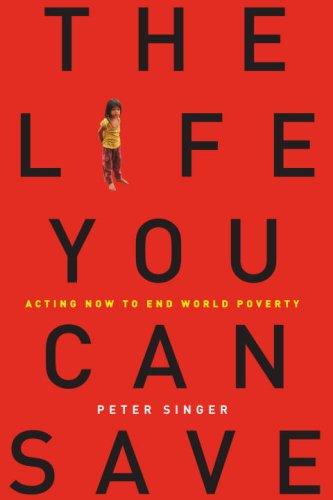
The Life You Can Save
by Peter Singer
Buy on AmazonThis is the right time to ask yourself: "What should I be doing to help?"For the first time in history, it is now within our reach to eradicate world poverty and the suffering it brings. Yet around the world, a billion people struggle to live each day on less than many of us pay for bottled water. And though the number of deaths attributable to poverty worldwide has fallen dramatically in the past half-century, nearly ten million children still die unnecessarily each year. The people of the developed world face a profound choice: If we are not to turn our backs on a fifth of the world's population, we must become part of the solution.…
Recommended by
"Because it’s a really inspiring read. It’s very nicely set out in terms of having clear arguments and picking up on things that are often said but not thought about. Peter Singer starts with a simple story – if you are walking past a pond and you see a child floundering and it looks likely that the child will drown, despite the fact that your new shoes may be ruined, you will automatically go into the mud to save the child. So he argues that if we all agree on this, why do we then buy new shoes and luxury goods that we don’t really need, when putting that money into an aid programme can save a life? He asks how we can accept that millions of children are dying from curable diseases and poverty every year, when in many places we have more than we need. He looks at that premise under many different spotlights. And he examines aid in a way that I really appreciate. He looks at all the key questions and all the aspects of aid, such as ‘Can we be convinced that our money will be well spent?’ He examines the question very thoroughly and comes up with a resounding ‘yes’. At the end he comes up with a practical plan as to how much people should give. And there are some really inspiring stories of people who have given almost everything they have. There is a group called the Fifty Percent Club. Some are rich whilst others are not, but they all derive great pleasure from donating half of their capital or income to good causes. He does calculations looking at the millennium development goals for 2015, and works out that if everyone gave $300 a year we would be able to achieve them. This is great, because as we get closer to 2015 it had seemed that the goals are no longer realistic. I myself had begun to accept that we set targets in this world that are not achieved and that poverty will continue. But this book is great because he says no, we can do it, but we all need to take responsibility. February 18, 2010. Updated: August 19, 2022 Five Books aims to keep its book recommendations and interviews up to date. If you are the interviewee and would like to update your choice of books (or even just what you say about them) please email us at [email protected] Support Five Books Five Books interviews are expensive to produce. If you've enjoyed this interview, please support us by donating a small amount ."
Aid Work · fivebooks.com
"I was thinking, “How would you introduce philosophy to someone who didn’t know anything about it?” I think the central question in philosophy is, “How should we live?” And that’s a question about which Peter Singer has a lot to say. The book focuses on the terrible poverty and disease found around the world, and how we in the West are living in a luxury that we could adjust just a little bit in order to alleviate that misery. He suggests that we give maybe 5% of our wages to charity. He’s not saying you have to live in a sackcloth and give away all your possessions. Even a small gift of 5% would make a tremendous difference to other people’s lives. It’s not just him preaching, he gives arguments for his positions. And even if you disagree with him, the process of reading his work makes you think, “Why do I disagree?” He is in the tradition of Socrates – somebody who challenges your preconceptions and asks you to respond. Singer starts with a compelling thought experiment. Imagine you’re passing a pond. There’s a young child drowning in the pond and his head’s just about to go underwater. You’re on your way to work, you’re nicely dressed. But you’d surely jump in the pond and try to save the child, wouldn’t you? Almost anyone would do that unthinkingly, even though it would ruin their expensive clothes and make them late for work. Yet in our everyday lives, we know that through inaction we are allowing children to die of poverty who could otherwise be saved by a minimal contribution – less than the price of an expensive pair of shoes. What’s the difference between the situation described in the thought experiment and our inaction in everyday life? Singer thinks that there isn’t an important moral difference. He says there are ways in which we could act that would be the equivalent of saving the drowning child’s life – giving to charities that tackle poverty, disease and so on. He believes most of us could be much more generous at very little cost to our own lives, and that the result of this would be of huge measurable benefit to mankind. Singer is brilliant because you don’t have to agree with him, but he goes through all the standard objections to his view and presents counterarguments. Someone might say, “The difference is that if I save the child myself I know the child is going to be saved, but if I give my money to a charity it might be wasted.” Well, there’s a website that has been set up which analyses the comparative effects of money sent to different charities. It comes up with charities where the effect of your donation is most likely to save lives. So Singer has second-guessed you, and come up with a counterargument and a practical way of implementing the conclusion he’d like you to embrace. Singer is incredibly consistent in his positions. He used to be a chess player, but he believes that the point of philosophy is not to solve chess-like problems but actually to make a difference. If you really believe, as he does, in a form of utilitarianism – the view that the consequences of our actions determine their rightness or wrongness – then that’s not just an intellectual position, it should affect how you live. Singer is a counter-example to the stereotype of the philosopher in an ivory tower, whose life makes no difference, who leaves everything as it is."
The Best Introductions to Philosophy · fivebooks.com
"This was a book that was very influential on me all the way back in 2009 and got me inspired to work on the problem of extreme poverty. I’ve been arguing for a longtermist worldview, focusing on civilization-impacting events, but there are major problems affecting the near term too. Still, every year, hundreds of thousands of children die unnecessarily of malaria, of diarrheal disease, of tuberculosis. You can do an enormous amount of good; it literally costs only a few thousand dollars to save a life. When we think about doing good in the world, we should appreciate how much our money can do. I included this book because whenever we’re engaging in prioritization or thinking about the big problems of our time, this is something that should really be borne in mind. Peter Singer also inspired me to give away most of my income. It can do a lot more good for other people than it can for me. If they could do absolutely anything, I think the thing that I would most want them to focus on is AI governance. AI is already the fastest-moving technology at the moment. There’s competition between the big powers, including the US and China. It’s clear that we need to carefully navigate this technology because the upsides are enormous, and the downsides are very great. I do think that the development of very advanced artificial intelligence could be one of the most important technologies ever. How should you govern this? What are the policies that are correct and in place? Honestly, I don’t really know. That’s why if I’ve got someone who is a polymath and super smart, I would love to have more attention on that, to ensure that we reap the benefits without paying the costs. Get the weekly Five Books newsletter Everyone is going to have different incentives. That’s why I particularly want to see more altruistically-motivated people, perhaps philanthropically funded, working on it because they can have a truly impartial perspective. Predictably, the US government is going to have the United States’ interests at heart. The leading AI labs will have their own interests at heart. People working in the AI labs take the concern seriously—they want to have a governance framework such that we have the upsides of AI without the downsides—but, at the same time, I do think having people who are operating in think tanks or going into government is especially valuable. They’re more concerned about how things go for the world as a whole rather than any particular interest group."
Longtermism · fivebooks.com