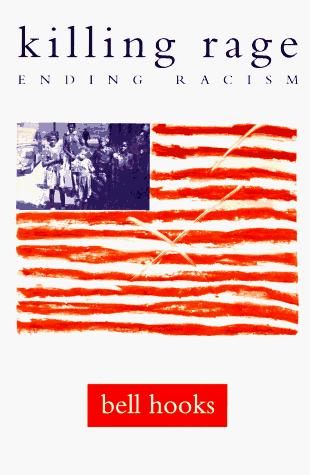
One of our country's premier cultural and social critics, the author of such powerful and influential books as Ain't I a Woman and Black Looks, Bell Hooks has always maintained that eradicating racism and eradicating sexism must be achieved hand in hand. But whereas many women have been recognized for their writing on gender politics, the female voice has been all but locked out of the public discourse on race. Killing Rage speaks to this imbalance. These twenty-three essays, most of them new works, are written from a black and feminist perspective, and they tackle the bitter difficulties of racism by envisioning a world without it. Hooks defiantly creates positive plans for the future rather than dwell in theories of a crisis beyond repair.…
"It’s humility. bell hooks is not even her given name. It’s a pen name. It’s as if the work is more important than the writer. This is a classic book that came out in 1995. It’s a collection of essays and it doesn’t just talk about rage, but it is foregrounded in the book. She discusses racism, and how we can end racism, but she begins with rage. So why even begin a book like that? She starts from a personal experience that she had on a plane, and the discrimination, or as we would say, explicit racism that she was faced with, coming from a particular passenger, a male passenger, and she began to feel that if she had been a white man, she wouldn’t have been treated in that way. The attendant was also in his corner, so she felt herself a victim of racism. She describes a visceral bodily response that she had to this, something like a killing rage. She was just trying to make sense of that emotion. First of all, she acknowledged that’s what she was feeling. She gave the reasons for why she was feeling that way. Black folks are constantly victims of racism and the misconception is that they just take it internally with a smile on their faces, but that isn’t accurate. She’s trying to make sense of this killing rage she felt. She then spends the next chapter defending rage. I had never read anything that attempted that before. She’s defending rage, she’s rejecting notions that it is pathological in black folks. She’s talking about its role, its positive role, how it can fuel action. She also gives a lot of warnings. Black folks and white folks are her audience. But she’s also giving a warning to make sure that it doesn’t go in a destructive way. She ends that chapter suggesting, ‘If we want to end anger, we probably want to start at ending racism. If anger is what people are so concerned about, if you have to get rid of this thing that you see people feeling, then perhaps you need to address the cause’. “Anger at racial injustice is probably the first strong emotion that I have a memory of” And then for those who may just be confused about the cause or be ignorant about the cause, she spends the next few chapters talking about racist encounters, institutional racism, and she challenges the reader to not only see it, but to tackle it as well. I found that illuminating. She has a tendency to talk about anger as an expression of love, which I borrow from her, and of how that love can be an act of resistance. I was just amazed by the work. It was so easy to understand, written in ordinary language, written to console the reader, in a way. I found that very persuasive. I’m not going to mention any specific news, but I was watching the news today, and I saw some things that broke my heart. It broke my heart because I just love humanity. I love people. I think people are due a certain kind of respect. So it breaks my heart when people are victims of racial violence. But it also breaks my heart to see people be perpetuators of that victimization. But it wasn’t just heartbreaking. As a result of witnessing these events in the news, anger began to arise in me and I just immediately shut off my social media. What was happening there? I’m angry in a response to the fact that I love people. That concern for people brings about this anger in that I am disappointed in their actions. But I’m also heartbroken that they’re being mistreated. Some people go on from this and like to say that the story just ends with the love. The story just ends with the compassion. But I think if you really desire justice, and you desire that people be everything that they say that they want to be, then when they don’t live up to that, and justice is not distributed, anger is going to come, it’s a response to a wrongdoing. So anger is not just compatible with love, as I argue, but it’s also an expression of love. My anger was at what I was witnessing, and it was an expression of the love that I was feeling for the wrongdoer as well as to the victims of that particular wrongdoing. bell hooks talks about love being a form of resistance. At one end, we have a tendency to think that rage is so radical, but then we also have a tendency to look at love as being less radical, as being a kind of acquiescing, almost accepting a form of oppression, for example. But we need to see that both of them have radical potential. hooks even talks in this book about her love being an act of resistance. To love, particularly to love a group of people who are not loved, who are despised, whose oppression is usually justified, to love them is an act of resistance. So if anger is an expression of that love, of course, that rage too is also going to be a form of resistance as well. We get all that from hooks. The title of her book is illuminating in this regard. The title of the book is Killing Rage , that’s usually written in bold. And then right beneath it, it’s still the title, Ending Racism . Now, you notice that it’s got an ‘-ing’, ending, right? It’s present action. And one of the things I find encouraging about bell hooks, is that she believed that even if you can’t totally eradicate it (and I don’t even think that should be the call), as long as you live your life and are participating in ending racism, then you get closer to what people have a tendency to think of as a utopian idea. Even if people can’t embrace what they may perceive as a utopian ideal of the eradication of racism, what bell hooks challenges us to do is constantly to engage in the process of ending it. What are you doing in your day-to-day actions? How are you responding to institutional racism?"