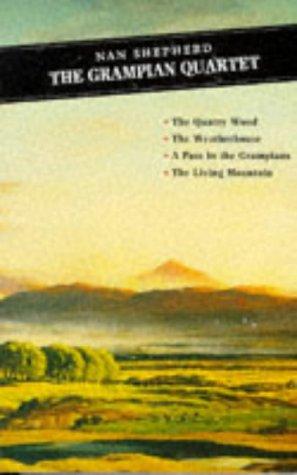
The Grampian Quartet
by Nan Shepherd
Buy on AmazonI almost chose Lewis Grassic Gibbon’s A Scots Quair , which is of course absolutely brilliant. Sunset Song was a really important book for me when I read it. I was about 22. Whereas I didn’t read Nan Shepherd until she was ‘rediscovered’ in the late 1980s, when she was brought back into print. I reread all of the Grampian Quartet last year, which comprises three novels and The Living Mountain , and it’s a quite remarkable achievement. Shepherd was one of a number of female writers working in the northeast of Scotland around this time. I’m thinking of Violet Jacob , Marion Angus , and one or two other prose writers. But Nan Shepherd is interesting because her trilogy— The Quarry Wood, The Weatherhouse, A Pass in the Grampians —came out between 1928 and 1933. Lewis Grassic Gibbon’s Scots Quair came out slightly after that. So she wrote her trilogy before his, but his is the one that has had all the fame and attention. I mean, rightly. They are amazing, brilliant, wonderful books. But I would like to see Nan Shepherd’s novels treated with the same kind of reverence because they are just as good and just as interesting, though they are very different. “Nan Shepherd wrote her trilogy before Lewis Grassic Gibbon wrote his; I would like to see her books treated with the same kind of reverence” Lewis Grassic Gibbon’s main character is Chris Guthrie. And he writes beautifully about this woman going from childhood through to adulthood, through a few marriages into middle age. Nan Shepherd is coming from a different perspective. I think the two trilogies really complement each other. They’re also both Modernists , experimenting with style and structure. The thing that comes very clearly through Nan Shepherd’s books is that women are frustrated by the political and social expectations of the time – the things they’re not allowed to do or be. They’re not allowed to go off to be doctors. They’re prevented from studying, not simply by the education system, but by the social and familial expectations placed on them. They’re certainly not expected to go to university. In The Quarry Wood , the heroine Martha is clearly a very intelligent girl, but she has to fight all the way to get to go to university in Aberdeen. Subsequently in The Weatherhouse and A Pass in the Grampians, even though they’ve moved on in time, the women are having to fight to have their voices heard, to bypass the strictures and the condemnation of the men in their lives, whether that’s their fathers or brothers or husbands or whatever. So Nan Shepherd was writing about things that were absolutely and completely relevant to women at that time. An awful lot of it still speaks to today. And then you’ve got The Living Mountain at the end of the Quartet . It’s just the most stunningly brilliant book. Again, it’s like Jekyll and Hyde , a very short book, but my goodness it’s packed with quality. Profound is a good word. Again, with a lot of nature writing , there’s an awful risk of people over-romanticising their relationship with nature. She doesn’t do that at all. I think her relationship with the Cairngorms is real, and it doesn’t stop her thinking really hard about what that relationship is. I never get the sense that she sentimentalises the mountains. She knows her place in the mountains. She’s not trying to conquer them, her appreciation is just in being there and experiencing what they have to offer. She wrote it during the Second World War , I think, and it wasn’t published until 1977. I remember reading it a few years after that, and thinking it was good. Then it kind of disappeared. But now it’s become a classic of nature writing. It’s a shame she never got to see it so successful. I think that’s true. There’s the sense that humanity is living close to nature in all of those books. Not so much in Gillespie , that’s centred on town life, although the town’s life is dictated by the fishing and the farming seasons. I do think it’s a very strong element in Scottish writing. A lot of contemporary Scottish writing is much more about life in the city, but I don’t think you can get away from the fact that the landscape and nature have had a big impact upon writers in Scotland. They still have that effect on me.