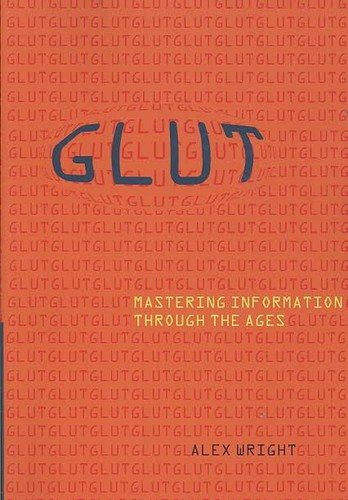
What do primordial bacteria, medieval alchemists, and the World Wide Web have to do with each other? This fascinating exploration of how information systems emerge takes readers on a provocative journey through the history of the information age. Spanning disciplines from evolutionary theory and cultural anthropology to the history of books, libraries, and computer science, writer and information architect Alex Wright weaves an intriguing narrative that connects such seemingly far-flung topics as insect colonies, Stone Age jewelry, medieval monasteries, Renaissance encyclopedias, early computer networks, and the World Wide Web. Finally, he pulls these threads together to reach a surprising conclusion, suggesting that the future of the information age may lie deep in our cultural past.…
"This is a fascinating book. It’s by a young guy called Alex Wright. He looks at the beginning of information, starting from single- and multi-cell organisms and how they transmit information, and goes right up to the Ice Age information explosion. From there he goes on to the Ancient Library of Alexandria, and then Gutenberg. It’s a whole history of information and what we, as humans, decide to keep in our heads. This is something I wanted to deal with in my own book, Final Jeopardy , about Watson. With machines like this, we have to say, ‘OK, so these things are becoming an external lobe or a brain that we all share. And if it’s an external lobe, what do we keep in the part of the brain that is between our ears?’ You mentioned GPS. Alex Wright deals with it very intelligently, and he has great stories about information economies that I never knew about. For example, he talks about Ancient Peru, where messengers used to travel across the Andes carrying woven threads known as ‘quipus’, or talking strings. When a messenger arrived at his destination, he would deliver his news while reeling off knots in the string like a rosary. For the Incas, people of no written language, the quipu served as their core information technology — it was a newspaper, a calculator, even a repository of laws. There’s a lot of interesting stuff in the book. And he finishes up with the Internet. From the time of Gutenberg, we’ve settled on the written language as the basis of learning. Now, with the Internet, we are reverting to a more oral, conversational tradition. Each one of us will have a different answer to that. But when you learn about Watson, and see Watson getting built, you see not only what Watson is strong at, but also what it struggles mightily to do, and what it is utterly incapable of. That’s a road map of where the greatest potential is for us. Watson has no capacity to come up with original ideas. It cannot carry on a conversation; it cannot create theory; it has no understanding of causal relationships. All of these are areas where we can, for many decades to come, remain masters in the world of information. A lot of us like having information; it’s nice to have information up in your head. If you look at the knowledge Ken and Brad have, you can say, ‘Well, I can find out those things by asking Watson, or by looking it up on Google.’ But if you have knowledge in your head, ideas come from that. It’s much harder to have that magic occur when you have to look up 20 things on Google first, and then figure out the connection between them and come up with a brilliant idea. It’s more likely to happen if it’s already up there."