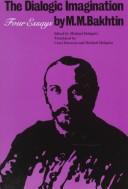
The Dialogic Imagination: Four Essays
by Mikhail Bakhtin & translated by Michael Holquist and Caryl Emerson
Buy on AmazonOne of the other problems I think people have with Derrida—and this is something shared by both his acolytes and his detractors—is that he’s seen as emerging out of nowhere. But he didn’t. The book I want to talk about is Dialogic Imagination , which is a collection of four essays by Mikhail Bakhtin. Derrida came from the tradition of phenomenology in France. But he also drew on a long tradition of critical reading and dialogic imagination. Bakhtin was a Russian theorist, who wrote a lot in the 1920s, ’30s, and ’40s. He was more or less unheard of in the West until after his death in 1975. He was very interested in the way that language functions as a type of dialogue. He saw fiction as the epitome of this. In fiction , there are various voices going on, the voices of the characters, the voice of novelistic technique, the voice of the narrator, the voice of the time—all of these dialogic things were clashing with each other. He was particularly interested in Dickens and Dostoevsky , and also Mark Twain, whom he saw as exemplars of this sort of method. Yes. But the literal dialogue is not necessarily two characters talking. The dialogue is also where a given character is talking in dialogue with all the other books that are being written, with a literary style, with what I think, with what the reader thinks. One of the things about dialogue is that it creates meaning. Now you and I, we’re having a dialogue here. We’re both saying things, and possibly thinking things that if we weren’t talking to each other, we wouldn’t say or think. So we’re creating meaning in some sense by dialogue. That is something that novels can do. But for Derrida even a philosophy book is talking to other books of philosophy, it is talking to its times, it is talking to its reader, and it is talking in the voice of the person speaking. This book by Bakhtin is a precursor of Derrida in many ways, arguing that you can’t just treat a book as characters doing stuff over the course of some period of time, with a final resolution. There are many other things going on, all this meaning being created and conveyed. Yes, it’s much more normally written. Just about everything is more accessible than Of Grammatology … Yes, absolutely. Bakhtin analyses Dostoevsky, giving an extended look at Dostoevsky’s work. Again, you have that familiarity, something to latch onto, whereas Derrida sometimes almost spins in space, or is referencing unheard of Sumerian texts, that sort of thing. Yes, definitely. That’s part of it. When you’re reading a book, you shouldn’t treat it as a realist thing. Fiction, even realist fiction is, of course, a created thing under a set of conventions. So, you need to be very aware of that. But he’s also fascinating on the way that language works in this way. People tend to think language conveys singular meaning in many cases. One of the ways of looking at him, I think, is to compare him to someone like Hegel , with his thesis, antithesis, and synthesis. In a sense, Bakhtin’s approach is similar, but without the synthesis. You don’t have this resolution that takes primacy. He, like Derrida, is fascinated by the way that language moves along like a river, as it were, and just keeps going and going and going and accreting meanings, developing meanings and changing meanings over time.