← All books
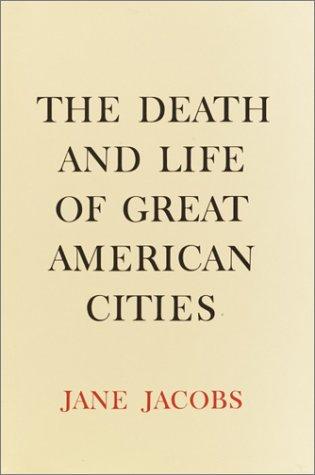
The Death and Life of Great American Cities
by Jane Jacobs
Buy on Amazon
The Death and Life of Great American Cities was described by The New York Times as “perhaps the most influential single work in the history of town planning. . . . [It] can also be seen in a much larger context. It is first of all a work of literature; the descriptions of street life as a kind of ballet and the bitingly satiric account of traditional planning theory can still be read for pleasure even by those who long ago absorbed and appropriated the book’s arguments.” Jane Jacobs, an editor and writer on architecture in New York City in the early sixties, argued that urban diversity and vitality were being destroyed by powerful architects and city planners. Rigorous, sane, and delightfully epigrammatic, Jane Jacobs’s tour de force is a blueprint for the humanistic management of cities.…
Recommended by
"She describes the beauty of ‘the ballet of the sidewalks’. She pointed out innumerable ways in which people are connected by proximity and the virtues of dense living. How urban inhabitants, for instance, worked together to keep cities safe. Eyes on the street in a dense neighbourhood make sure that if something is happening to a kid, someone is going to see it and stop it or report it. She pushed us to think of cities as not just an idle engineering problem that’s about putting up taller shinier structures, which is the direction we were heading in. She pointed out that older buildings and mixed-use buildings allowed people to connect with each other and create livable spaces. My first urban research paper, which was the beginning of my work on cities, tested some of the ideas expressed in her book, about the value of small firms and diversity. Her ideas seemed to be borne out by the data. She observes that old buildings were cheap and new buildings were expensive, which leads her to conclude that the way urban policy should change is by not building new buildings on top of old buildings. Unfortunately, that’s not how supply and demand works. But it led us to positions that ended up being very costly. When she lived in Greenwich Village, it was affordable to ordinary income people like her and her husband. Jane Jacobs was never ordinary, but she was middle income. Now that area has become unaffordable to new entrants other than hedge-fund millionaires, in part because it has been a historic district and hasn’t allowed enough new building for 40 years. So many cities have made growing within them difficult by putting overly restrictive land use controls in place. I think these restrictions are not in our overall best interest. Cities are incredibly important to America and the world’s future. And yet we’ve had very little debate about policy for our cities. Although, there have been encouraging things that came out in the last few days about the administration’s budget. The national policies that I would like to see include cutting the subsidies for sprawl. On average, more than 85 per cent of the occupants of unattached dwellings are owner-occupiers. And more than 85 per cent of people who live in multi-family buildings, with five or more units, are renters. So subsidising home ownership pushes people out of urban homes to suburban homes. Likewise, transportation policy is biased towards building highways in Montana. That’s just the way our political system works. We need to correct that bias. Most importantly, so many parents perceive a huge gulf in quality between city schools and suburban schools. There is nothing more important to the future of our cities than making sure that kids who grow up in cities are able to access a great education. More than any infrastructure project, great public education can resuscitate cities."
"Jane Jacobs was an architectural writer, not an academic, and she was in many ways an engaged member of the public. She was involved in the 1950s and early 1960s with campaigns to preserve Greenwich Village [in New York], which is where she lived. And out of this came the idea of The Death and Life of Great American Cities , in which she creates the fulcrum on which this new urban thinking is fixed. This book sums up these new ideas of putting people first – that the city is complex but not a place that needs to be rationalised. That you should look at life on the street, rather than the motorways, as a sign of what urban life really is. “Cities are where the 21st century is really going to happen. Cities could either be our coffin or they could be our ark.” She writes very simply about Hudson Street, where she lives, and various other parts of New York, and she gives the city a human face. She looks at people right at the heart of the city, and shows that a neighbourhood can be chaotic and rundown and still have more life in it than a gated community of millionaires. We’ve been experimenting in urban forms for about 9,000 years. The first cities were created in what one historian, Ian Morris, calls the “happy latitudes”. In other words, the latitudes around the equator which were the first to come back to life after the ice age, and around which the first communities were formed. We normally assume that the origins of cities began with a farm, then a village, then a town – that they grew incrementally. In fact, archaeologists have shown us that the very first cities were moments of extraordinary revolution. We assume that agriculture came before cities, but what has been shown is that there was a moment – lasting about 300 years – in which everything one thinks the city is was spontaneously created, and agriculture was part of that. The city created the technology to sustain it, rather than the other way around. So cities are completely different to anything that has come before. Since those 9,000-year-old origins, we’ve been experimenting with different forms of the city depending on climate and population. Technology has always been part of the mix of how a city works. Today, two of the technologies that drive us most – the Internet and the airplane – mean that we don’t need to be physically close to each other, and that we are spending more and more time travelling from city to city, respectively."
"What book should everybody read before the age of 21? Jane Jacobs's The Death and Life of Great American Cities."