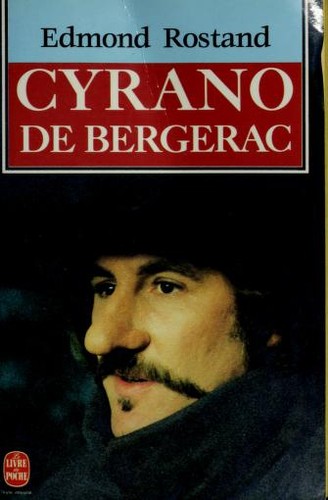
Cyrano de Bergerac
by Anthony Burgess (translator) & Edmund Rostand
Buy on AmazonCyrano de Bergerac, verse drama in five acts by Edmond Rostand, performed in 1897 and published the following year. It was based only nominally on the 17th-century nobleman of the same name, known for his bold adventures and large nose. Set in 17th-century Paris, the action revolves around the emotional problems of the noble, swashbuckling Cyrano, who, despite his many gifts, feels that no woman can ever love him because he has an enormous nose. Secretly in love with the lovely Roxane, Cyrano agrees to help his inarticulate rival, Christian, win her heart by allowing him to present Cyrano’s love poems, speeches, and letters as his own work.…
Recommended by
"It is set in the 17th century. Cyrano de Bergerac is the play’s hero, a cadet – a nobleman serving as a solider in the French army – and he’s deformed, with a nose so enormous that people come from far and wide to view his “protuberance”. He falls madly in love with his cousin Roxane, who is witty and leaned, but because of what he believes to be his outward ugliness he cannot proclaim his love for her. Instead, an extraordinary triangle emerges. Christian de Neuvillette, who like Cyrano is a cadet, is absolutely beautiful but very inarticulate. What Cyrano does is lend him his words and between them they become the perfect man. But it’s Christian not Cyrano who takes the prize with Roxane not realising that she has fallen in love with the wrong person and it’s only at the end of the play, many years after Christian dies in the siege of Arras, that she comes to grips with this fact and understands that her real devotion should be for the ugly Cyrano. I think it’s interesting that Cyrano has a big nose. I don’t know if this was subliminal, but the fact is that a big nose was one of the most important features in the caricatures of Jews. This is something that’s not widely discussed but it’s very interesting that this was the deformity that Rostand picks on to create a great hero who, in this regard, departs from the classical model. It came out as the Dreyfus affair was just heating up, and it quickly became a play around which the French could unite at a time when the affair was tearing them apart. What people loved about Cyrano de Bergerac is that it seemed to display a distinctive French quality – panache . The play’s emphasis on verve and wit that overcame adversity enabled men and women of often different values to identify with particular aspects of Cyrano’s character. Cyrano asserts an aristocratic sense of noblesse that appealed to the right. At the same time, he is a remarkable swordsman and dueler, which both artistocrats and republicans endorsed in this period as a virile manner in which to settle disputes. He is also characterised by an independence of thought and a refusal to be patronised, a quality which attracted him to the left. In this, he seemed to resemble the early “intellectuals” of the affair. What’s also really important about the play is the era in which it is set. It’s France of Louis XIII and the ancien regime , before the great centralisation of Versailles and the Sun King. It also depicts a France that successfully beats the superior Spanish forces. This victory confirmed a French sense of grandeur in the 1890s,when they were still smarting from defeat in the Franco-Prussian war in 1871. So virtually all the French love this play, but at the same time it was something which inadvertently revealed Dreyfus’s insufficiency by comparison. Dreyfus was as obsessed as the play’s author Rostand with conceptions of honour. But whereas Cyrano is absolutely eloquent, Dreyfus was stolid, spoke French with a lingering German accent, was inarticulate and lacked any theatrical presence. When he finally comes back in 1899 for his second trial, he has lost some teeth and has problems speaking after living in solitary confinement for almost five years. People were so disappointed with Dreyfus. They wanted a Cyrano, but what they get instead is Dreyfus – a Jew who is not rooted in the soil of Gascony like Cyrano but somebody who lacks verbal virtuosity and appeal. Instead they pair Cyrano with Georges Picquart – an army officer who submitted evidence to his superiors showing Esterhazy’s guilt – who was dashing and brilliant and, importantly, not Jewish."
The Dreyfus Affair and the Belle Epoque · fivebooks.com
"The love story that is told in Cyrano , with its bittersweet, heartbreaking ending, is one of the most powerful I’ve ever encountered. The eponymous character is an incredibly intelligent and funny man who has the misfortune of having an extraordinarily hideous nose—a nose that is so prominent and so unattractive that it is hard for anybody around him to take him seriously. He’s in love with his beautiful cousin, Roxane, whose eye is captured by a young man who, like Cyrano, is a cadet in the French army. This young man, Christian, is remarkably handsome but not at all eloquent. Christian enlists Cyrano’s help in wooing Roxane with words, by writing his love letters. The play is the story of a three-way love affair. Roxane thinks that she is being courted by Christian, but the words that enrapture her have all been composed by Cyrano. Support Five Books Five Books interviews are expensive to produce. If you're enjoying this interview, please support us by donating a small amount . Yes, this is a completely sentimental 19th-century play; it’s really over the top. After the passage of fifteen years, years during which Roxane has pined for Christian, Cyrano is dying. Too late, Roxane realizes that it is Cyrano’s words she loved, and she declares her love to him. Cyrano is too delirious to hear but Rostand concludes with a memorable redemptive detail. Cyrano always prided himself on a white feather, his panache . He retains this white feather flourish. ‘Panache’ is his dying word, and the last word of Rostand’s play. Many of our modern myths were created during the last decades of the 19th century. Dr Jekyll and Mr Hyde dates to that era, the story of two personalities in a single body and a monster within unleashed. The period also gave birth to Sherlock Holmes, a character with superior powers of discernment and detection who solves crimes using scientific techniques so effective as to seem almost preternatural to those around them. Certain popular storytellers in that era (Bram Stoker’s Dracula is another) boiled narratives down to their absolute essentials. These characters had creators who were unafraid to think schematically and structurally and give their protagonists near-mystical powers. Rostand’s Cyrano , the character and the play’s plot, are so brilliant that emulation is inevitable. In Cyrano , the main character in whom we’re emotionally invested is forced into the position of bystander rather than participant: he’s assigned a minor role in the courtship as Roxane understands it, but assumes his true central place in the story for those of us watching. The brilliance and ingenuity of that story structure captivated audiences in the nineteenth century; it should be no wonder that it always stayed with us."
The Best Love Stories · fivebooks.com