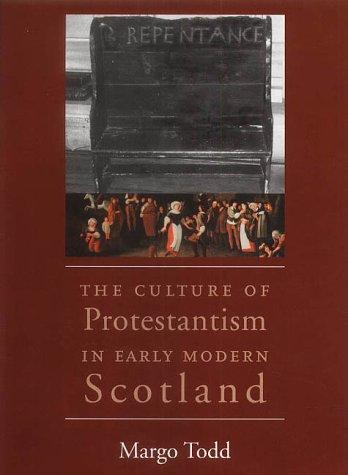
The Culture of Protestantism in Early Modern Scotland
by Margo Todd
Buy on Amazon"The Protestant Reformation of the sixteenth century brought a radical shift from a profoundly sensual and ceremonial experience of religion to the dominance of the word through Book and sermon. In Scotland, the revolution assumed proportions unequaled by any other national Calvinist Reformation, with Christmas and Easter formally abolished, sabbaths turned to fasting days, and mandatory attendance of weekday as well as Sunday sermons strictly enforced as part of an invasive disciplinary regimen."--BOOK JACKET.
Recommended by
"So first of all I’ve chosen a book by a modern American scholar, Margo Todd. She is writing about the Scottish Reformation, which produced the Presbyterian Church of Scotland (still the Scottish national church). Traditionally a lot of writing about the Scottish Reformation presents a picture of an enormously gloomy, repressive society – and there’s something in that. But what Margo does is present this wonderfully rich, detailed picture of the lives that people led. It was a very disciplined society. For example, the Scottish Protestants invented a new piece of church furniture which they called the Stool of Repentance. Sinners in the parish sat on it at church until they’d been absolved of their sins. And you think, ‘Gosh, that’s so tyrannical!’ But the great thing about the society she is describing is that everyone was involved. The whole congregation would stare at these people Sunday after Sunday and then, at the end, the whole congregation would welcome them back, hugging them and shaking their hands. This was a discipline that came out of ordinary people’s lives and gave them a sense of power – because it was a society with no policemen and no security forces to speak of. It was a very scary world in which anyone might burst into crime, and you can see how attractive this sort of structure would be for people. She has the most wonderful stories about these disciplines: for example, one sea captain who was visiting from the Netherlands and went out on the razzle one night and had a wonderful time drinking and fornicating and when he had a hangover the following day he felt so guilty that he went to the local church and offered himself for penance before the congregation. You get the sense of people struggling with their own consciences and trying to fit into this world. And there’s another lovely story about the Stool of Repentance. It only existed in Scotland, and an Englishman came up to visit Edinburgh one day, and he went to church on a Sunday. He was looking around for a pew, and the church was crowded, but he saw one empty pew at the front, and he thought, ‘Oh, I’ll sit there – I’m a gentleman, I’m important, and it looks an important seat.’ So he sat down on it, and of course it was the Stool of Repentance and the whole congregation burst into laughter at seeing this stupid foreigner sit where you should never sit. And it goes on like that. It’s a great book. It was an absolutely huge turnaround, part of a real reformation of manners. Society moved from a society where the festivals of the church were hugely important, to one where discipline was valued. Scottish society remained full of festivity, but it had a rather different relationship with the Church. The Church was generally on the side of buttoning yourself up after the Reformation, whereas beforehand it might well be on the side of unbridled fun. It depends where you start from. It’s easy for us 21st-century liberals to feel it was dreadfully repressive, but if society is constantly on the edge of violence, as that society was, I think we’d feel rather differently about the community disapproving of people stepping out of line. We all make bargains with the society we live in, and theirs were just a different set of bargains. It’s not up to us to criticise them."
The Best Books on the History of Christianity · fivebooks.com