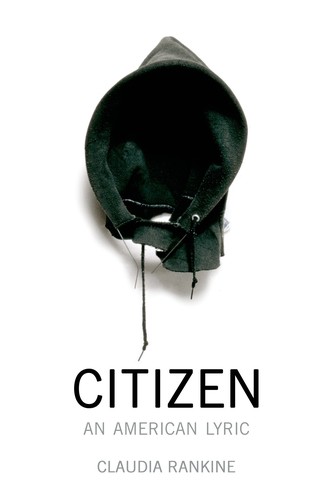
Citizen: An American Lyric
by Claudia Rankine
Buy on AmazonYou take in things you don't want all the time. The second you hear or see some ordinary movement, all its intended targets, all the meanings behind the retreating sounds, as far as you are able to see, come into focus. Hold up, did you just hear, did you just say, did you just see, did you just do that? Then the voice in your head silently tells you to take your foot off your throat because just getting along shouldn't be an ambition. --from back cover "Claudia Rankine's bold new book recounts mounting racial aggressions in ongoing encounters in twenty-first-century daily life and in the media.…
Recommended by
"This is a book that is different from all the others because it’s a book of poetry. I first came across this wonderful book while watching the news about a Trump rally. There were usually a variety of participants and supporters who were sitting behind Trump on stage. There was one young lady, a black American, who was sitting there listening to Trump. Then, after a while, we see her making faces, there’s a little bit of confusion and disagreement. And then you start seeing her just put the book in front of her face. So people are like, ‘What book is she reading?’ because you can see her in the camera. She basically tells the story about how she goes to the rally open-minded. She wanted to hear what Trump had to say. Then she just realized, ‘I just can’t. What he has to say, what’s happening at this rally, is just not good for American democracy.’ So she takes out a book that she happened to have in her bag and it’s the Claudia Rankine book. Support Five Books Five Books interviews are expensive to produce. If you're enjoying this interview, please support us by donating a small amount . Claudia Rankine is a poet. There is a meditation on anger in the book that I just found illuminating. What I found fascinating is she has a tendency not only to talk about anger and race, but she’s doing it in a way in which she’s positioning tennis star Serena Williams, as an example of how she wants to consider us to think about race and rage. She begins to talk about how, for example, there’s a kind of what she calls ‘commodified’ rage of oppressed people, and what she means by commodified rage is that you are allowed to be angry, as long as it can create capitalistic profit. So you can create angry music. We get hip hop in the 90s, that was very conscious, very angry, but we know that the owners of those record labels were white and it was feeding into an industry so people make money. Yes, that’s commodified anger. You’re allowed to have commodified anger, but there’s a kind of anger that you’re not allowed to have. And that is the kind of anger that arises out of being discriminated against, as a result of being mistreated, and it doesn’t make money. It’s not commodified, doesn’t benefit audience members, it benefits the person who’s angry. And the person that she uses as an example of this is Serena Williams. She’s using her as a black subject to allow us to understand how we view anger and rage on the black body, but also to show how we view it when it is embodied by a black woman. For those who are not tennis fans, there’s been a history of…whether you agree with these calls, or you don’t… unfair calls that have been made in relationship to Serena Williams when she’s playing tennis. At times Serena gets vocal about unfairness. She will always speak up for herself. And then you get instances in which she and Venus Williams would be explicitly victims of racism at these events from audience members, so much so that they had to boycott one of them, because there was specific racism. Claudia Rankine even talks about an example in which a white tennis player begins to imitate Serena Williams on the court by imitating her black body. She puts things inside her pants to make herself have a big buttock area – it was just completely racist, and the audience laughs at this. Rankine uses Serena Williams as an example of someone who’s had to take this kind of abuse. When an unfair call is made, all of that just comes out of her and she expresses the anger. That’s an example of what black rage looks like. It’s a boiling rage. Black people who’ve been oppressed have been trying to hold this in all this while, they continue to be mistreated, and then it just comes out. And then she talks about how people began to criticize Serena Williams about her reaction, these calls to civility, ‘oh, we don’t act like that in tennis.’ We’re talking about the asymmetry here, in which white men are allowed to do this, but Serena isn’t. It just goes to show that the asymmetry points to a larger issue of justice. These calls for civility to her, which kind of models calls to what happens when oppressed people are angry, people respond to that anger by reminding them that there’s a certain kind of way that they ought to act. Going back to your example of white male tennis stars—because it’s not just race, but also gender that can complicate things here. They are allowed to be angry, rightfully so, in ways in which women and black people are not allowed to be angry. She uses these meditations about anger in the embodiment of Serena Williams, in ways that makes us contemplate not only what she is experiencing, but what we put on black folks in general and their emotive responses in general. There’s something that you can do with poetic language that you can’t do in a traditional essay. We were talking about eloquence in relationship to Baldwin and Cornel West earlier, with this kind of methodology you can give illumination of not only Serena’s world, but our world in general. And that’s something that I really appreciated. I learned a lot from that."
Anger at Racial Injustice · fivebooks.com
"The meaning of the word ‘technology’ has changed over time. In Ancient Greek, ‘logos,’ the second part of the word, means logical reasoning. ‘tekhnē,’ means craft or skill or art. For the ancient Greeks, ‘tekhnē’ included medicine, sculpting, music, and all sorts of things. So ‘technology’ is any kind of applied know-how. In the speculative fiction genres, technology ranges across science and nature. Technology can also be social tools, such as race. A really good example of this comes from the artist Wendy Chun, who is one of several intellectuals and makers who talks about race as a form of technology. Chun says, ‘Don’t think about what technology is , think about what it does .’ If a tool or a skillful activity consistently has a certain effect, then it’s a technology, so to speak. Race is an artificial category—there’s nothing deterministic about it in the natural world. It’s an artificial category that’s being used or applied to have a particular social effect, or to legitimize or create social structures around certain geographies or communities. So race is a sorting technology, which exists to organize people in ways that make certain kinds of exploitation or labor easier for the people using or controlling the technology. It’s quite an internationalist outlook and she plays with well-known instances of contemporary racism, things that we’re all familiar with, like Serena Williams calmly playing outstanding tennis under hostile scrutiny. She compares the LA riots protesting the police beating of Rodney King with the London demonstrations protesting the killing of Mark Duggan. She draws on interviews with Zinedine Zidane about what it’s like being perceived to be from the Middle East while playing football for France in the World Cup. Then she mixes up these everyday elements with quotes from critical theorists. One of my favourites is: “The state of emergency is also the state of emergence.” That’s from Homi Bhabha. The narrator’s voice is so curious and empathetic about the people who are around them, and with whom they’re interacting, that you feel what it’s like to be a Black person in a white space, and you also feel what it’s like to be a white citizen interacting with a Black person. It’s painful precisely because you inhabit both perspectives at the same time. Depending on which perspective you take, you could either take the view that this is a utopia where the technology is doing its function of segregating and organizing and creating a hierarchy that favours you, or you could take the view that this is a dystopia where the technology unjustly places you under constant threat. It is ambiguous as to whether what you’re exploring is a tech utopia or a tech dystopia—but this is what it’s like when the tech is working, and you see both sides of it. It’s bruising. And it’s particularly effective because it’s a prose poem—a poem sometimes written in prose, sometimes in verse, sometimes blank verse, and interspersed with images and collages. It’s pushing the boundaries of language so that we can think and feel in new ways. Like Svetlana Alexievich, Rankine is finding or making a new way of exploring and articulating this uncharted territory—this ‘state of emergence’. It makes me think back to Ezra Pound again, and how artists can create the new forms of expression that we need around new kinds of tech utopia and dystopia. In this conversation, we’ve discussed different forms of technology, and different ideas and experiences of utopia and dystopia. We’ve discussed race as a technology, Chernobyl, speculative fiction and ancient Greek tragedy. We haven’t actually discussed AI, though AI is why so many of us are interested in tech utopias and dystopias right now. But by looking at these other approaches to tech utopia and dystopia, we can see that the rhetoric of AI creating a kind of utopia is misguided, and risks creating a dystopia instead. We can see that we need to develop the social and emotional skills to understand and illuminate the unconscious desires that guide our political fantasies, and to be able to navigate ambivalence and contradiction about unsolvable political problems. We can see that we need to be conscious of the other technologies that AI will be interacting with—whether that is nuclear power, or race. We can see that we should expect AI to reveal human consciousness in new ways, and maybe even challenge it in new ways. And we can see that we are going to need artists to help map out and establish the new forms of expression that will be needed."
Tech Utopias and Dystopias · fivebooks.com
"Though Claudia Rankine’s poetry, by turns lyrical and narrative, is always stunning in its ability to speak to the present American moment, Citizen feels especially necessary. A finalist for the National Book Award, this collection examines everyday encounters with racism in the second person, forcing the reader — regardless of identity — to engage a narrative haunted by the deaths of Michael Brown, Trayvon Martin and Renisha McBride."
NPR Books We Love — 2014 · apps.npr.org
Publishers Weekly's Best Books — 2014 · publishersweekly.com
"Like a lot of definitions, that refers you to the definition of something else. This is one of the reasons that the epigraph to the introduction of my anthology was Gertrude Stein: “What is poetry and if you know what poetry is what is prose.” Because sometimes these arguments become rather circular. People ask, ‘How do you define a prose poem?’ My response to them is ‘Well, how do you define a poem?’ It’s not as though that’s a question with an easy answer. When we define a poem now, we usually mean ‘lyric’—that form of intense emotional expression associated with song, but obviously, in written poetry, increasingly detached from a musical setting. (Though I have sometime wondered if one analogy for prose poetry in popular music is the spoken-word song, such as Tom Waits’ “What’s He Building in There?”). Support Five Books Five Books interviews are expensive to produce. If you're enjoying this interview, please support us by donating a small amount . I think when Rankine calls Citizen ‘an American lyric’ and calls her previous book, Don’t Let Me Be Lonely (2004), an ‘American lyric’, she is deliberately challenging the definition of lyric. She’s in the tradition that goes back to Wordsworth and Coleridge calling their poems Lyrical Ballads , and thinking of how ‘lyrical’ has a certain high-culture association with the refined, literary way of writing poetry, and ‘ballads’ has the low-culture association of oral literature and folk song. Like Wordsworth and Coleridge bringing together those words, by juxtaposing those two terms ‘America’ and ‘lyric’, Rankine is saying that we need a new working definition of ‘lyric’, and perhaps a better definition of ‘American’ too. ‘An American lyric’ has the sort of oxymoronic quality that ‘prose poem’ does. These little two-word phrases that challenge you to rethink your definition of both parts. I think shape-shifting is right for Citizen . Obviously, it’s been admired and acclaimed, but I do feel the general reception of it has underplayed its artfulness. Its technical subtlety and overall arrangement has been neglected, because it has been classified as a kind of documentary work. The focus has been on its vignettes of everyday micro-aggressions, not its more extended argument. Yes, and ‘shape-shifting’ is a nice description, because if you read Citizen as a through-composed work, as a complete thing, it changes its form. The plain documentary prose—which has come to characterize it—is only part of it. There’s the critical essay on Serena Williams. There are passages of verse, too. Rankine is clearly a writer who admires Stein; sometimes, her sentences sort of do what Stein does, which is to knock through the walls of grammar and just let words run up against each other. “Rankine is saying that we need a new working definition of ‘lyric’, and perhaps a better definition of ‘American’ too” At the start of Citizen , I think it’s the first sentence, she says, “You are alone and too tired even to turn on any of your devices.” That’s immediately a bit Ponge; it’s clueing us in to the fact that this is going to be a reflexive sort of writing. It’s saying: I’m too tired to use any of the devices that you might associate with lyric poetry. But over the course of the book, it’s full of devices, in that artful sense. It’s also a book which needs to be read out loud. Like Tender Buttons , it’s a book that needs to be heard and felt to have its full effect. Rankine was interviewed on the Guardian podcast when the anthology came out and she summed up her reason for using prose with a strikingly Steinian phrase—she said it was ‘the perfect form . . . to create the music of the narrative of the devastation altogether’. Anyone who can come out with something like that on the spot is, as far as I’m concerned, a bona fide genius. Yes. Racism is structural and prose is a means of exposing that structure. There’s a great review of Citizen by the poet Vahni Capildeo, where she compares it to a “crystalline aggregation”, a “lump of geological fact”. She says, “fits no human palm without spiking it somewhere.” In using prose, Rankine wants to look the reader directly in the eye—not to go around the subject. But I think there’s another side of that, which is that she wants to also draw you in. Her lyricism wants to establish an interiority. One of the really important passages in the book is where she talks about Robert Lowell. She doesn’t name him directly, but it’s apparent that she’s addressing Lowell and in particular thinking of his book Life Studies (1959), which has a prose memoir as its middle section. Your ill-spirited, cooked, hell on Main Street, nobody’s here, broken-down, first person could be one of many definitions of being to pass on. The past is a life sentence, a blunt instrument aimed at tomorrow. Drag that first person out of the social death of history, then we’re kin. […] Listen, you, I was creating a life study of a monumental first person, a Brahmin first person. If you need to feel that way—still you are in here and here is nowhere. Join me down here in nowhere. It’s such a powerful passage because she’s directly addressing the author of the most famous book of post-war American verse, Life Studies , and the way he mixes prose and free verse to present that apparently open and confessional portrait of himself. She’s challenging that and how it has dominated the idea of the ‘American lyric’: Lowell, as a privileged white man, has been able to do such a thing, to make such a full and open confession of himself. But what would have happened to a black woman who had tried to do that in 1959? Because prose poetry often comes from the margins of the literary canon, scholarship on the prose poem perhaps has a slightly better-than-average track record here. Three important studies that come to mind, for example, are by women: Marguerite S. Murphy, Nikki Santilli and, most recently, Jane Monson. And its hard to account for it as an avant-garde form without acknowledging Stein. But I do think that the available accounts of prose poetry in English have tended to be very American-centric. That was something I wanted to try to shift in the anthology, to look at the way prose poetry has this international existence, and how important translation has been in developing it as a form that leaps almost simultaneously into multiple languages in the modernist era: from French into English, Russian, Chinese, Bengali, German, Spanish, Japanese, and more. And then, of course, Anglophone poetry is not just written in the UK and the US, but also in Australia, New Zealand, India, the Caribbean, Africa. Get the weekly Five Books newsletter To come back to your question, Stein, as I’ve already mentioned, suffered a lot of mockery before she was admitted to the modernist canon. There’s also Amy Lowell, who was almost totally forgotten because Pound won the propaganda battle to claim Imagism as this sort of pared-down free verse, whereas Lowell was developing what she called ‘polyphonic prose’, which is full of exuberant music and imagery. When I first read her “Spring Day” (1916), I thought wow, there’s a whole other side of Imagism here which is prose poetry, and it’s almost never mentioned. There are various points all along the way where you find people have been written out of literary history. They’re often women, or queer writers like Jack Spicer—Spicer’s Letters to James Alexander (1958–59) is a sequence of wonderfully direct prose poems—or black writers. Ron Silliman suggests in his essay on prose poetry, ‘The New Sentence’, that possibly the first American prose poet is an African-American called Fenton Johnson, who writes this unforgettably poignant monologue called ‘ Tired ’—although, according to my own chronology, Johnson is predated by Emma Lazarus, the Jewish American poet best-known for the sonnet that hangs inside the Statue of Liberty, whose sequence “By the Waters of Babylon” is subtitled (after Baudelaire) “Little Poems in Prose”. So, yes, I think there is still work to do in re-writing the history of modern poetry to bring those voices back in. There’s so much more that I could have put in the anthology, if I hadn’t had a page limit—a whole other book . . ."
The Best Prose Poetry · fivebooks.com