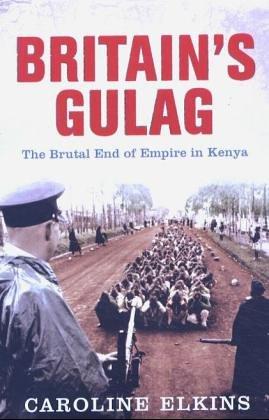
This sits squarely in the style of modern narrative history writing of which Britain is a great producer. It’s very much focused on the prison camp system during the Mau Mau uprising in Kenya – ‘the pipeline’ as it was known. It’s based on a large amount of oral history, interviews that she conducted with survivors of the camps. The Mau Mau uprising was a conflict that was to some degree repressed, and I think this is a significant work in writing its history – I think the author would see herself as reclaiming that history. In her final chapter she writes directly about its suppression and about the afterlife of the conflict, and the fact that there was no official parliamentary inquiry – so there was no real self-examination at the time on the part of the British. It also seems to be the case that a large amount of significant documents pertaining to the camp system that were in the Commonwealth Office were deliberately destroyed. “It also seems to be the case that a large amount of significant documents pertaining to the camp system that were in the Commonwealth Office were deliberately destroyed.” It is quite a campaigning book, in that she thinks that the official historical record is misleading. What became controversial about it afterwards is her numbers – some people have thought that her figures overestimate the number of people that went through the camps, which for me, in a way, is neither here nor there. If it was true for 200,000 people rather than 300,000 people, that doesn’t really impact on the way I think about those events. At the nub of the controversy about her figures is an article that challenged her method of calculation. She also gave a hostage to fortune I guess in her choice of title – so someone like Niall Ferguson could write an article saying: while there’s a lot that’s very interesting and valid about this book, a simple equation between what Britain did in response to the Mau Mau uprising cannot seriously be compared to the Stalin terror and its camps. But that’s an argument on the level of rhetoric rather than reality, I think.
"This sits squarely in the style of modern narrative history writing of which Britain is a great producer. It’s very much focused on the prison camp system during the Mau Mau uprising in Kenya – ‘the pipeline’ as it was known. It’s based on a large amount of oral history, interviews that she conducted with survivors of the camps. The Mau Mau uprising was a conflict that was to some degree repressed, and I think this is a significant work in writing its history – I think the author would see herself as reclaiming that history. In her final chapter she writes directly about its suppression and about the afterlife of the conflict, and the fact that there was no official parliamentary inquiry – so there was no real self-examination at the time on the part of the British. It also seems to be the case that a large amount of significant documents pertaining to the camp system that were in the Commonwealth Office were deliberately destroyed. “It also seems to be the case that a large amount of significant documents pertaining to the camp system that were in the Commonwealth Office were deliberately destroyed.” It is quite a campaigning book, in that she thinks that the official historical record is misleading. What became controversial about it afterwards is her numbers – some people have thought that her figures overestimate the number of people that went through the camps, which for me, in a way, is neither here nor there. If it was true for 200,000 people rather than 300,000 people, that doesn’t really impact on the way I think about those events. At the nub of the controversy about her figures is an article that challenged her method of calculation. She also gave a hostage to fortune I guess in her choice of title – so someone like Niall Ferguson could write an article saying: while there’s a lot that’s very interesting and valid about this book, a simple equation between what Britain did in response to the Mau Mau uprising cannot seriously be compared to the Stalin terror and its camps. But that’s an argument on the level of rhetoric rather than reality, I think."
"I wanted to include this because, although it’s not to do with the Opium war, it raises very important and broad questions about how we in Britain remember our imperial past. Thinking specifically about the opium trade, it’s fair to say that Britain’s role in these events is not particularly well understood or known in Britain today. Even the physical traces are neglected – our old East India docks have been overrun by wild birds, or redeveloped into glass and steel apartment blocks. As a British student, it would have been quite easy for me to get through the history curriculum without ever encountering the Opium War, if I hadn’t chosen to study Chinese. And back in 1997, at the time of the handover of Hong Kong, there was no mention in the dignitaries’ speeches of opium wars fought over it. I can’t say whether we’ve forgotten about our Opium War out of laziness or out of guilt, but I do think that there is a tendency in Britain to think of ourselves as post-imperial, and avoid reflecting on some of our colonial misdeeds. The uncomfortable fact remains that a large slice of the British Empire was bankrolled by opium money, and opium is a highly addictive and illegal narcotic. That is a very inconvenient truth. Some historians of the Opium War, and politicians and merchants at the time, argued that we just brought the opium to China, and the Chinese didn’t have to smoke it – or that if the British hadn’t sold the opium, some other country would have. But you can’t escape the fact that it was the British who were growing the opium in India, and selling it for profit in China. When I first read Caroline Elkins’s book, I was shocked by the crimes committed by the British colonial regime in the 1950s. Her revelations about torture and forced slave labour perpetrated by the British in Kenya completely refuted the lazy idea you sometimes hear that the British were somehow “less bad” as colonial overlords than the French or the Belgians. So the book really throws open the debate about the benign nature of the British Empire, and about how we should think about this period in our history, which is still so defining to us. Although we think of ourselves as postcolonial, our experience as a vast empire still shapes many of our foreign policy decisions today. Why were we in Iraq? Why were we in Libya? Why are we in Aghanistan? Because of the assumption that Britain should have a global policeman’s role. I think we need to ask questions about what originally bankrolled our international influence (namely opium), whether we are entitled to play that global role, and how we have played that role in the past. We certainly didn’t play it very creditably during the Opium War."