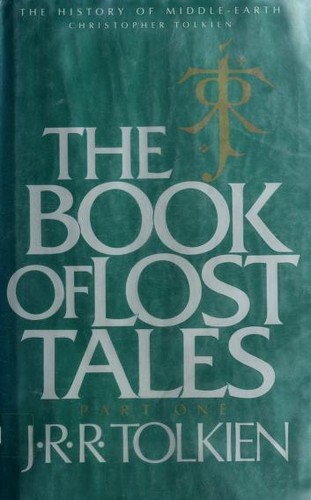
The story begins with a man named Eriol, as he lands on the 'Lonely Island' mythical prehistory England. While traveling he stops at the "Cottage of Lost Play" a house owned by Lindo and Vairë elves. They tell him how they came to be there, and of a place called the 'Cottage of Children', a place where Children that had gotten lost in the woods could stay. Its caretaker left and the cottage was rediscovered by Lindo's father, and he took the children to this island, with him, and now Lindo looks after them. The next day Eriol walks in the garden and meets the door man, and is told the story of "The Music of the Ainur". A creation myth where the creator sings into being immortal spirits, that with their help sing into being the world.…
"Yes. The Book of Lost Tales itself is a work that Tolkien began in 1916-17, aged twenty-five, and is the first narrative work on the history of Valinor and Middle-earth. However, the subtitle – “A History of Middle-earth” – applies to a larger book series that also reproduces other work from throughout his life. The Book of Lost Tales takes up the first two volumes, but there’s more beyond that to explore. The editor is his son Christopher Tolkien, and there couldn’t be a better guide to the texts. In his forward, he discusses the process behind The Silmarillion , where he needed to make choices between inconsistent and messy extant texts to bring everything into a single coherent narrative. In this series, he presents pieces as they were left, without making editorial choices. It’s one for real Tolkien fans who would like to get in the weeds of his lifetime’s creation themselves. No, there’s always a commentary essay, but it comes after the text. Linguistic comments and changes to names are dealt with in annexes. The idea is that you can get at the text itself without interruption if you want, and also follow Christopher Tolkien’s editorial insights. Another Inkling. Yes, sure. The Inklings were a group of writers in Oxford who met to read and critique each other’s work – the Eagle and Child pub claims them particularly. The most famous members were Tolkien and C. S. Lewis ."