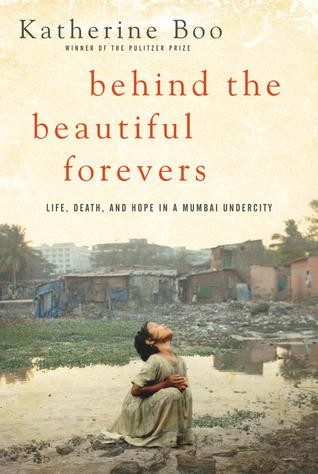
Behind the Beautiful Forevers
by Katherine Boo
Buy on AmazonThis enhanced eBook features exclusive video footage shot over the course of three years by the author and several children of the Annawadi slum. From Pulitzer Prize-winner Katherine Boo, a landmark work of narrative nonfiction that tells the dramatic and sometimes heartbreaking story of families striving toward a better life in one of the twenty-first century’s great, unequal cities. In this brilliantly written, fast-paced book, based on three years of uncompromising reporting, a bewildering age of global change and inequality is made human. Annawadi is a makeshift settlement in the shadow of luxury hotels near the Mumbai airport, and as India starts to prosper, Annawadians are electric with hope.…
Recommended by
"It would be impossible to answer that question at this moment without starting with Kate Boo’s 'Behind the Beautiful Forevers,' which is flawless. When I was on book tour last year I talked about it more than my own book."
By the Book: Anna Quindlen · nytimes.com
"Katherine Boo did this so powerfully in her Mumbai masterpiece, Behind the Beautiful Forevers. I still remember her description, through a low-income character's eyes, of walking into a hotel and seeing rich women carrying handbags as big as household shrines."
By the Book: Anand Giridharadas · nytimes.com
"“Behind the Beautiful Forevers,” by Katherine Boo, about life in a Mumbai slum. It’s nonfiction that is as riveting as a great novel — so absolutely exquisite that it made me sort of sick."
By the Book: Anne Lamott · nytimes.com
"because it provides such a frank, compassionate, unsparing portrayal of the experience of poverty."
By the Book: David Leavitt · nytimes.com
"I'm astonished and moved to see how she intimately engages and clearly depicts the lives of people living in a slum village next to the airport in Mumbai."
By the Book: Elaine Pagels · nytimes.com
"Katherine Boo’s “Behind the Beautiful Forevers.”"
By the Book: Salman Rushdie · nytimes.com
By the Book: Siddhartha Mukherjee · nytimes.com
"I’ve been meaning to read Katherine Boo’s “Behind the Beautiful Forevers” for a long time. I’m saving it for my next plane trip."
By the Book: Tom Perrotta · nytimes.com
"Yes. The last two books I’ve given you are about Mumbai, and all of the books I’ve given you also are, to a very large degree, about Mumbai as well. Ambedkar’s political career unfolds in Mumbai. His house is not far away from where I’m talking to you right now, and it’s still, today, a place where people go either on pilgrimage or to venerate the political ideas that he stood for. If you read Guha’s India After Gandhi, a good part of the economic, political, and social activity it describes takes place in Mumbai, especially when he talks about India’s urban transformation. If you look at Metcalf and Metcalf, again, Mumbai is a central character in the story of the development of modern India. Maximum City and Beyond the Beautiful Forevers look at contemporary Mumbai, which is the place that I’ve fully lived in for the past five years. Since I’m not a native Mumbaikar, these two books have been useful for me to understand the city that I live in and the city that I study. The reason why I picked Beyond the Beautiful Forevers is that it is a great book to understand the widening differences that you see playing out every day in Mumbai between the rich and the poor, the privileged and the non-privileged, those people who have things like recourse to the law or access to proper schools and hospitals and those who don’t. It’s an account of the lives of various individuals, in a slum that I believe no longer exists. It was taken over in the early 2000s to expand the international airport, which, again, is a telling commentary on where a lot of people get shunted out from the story of modern India. It is an account that is remarkable on many levels. First of all, the detail that Boo was able to bring to us about the lives of these individuals (who, more often than not, are written out of newspapers and written out of historical accounts) is quite dramatic and really is a testament to her journalistic skills. It is written in a very detached manner. Nevertheless, you can detect the author’s anger and frustration at the sheer injustice that these people face. Of the several characters in the book, many die. Some die horrific, violent deaths. For an outsider like her, someone who is not from India, not from Mumbai, chronicling this in a book and doing so in an objective manner, where her goal is just to set out the larger framework of why bad things are happening to these people without getting caught up in the tragedy of their lives, is quite an achievement, in my opinion."
Modern Indian History · fivebooks.com