Will McMorran's Reading List
Will McMorran is a translator and senior lecturer In French & Comparative Literature at Queen Mary University of London.
Open in WellRead Daily app →The Marquis de Sade (2017)
Scraped from fivebooks.com (2017-03-15).
Source: fivebooks.com

Marquis de Sade · Buy on Amazon
"That’s a very good question. The 120 Days is essentially unreadable in every possible way. Unreadable in the sense that it’s hard to read, unreadable in the sense that it’s upsetting to read, and unreadable also in the sense that it’s difficult to decode. It’s easy to forget about authors when they’re well behaved. But when you’re dealing with an author you don’t entirely trust, you become much more aware of him as a figure. And when the fiction is extreme, as it is in Sade, then we do think about intentions more. “It’s easy to forget about authors when they’re well behaved. But when you’re dealing with an author you don’t entirely trust, you become much more aware of him as a figure” To complicate things further, I suspect that those intentions may have changed during the writing of the 120 Days . The state of the manuscript is relevant here. The introduction and the first part are more or less finished. If you read the end of the introduction and part one, yes, it’s shocking and there are unpleasant things in there, but one can just about imagine it being published. The rhetoric is quite polished, the style is quite formal, and it feels like a realised piece of fiction. Thereafter it becomes more and more extreme, and increasingly unpublishable—certainly in 1785. So it’s difficult to say what he’s trying to achieve. I can see why you’d ask if it’s just a kind of exorcism or fantasy of a prisoner living in an incredibly confined space. Another way of asking that question is: who was the intended reader of that text? And it may well have been Sade. There’s an allusion, towards the end of part one, where he suggests that he was imagining a publication in four parts and says, if the reader is still interested then I will publish the rest. He may have held on to the idea of it being a publishable text at that stage. But then he must have abandoned the idea of publication and at that point the text became something else—maybe a test for himself to see how far he could go. It’s very striking that he writes it in a very short space of time – he writes it in thirty-seven days. Our translation took a lot longer than that! There is just this outpouring of escalating violence. It’s a really strange text. On one level, you can see it as a collection of stories. Had it been fully realised, it would have gone on to be thousands of pages long. It’s a sort of Decameron in its conception, with the classic set-up of a storytelling frame. It’s very important to acknowledge that it’s a work born out of his imprisonment and this informs the kinds of spaces that we get in the novel. He’s writing in a prison cell in the Bastille and the fantasies in the novel revolve around enclosed and subterranean spaces. And he does recount the plight of prisoners. And this raises the question: is he identifying with the libertines or the prisoners? And you’re right to say it’s a work of fantasy. It’s not a realist novel. So, who knows? Did it have some therapeutic value for him? Possibly. He was mentally unwell at the time he wrote it, and there is evidently an obsessive quality to the cataloguing of perversions. Yes, there’s grotesque exaggeration. One of the challenges for modern readers of Sade is that they are used to novels. We have a sensibility that’s informed by nineteenth-century fiction where you have characters drawn with psychological depth — characters with whom you empathise, whose fortunes you follow and so on. Sade’s fiction is more early modern than modern. It’s less to do with characters than types. You get these amplified figures, these exaggerated figures, like Gernande the vampire, or the giant Minski in Juliette —and they are all representing a particular quality or vice. Justine and Juliette are the same in that respect. Justine is an emblem of virtue, and for modern readers she feels like a character with whom we should empathise—particularly when all these horrible things happen to her. But our empathy is probably not one that an eighteenth-century reader would have had. So, there is a sense in which our habits of reading fiction are not those that Sade would have anticipated. The plot is simple and horrifying. There are four libertines who each represent the four pillars of French society. You have a Duke, a Bishop, a financier, and a judge. The novel describes the four months they spend in a castle one of them owns in the Black Forest, locked away with harems of teenage boys and girls, some old crones, some well-endowed “fouteurs” or “fuckers” and some other servants. They also take with them four experienced prostitutes who are there to act as storytellers. Over the period of one hundred and twenty days, the four libertines listen to various “passions”, and then enact them. There is an escalation of violence, and over the one hundred and twenty days, the passions become increasingly extreme and most of the prisoners are murdered. It’s basically like The Canterbury Tales or The Decameron , the classic locus of people shutting themselves away from the outside world and listening to stories. The difference with Sade is that they perform what they hear. The castle moves, oddly. It starts off in Switzerland and then he changes the location to Germany. There is a fairy-tale aspect to the location: the forest has always been a richly significant space in storytelling. It’s the space in which the rules of the everyday world are suspended and where extraordinary things happen. What Sade emphasizes in the introduction is the sense of isolation from the outside world. It’s not just that they’re in a forest but they’re in a castle surrounded by a plain which is itself surrounded by mountains within that forest. It is a place of absolute isolation from the outside world. There’s the strange kind of paradox that you get with Sade that by locking yourselves up you can be free. And he creates these spaces of isolation in all his novels. One of the things that defines pornography is an intention to arouse the reader or spectator, but it’s not entirely clear if this is the case here. It might have been intended to arouse its author—who was also its reader, its only reader for a long period of time.It’s complicated by the fact that what seems to be the driving force in the 120 Days is that it is not interested in anodyne passions. It is not interested in run of the mill sexual desires. It takes for its subject perversions—what we could call paraphilia these days. The narrator says in part one, I’m presenting you with six hundred dishes. You’re not going to like all of them but they’ll be one there that you will like. And if that’s the case he’s got you: you lose any moral high ground if he finds the one you like. But the truth is that many if not most readers will find no such passion. Even Sade’s staunchest defenders have lamented the obsession with coprophagy and coprophilia. That material will have a niche audience, but it’s certainly not designed to have broad appeal. I think what drives the cataloguing of perversions is not so much the desire to arouse but the desire to transgress, and to fantasize about transgression on a massive scale. It may seem bizarre, but the 120 Days was presented by sexologists as a work of science—which tells you the dodgy ground sexology was on at the turn of the twentieth century. But you can almost see why, because there is some sort of attempt at systematization. Passions are divided into four different categories within which there are these almost endless variations. The whole very much takes the structure of a catalogue—so it does read like an early version of the Psychopathia Sexualis (not a flattering comparison for the latter it must be said). “There is a certain amount of trepidation about putting something out there which is still, one could argue, the most extreme work of fiction ever written” So, sexologists promoted the idea that it was a work of science and nobody questioned it—because nobody other than a few hundred readers had access to the text (it was initially published in a very limited and expensive private edition). The myth of the 120 Days as a work of science endured right into the 1950s and even 1960s, with Sade talked about as a precursor to Krafft-Ebing and even to Freud. It seems ludicrous now: many of the passions are simply twisted ways of killing people—with no sexual element at all. Some of the passions are horrible and shocking and upsetting, but others are just surreal and strange.It’s not a uniform text and, in that respect, you can’t really have a uniform response to it. But overall I don’t think it’s a text driven by the desire to arouse the reader. It may be to shock the reader, which goes back to your question, or at the very least there is a desire to broaden the reader’s horizons. Whoever that reader may be… Sade wrote it in the Bastille in 1785 on bits of paper that he glued together to form a scroll, which he then hid in a cylinder. Although he only wrote an incomplete draft he never returned to it at any point in the next four years. He had the opportunity to finish it but never did.Then he was overtaken by events. Just before the Bastille is stormed he is moved to another prison in the middle of the night—he says, naked—and is not allowed to take all his affairs with him. He pleads with his wife to fetch his belongings but the day she goes is the day the Bastille is stormed.It’s difficult to separate fact from fiction here but that scroll disappeared either in between him leaving and the 14th July or during the storming of the Bastille. Either way, it was pilfered and sold to another Provençal aristocrat. It remained in the hands of his family for the rest of the nineteenth century. So, for a couple of generations, it was a well-kept secret.Then a German collector acquired it and a sexologist called Iwan Bloch published it for the first time in 1904, but in an edition riddled with errors. Almost thirty years later, Sade’s descendants bought the scroll and Maurice Heine completed a proper transcription and published an edition in the 1930s. He was the last editor to see the scroll in its entirety, and the only one to publish the novel uncorrected. All the French editions since his edition have corrected all the little errors and tidied up the punctuation. So, the fact that it’s a draft—not a completed novel—has been eroded by those subsequent editions. That’s why, in our translation, we tried to get back to the “draftness” of it. We kept the mistakes and tried to stay as close as possible to the original syntax. The Sade family kept the scroll until the 1980s and then a bookseller friend of theirs offered to have it valued. He smuggled it over the border to Switzerland and sold it to a collector called Nordmann. Legal wranglings ensued for the next three decades, essentially. In 2014—the bicentenary of Sade’s death—a private foundation bought the scroll for 7 million euros, brought it back to Paris, and exhibited it. But the director of this foundation is now being investigated for fraud because of the dubious ways in which he raised funds, and the foundation has been closed down. The scroll is now under lock and key and is likely to be sold as an asset. It’s come full circle, really. It started its life in prison and now it’s gone back there. I suspect—I hope—what will happen next is that the French National Library will buy it and make sure it never leaves France again."

Marquis de Sade · Buy on Amazon
"This is Sade’s version of Pygmalion, really. And, being Sade, it’s a fairly twisted version of Pygmalion. It’s the story of Franval, a libertine who marries a beautiful young woman but his interest isn’t really in her, but in the child he wants to have with her. So the Pygmalion myth of a man falling in love with his own creation is played out in this text as a father-daughter incestuous relationship. Franval raises his daughter in isolation from her mother and the outside world, and creates his own curriculum for her education—a little like Rousseau in Emile . Sade perversely presents Franval as progressive—for example, he refuses to have his daughter dressed in restrictive corsets and so on. But then there’s obviously a less than progressive reason why he prefers her in loose clothing… As Eugénie grows up she falls in love with her father, and the story becomes a battle between the Christian values represented by Eugénie’s mother and the libertine values represented by the incestuous lovers. Eugénie says to her father, “I was not afraid to defy customs which, since they vary from country to country, cannot be considered sacred”. Sade is very keen to point out that different cultures have different values and thus that there are no absolute values. There are different debates going on in that short story. The priest, Clervil, serves as a spokesperson for Christian morality, and Franval often uses moral relativism to push back against Catholic doctrine. But I think you’re right: underlying it is a kind of amoralism. There’s a sense in which Eugénie is free because she’s kept away from all of these moral prejudices. There is this contradiction in the text in which she’s presented as a character who is utterly free from all contamination by religion or morality. At the same time, from a different perspective, she’s obviously the product of a very tightly controlled and manipulated environment in which her father has been the dominant—and abusive—figure. I don’t think anyone ever convincingly converts in Sade. Whenever a character converts it’s always for reasons of respectability. Sade published “Eugénie de Franval” in a collection called The Crimes of Love and did so under his own name. He was now trying to become a respectable man of letters, so evidently he needed to have his villain recant at the end. And the circumstances in which he does so are rather odd: Franval gets caught in a thunderstorm and suddenly realises the error of his ways. And his conversion is pretty creepy too—the text talks about him profaning the dead body of his wife. This is Sade being respectable-ish. What’s striking in the edition that you will have read—in the excellent translation by David Coward—is that there are two scenes which Sade cut from his edition. There’s one scene in which Eugénie tries to seduce the priest, and there’s another extraordinary scene in which Eugénie is literally put on a pedestal and offered as a spectacle to Franval’s best friend, Valmont—the classic name of a libertine. Put politely, it is a scene of pornographic consumption and masturbation. “Eugénie de Franval” is a fascinating text because it’s Sade writing for a public readership and just about staying within the bounds of decency. I chose it as a kind of contrast to the 120 Days, to show that there’s another side to Sade. There’s the Sade that’s seemingly unrestrained and unchecked. His dictum in the 120 Days and other writings is “tout dire” (say everything). That said, he doesn’t actually tell all in 120 Days : he keeps little secrets in the text. There are little closets in the castle which remain closed to the reader. So, even when he’s at his most excessive, he still creates the illusion of keeping a little in reserve. But in “Eugénie de Franval” it’s him working within much tighter constraints. He wants this story to be read. So, there’s an interesting dialogue going on between the narrator and his readers but there’s an even more interesting dialogue going between the lines and that’s between Sade and ourselves. That’s a tricky one. Is it the narrator who is unreliable or is it the author? We’re used to the idea of an unreliable narrator—a narrator we can’t trust. The classic unreliable narrator is one who may be lying or mistaken as to the truth. With Sade, I’m not sure whether the narrator is unreliable. The narrator is doing a certain kind of job. The problem is that we’re worried about the author being unreliable. If this story were not by Sade, we would have fewer concerns about the narrator being unreliable. We might be a little suspicious, but we tend to assume, lazily, that authors have good intentions; that when a moral point is being made, it’s being made sincerely. The problem with Sade is that you don’t have those certainties any more. There seems to be hypocrisy in this story. But how much of that hypocrisy is the source of our own suspicion? “With Sade, I’m not sure whether the narrator is unreliable. The problem is that we’re worried about the author being unreliable” There’s a very interesting bishop called Jean-Pierre Camus who wrote short stories very much like Sade but a century earlier. If you read these you find exactly the same moral tone that Sade adopts, and equally lurid content. But he’s a bishop. So, we don’t dismiss him as a hypocrite quite as quickly as we do Sade—depending on how we feel about Catholic bishops of course. So assigning unreliability is complex in the case of Sade’s fiction: it’s difficult to know how much of our suspicion comes from the text and how much comes from our own preconceptions about Sade. Absolutely. In terms of mothers, it’s often said that Sade hates mothers. Sade was never close to his own, and had a terrible relationship with his mother-in-law, obviously, given that she put him in prison. But there’s a recurring theme in Sade’s fiction—and particularly in Philosophy in the Boudoir —about severing the sense of connection between generations, and between mothers and children in particular. It’s striking that in “Eugénie de Franval,” Eugénie is separated from her mother for the first seven years of her life and has no feelings of gratitude for being brought into existence by her. In other works this extends to the relationships between fathers and children too: why should we be grateful to either of our parents for simply indulging their sexual appetites? As for Franval and Eugénie, there is a sense in which Franval falls in love with his daughter, as she does with him. It’s not just a sexual attraction but an intellectual one: she is a perfect embodiment of his philosophy, and the perfect opposite of her virtuous, repressed mother."

Roland Barthes · Buy on Amazon
"I chose it not because I agree with very much of it, but because it’s been the most influential work of Sade criticism. If you were to pick out the one book that brought Sade in from the cold, I think it would be this one. So, it has a historical importance in terms of the reception of Sade in twentieth and twenty-first century culture. And, in many ways, it’s still where Sade criticism is today. The first chapter in Sade/Fourier/Loyola was published a few years earlier, in 1967, as an article. Barthes then published this book in 1971 with additional material on Sade. It comes at a really important time. For the first half of the twentieth century, Sade had only been read by very select group of wealthy, bourgeois, male readers. It’s only in the 1960s and early 1970s that Sade becomes accessible to the public, in cheap paperbacks. Barthes’ article-then-book on Sade is a crucial intervention, and it’s not a coincidence that he writes “The Death of the Author” at the same time. There’s a strategic reason for killing off the author when the author you’re reading happens to be a criminal. By killing off the author, Barthes kills off all the reasons why you can’t read Sade. And it’s a lot easier to read Sade’s fiction if you separate the life of the author from the life of the work. Sade/Fourier/Loyola set the tone for subsequent Sadean criticism for the next few decades. The central argument in Barthes’ book is that it’s a mistake to read Sade as anything other than words. Anything other than language. It’s semiosis not mimesis, he says. He eliminates all the reasons Sade was unreadable beforehand—the violence, the horror, the nihilism. For him, it’s just black ink on a white page. “By killing off the author, Barthes kills off all the reasons why you can’t read Sade” He says famously in Sade/Fourier/Loyola : “écrite, la merde ne sent pas”—“written down, shit doesn’t smell” and that the only universe in Sade is the universe of discourse. In other words, it’s harmless. What he’s effectively doing is severing Sade’s works from the real world. He’s providing a safe sanctuary in which you can look at this stuff without worrying about it. And there’s lots of interesting analysis that come out of that. Barthes shines a light on all sorts of different signs and codes in the text and so on. And a long line of critics follow and repeat the Barthes line—that the violence is linguistic—right into the 1980s and beyond. There are still many today who prefer to focus on language rather than content. A few years ago, I was at a conference on violence in the eighteenth century, and I was very struck by a critic choosing to talk about the word “violence” in Sade’s fiction rather than actual representations of violence. That is very much the Barthian approach: you focus on a word. But it seems perverse to me. I’m not saying that Sadean language isn’t interesting, but the reality is that’s not what draws readers to Sade. One of the jobs of the critic is to convey some sense of what it is like to read a particular text. And Sade criticism largely fails to do that. The model for literary criticism has long been science, so we talk about analysing and dissecting a text and so on. This encourages rigorous thinking and that’s obviously good, but there’s a sense in which it’s missing something too. There is still a defensiveness which leads some Sade critics to emphasise the scientific aspect of their interest in Sade. They want to be seen as scientists in white coats, not perverts in dirty macs—clinical, not sexual. Although the emphasis in Sade criticism has shifted from the linguistic to the historical, the latter approach also keeps Sade at a safe distance. Sade is neutralized and the reader is simply left out of the picture. The problem with Barthes’ approach is that it talks about words on the page but never about the reader who reads them, visualises them, and lives with them in their imagination. Barthes actually evolved from this position, but Sade critics didn’t really evolve with him. For example, they still largely refuse to discuss Sade’s biography. “The problem with Barthes’ approach is that it talks about words on the page but never about the reader who reads them, visualises them, and lives with them in their imagination” So, in one corner you have Sade’s biographers and in another you have Sade’s critics but there’s no interaction between the two. It’s seen as vulgar to raise the life in relation to the works. There’s a strange sense in which all the things that I think make Sade’s fiction fascinating—all the things that readers notice and are shocked by—are exactly the things that we don’t talk about. That seems like a wasted opportunity to me, really. It’s a shame that Sade is hardly taught anywhere—in France or in England. My suspicion is that the linguistic or historicising approach adopted by Sade critics would get short shrift from students. If you try to teach the Barthes line to your students, they will simply stare at you in disbelief. This idea of examining the text in complete isolation from the experience of reading that text wouldn’t wash anymore.I feel very lucky to have been allowed to teach Sade, and there’s no doubt it’s shaped my thinking about him in all sorts of ways. I also suspect there’s a reputational concern that has prevented some critics from teaching Sade. For others, it’s simply awkward and embarrassing—particularly when you’re a middle-aged man teaching largely female cohorts of students. You can’t help but be—you need to be—self-conscious about teaching Sade."

Angela Carter · Buy on Amazon
"This was written a few years after Sade/Fourier/Loyola , and Carter had obviously read both Barthes and Foucault. You can read Foucault between the lines throughout The Sadeian Woman. Carter is a fascinating writer in all sorts of ways. She was one of the first English writers to engage with Sade—who was a banned author in England at the time she was writing because of the moral panic that followed the Moors Murders (when it transpired that Ian Brady had read Sade’s Justine). It’s also a time when second wave feminism is starting to exert its influence on Anglo-American culture, and in fact Sade becomes a highly contested figure within feminism at this time. Support Five Books Five Books interviews are expensive to produce. If you're enjoying this interview, please support us by donating a small amount . On the one hand, we have Angela Carter’s book on Sade in 1979 and on the other Andrea Dworkin’s Pornography , dedicated to Rose Keller, and with a really interesting chapter on Sade. And Dworkin is furious with Carter for her book. There’s a heated debate between these different strands of feminism around the power of pornography and the relationship between violence and pornography.Sade becomes a totemic figure in this debate—a poster boy for pornography and violent pornography at that. He is seen by both Carter and Dworkin as the true face of men lurking behind pornography. But Carter recuperates Sade for female readers, which seems a really counterintuitive move in all sorts of ways. She’s not the first to do so. The French poet Guillaume Apollinaire compiled a little anthology of selections from Sade in 1908, and in his introduction to that he talks about Justine and Juliette as two different visions of womanhood, the former subjugated and the latter liberated. He famously describes Sade as “the freest spirit who ever lived” and as someone who wanted women to be just as free as men. As strange as it may seem, Apollinaire is presenting Sade as a kind of proto-feminist, and it’s striking that Carter quotes him in The Sadeian Woman. Carter is obviously fascinated by Sade, and deeply influenced by her reading of his fiction— The Bloody Chamber has Sade all over it. And Carter is fascinated by Juliette in particular, by this figure of female power—a woman of action. Juliette becomes a model for some of the female protagonists in The Bloody Chamber . What also interests Carter is Sade’s acknowledgement of women as sexual beings—something which she thinks is revolutionary. There are issues in terms of the historicity of all that, and I think Sade is slightly less revolutionary than she thinks, but she is right to talk about Sade seeing sexuality as being at the heart of human identity. And Sade is certainly interesting on women. Carter’s reading of Sade is idiosyncratic and provocative, but it’s no less brilliant for all that. It’s not a historicised reading of Sade, it’s using Sade and thinking about Sade in relation to the moment at which she’s writing. It’s basically two cultures being thrown together and seeing what comes out of it. Dworkin coruscates Sade critics for minimising his violence against women and she’s right to do so. She goes too far in all sorts of ways but she’s a good polemical writer. She is brilliant on Roland Barthes’ dehumanisation of Rose Keller. In Sade/Fourier/Loyola , Barthes says that what fascinates him about Sade is the little details, like the fact that instead of saying “mademoiselle” he says “milli”, a Provençal variation. Barthes says he is also fascinated by the “white muff” in the account of the Rose Keller affair. Dworkin rightly notes that Barthes marginalises Keller and her suffering—she disappears from the picture and he focusses on the objects. So, there is a sense in which Sade’s critics simply duplicate the misogyny that they read. Then Dworkin attacks Carter, but less successfully—she underestimates her. Carter is not saying Juliette is how women should be—she expressly says she is not a model for female behaviour—but she is saying that through Juliette Sade dismantles myths about womanhood (myths of maternity and so on). For Carter, the fact that sex in Sade’s fiction is for recreation not procreation is important, and useful; she puts Sade to work in the service of women and that’s a really interesting idea. I like the idea of “An Exercise…” because I think there is a sense in which she is trying something out. And it’s not perfect, but there are these fascinating little insights that are just thrown up throughout. She talks about the moral strength of the victim in Sade, for example. It’s also striking that the most compelling literary criticism on Sade has been by women: somehow women have found it easier to write about Sade than men. Maybe it’s because they are not incriminated in the same way by it. “It’s also striking that the most compelling literary criticism on Sade has been by women” This is true of the academic study of pornography more generally too. Linda Williams, who wrote a pioneering study on pornography called Hard Core , said a few years ago that the most interesting work in that field has been almost entirely produced by women or gay men. Straight men have not done very well on the subject, and I think the same thing has happened with Sade."
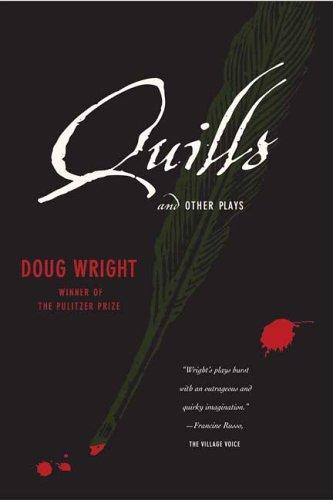
Doug Wright · Buy on Amazon
"I thought it would be interesting to have a creative response to Sade as well as a critical one. Creative responses to Sade have been a mixed bag. Most Sade adaptations have been pretty awful—with the exception of Salò —and films about Sade have not been very interesting either. But “Quills” engages with Sade in intriguing ways. It plays fast and loose with the facts, and is completely—wilfully—inaccurate historically, but that doesn’t bother me. It homes in on what’s interesting about Sade in a way that academic criticism doesn’t always, and in particular plays out a debate about the power of fiction over the reader. Obviously, it’s not going to side against freedom of expression, but it does explore the idea of fiction as something dangerous, as something that can change us. There are some very interesting scenes in which the act of reading is staged and shown to be performative rather than passive. There’s one scene in which Sade, without pen and paper, has to relay his words orally from one prisoner to the next until it reaches Madeleine, who transcribes them. And there’s another scene in which Sade has written a story on the walls of his cell—a really anodyne story with no sex or violence. But the director of Charenton, Royer-Collard, interprets it as a story about his wife’s infidelity. So it shows how much a reader brings to a text, and how subjective our interpretations are. In fact, the story is open to all sorts of other readings: it’s about Sade’s love for Madeleine, and it’s also about the power of fiction. it’s a really telling example of what can happen to a story in the hands—and minds—of different readers. I think that’s why I chose it. It shines a light on the reader, and that’s what Sade critics haven’t done very well at all. The translation was interesting in that respect. I’d been working on Sade—and teaching him—for a while by that time, but putting something like the 120 Days out there into the public arena is different because you don’t have the same kind of control. When I’m teaching, I’m setting the tone in the classroom and asking students to think about Sade’s works in a particular way, so there is an element of direction. The only equivalent for that when you’re publishing a translation is the introduction, but how many people actually read introductions? Probably not that many. So, there is a certain amount of trepidation about putting something out there which is still, one could argue, the most extreme work of fiction ever written — and all the more so because I don’t dismiss the idea of texts having negative effects on readers. It’s not like I think it’s completely safe. That said, because it’s such an extreme text, that strangely makes it slightly easier: there are other works by Sade which are less extreme but potentially more unsettling. Get the weekly Five Books newsletter The 120 Days is not a seductive text in any respect: most readers will simply be horrified and revolted by it. And what we tried to do in our translation was to make it as horrible and as upsetting in English as it is in French. I can’t imagine censoring Sade for an adult readership. That said, would I want my children to read it? No. Do I warn my students before inflicting it on them? Yes. That’s a big question and it’s the sort of question that’s treated very differently by literary critics and analytic philosophers. The problem with literature—and this is the sort of thing that analytic philosophers don’t always acknowledge—is that the same text can be interpreted even by the same reader in different ways. What a question like that often ends up being about is authorial intention. The problem with Sade is that it’s very difficult to know what those intentions might have been, and I’m not sure it matters. “The 120 Days is not a seductive text in any respect: most readers will simply be horrified and revolted by it” For me, the question is less about the moral value of a text but the moral value we can extract from it. There are ethical questions raised by the reading of Sade because these are texts predicated on violence and we are party to that violence on some level. The critic Marcel Hénaff said that “to read Sade is to conspire with him” and that’s the kind of dilemma that I think about an awful lot. How can we read a vicious, misogynistic text without becoming complicit? And it’s something my students and I discuss a great deal. So for me reading fiction is—must be—an ethical as well aesthetic experience. The two are inseparable."