Tommie Shelby's Reading List
Tommie Shelby is the Caldwell Titcomb Professor of African and African American Studies and Professor of Philosophy at Harvard University. He is the author of Dark Ghettos: Injustice, Dissent, and Reform (2016); and We Who Are Dark: The Philosophical Foundations of Black Solidarity (2005).
Open in WellRead Daily app →Prison Abolition (2023)
Scraped from fivebooks.com (2023-05-25).
Source: fivebooks.com

Peter Kropotkin · Buy on Amazon
"My first choice is Peter Kropotkin’s In Russian and French Prisons , published in 1887. This could be regarded as the first book-length defense of prison abolition, though no doubt there’s some out there I’ve missed. Kropotkin was a revolutionary and an anarchist theoretician. One reason I chose this book was to highlight the anarchist strand of abolitionist thought, which opposes all forms of government. Also with Kropotkin, this is a person who spent two years in a Russian prison, and three years in a French prison. He’s drawing on that experience in addition to his broader theoretical point of view as a communist and a person who supports decentralized communities. This is a good point you raise here. He is a kind of communist, one that favors fairly small communities of workers sharing the work and sharing the product of that work in an equitable way, consciously attending to each other’s needs. It’s not a community of strangers. It’s not mass society. So it’s a particular way of thinking about what it means for us to live with one another in a way that’s just and humane. Obviously, if you expand out to the kind of societies we now mostly occupy, which are large, multimillion and multiethnic political communities, they don’t really have that kind of structure. And you can see why prison might arise as a way to respond to this circumstance. Kropotkin also has—most abolitionists do—a theory of crime. He thinks crime is partly a matter of environmental factors or climate factors, and it’s partly a matter of untreated illness, both physical and mental, that needs to be attended to. But probably most important in terms of his critique of prisons, he believes that the big cause is the way society itself is organized. Having a mass capitalist society is very impersonal and anomic. It’s not surprising that you’re going to have these kinds of problems and then develop this instrument, the prison system, to deal with it. I think that’s right. What I find most interesting about this book is the way he talks about what the prison does to people. He thinks of the prison as an instrument that deforms the will of prisoners, making them less able to resist temptation and antisocial impulses. That’s partly because of the authority that prison officials have over people and the way they abuse that power over those in their care. But it also has to do with the way prisoners live in the environment of the prison, where they don’t have opportunities to practice resistance to the temptations of social life, to learn how to develop their sense of autonomy as rational agents, to hold those baser impulses in check. Kropotkin believes the structure of prison actually makes people worse, and I think that’s an interesting line of argument. Yes, that’s his position."

Eugene Victor Debs · Buy on Amazon
"Born in Indiana, Debs was a socialist and labor organizer, a radical but also a politician. He ran for public office many times, including for President of the United States on the Socialist Party ticket. He also spent time in prison. One of the things you get in a lot of prison abolitionist writings, and certainly in Walls and Bars, is an emphasis on how often imprisonment is used as a method of political repression. It’s a way for those in power to neutralize popular leaders who dissent or are resisting the way society is currently organized. As a radical labor organizer, Debs was often strongly at odds with those in power and found himself in prison as a result. He was a very influential figure in the broadly American socialist tradition, though if you read this book you’ll hear familiar notes from Marx and earlier British socialists, as well. He does. Interestingly, he thinks that in a more humane society, a socialist society, there wouldn’t be prisons, and that’s the kind of society we should be trying to bring about. He does, however, have a lot to say about how, in the meantime, the internal life of prisons should be reorganized. He imagines a very different way of structuring them, where prisoners have much more self-determination, much more control over what’s happening inside, and participate in the running of the prison. The central thesis of the book is something like this: capitalism causes poverty, which causes crime, and the prison system then becomes necessary to protect capitalist control over productive assets and the conditions of work. So that’s largely what he’s trying to establish. Something that runs throughout the book is the thought that what we’ve got is a system that creates people who are impoverished and desperate and who live in precarious communities, strained in ways that lead them to resort to criminal conduct, either to meet their various needs or sometimes because they’re angry and resentful about their conditions. They find themselves in prison, many worse off as a result, and then they’re let out with little in the way of rehabilitation, and just return to the same thing. And so the cycle in and out of prison is perpetuated. It’s not surprising, then, that you have these high recidivism rates. It often is. I agree with you it doesn’t have to be. One could simply emphasize the nature of prison conditions, how they are dehumanizing, how incarceration makes people worse, how it invites people to abuse their power, how it’s not effective at preventing crime, and so on. One could insist on these points without any commitment to Marxist philosophy. I think that anybody who wants to make the case for abolition and be persuasive to people who are going to be immediately very skeptical, you’re going to need to justify your position to them with some kind of theory of crime. You need an account of why people are behaving in these ways. We know that people sometimes do terrible things. Why are they doing them? Why should we think we could create conditions where they wouldn’t behave in those ways, or do so only very rarely? Marxism and the broader socialist tradition give you one sort of answer. Not the only answer, but one answer to that question, which is that we have a system of exploitation that impoverishes the people who create the wealth that the wealthy then get all the benefits from. And these same beneficiaries are largely able to avoid the prison system: when they do commit crimes, at times horrific crimes which harm many more people, they are able to buy their way out of the system with lawyers, and so effectively avoid having to serve time. So this creates enormous resentment on the part of working-class people. I think this is a very compelling explanation of at least a lot of crime — not all crime, but a lot of crime. I think that abolitionists, many of them at least, would these days say, ‘Look, this is a long-term project’. They’re not really imagining an abrupt break from the global capitalist system, but something that we will work at over time. They might even imagine that we’ll do this by prefiguring the form of life that we want to bring about in smaller-scale communities, a proof of concept, in a way: ‘Let me show you that you can live in ways without such heavy reliance on policing and prisons and surveillance. And yet, it would be peaceful.’ That’s the kind of thing you might scale up and convince others to reorganize society on the basis of this success. Prison abolition needn’t be revolutionary, though it often does have that orientation. That’s absolutely right. It’s probably one of the reasons why a lot of abolitionists think of abolition as a long-term project, because in addition to fighting against an ethos of competition and domination which you might associate with capitalism, as we know it, you also have to fight against an ethos of retribution and retaliation and ramping up of punishments in response to people’s harmful wrongdoing. That takes work too, to get people to relinquish that way of responding. It’s natural to respond in that way: it’s a familiar human disposition to be angry and resentful and to want to strike back against those who do wrong, including those who harm our communities. But we must work through that—as we do with many other impulses that are anti-social or destructive—to a different way of thinking about human wrongdoing and the harm it does. We need to respond in a way that’s not only more effective, but also just more humane, in a way that understands human frailty, in a way that understands the environmental conditions that lead people to behave in these ways. We need to create the conditions for reconciliation between those who do wrong and those who are harmed or survive that wrongdoing. So prison abolition will inevitably involve an attack on the retributive framework."

Michel Foucault · Buy on Amazon
"Yes, Discipline and Punish is more theoretical and abstract than a lot of abolitionist writing, and Foucault is of course not just attacking the prison system, but other social systems of domination and control that he thinks are attendant to it. He has large ambitions here in critiquing a central feature of modern social life, one that some people now call the carceral system or carceral ways of responding to others and controlling others. The way I think of it is that incarceration is the broad category of institutional confinement. We’re not talking about just locking people up in buildings; we’re talking about an institution that’s hierarchically structured, with strict rules of order, and uses surveillance and control of people’s movements and communication inside and outside the carceral facility. A carceral facility can be used for a variety of purposes. Sometimes it’s used to punish. But other times, it’s at least ostensibly being used for psychiatric treatment, or for rehabilitation, or for detention. Sometimes it’s used in the context of war, when trying to deal with prisoners of war, sometimes for a quarantine, when there’s a serious threat to public health. “Anybody who wants to be an abolitionist now must make gun control part of their position” You’ve got this broader system of confinement that’s a highly structured, hierarchical system with a lot of surveillance. This has the effect, so Foucault says, of not only directing and restricting the movements of those inside, but it can also restructure their souls, making them more docile, easier to control, more inclined to submit to authority, and the like. When he’s talking about a carceral system, I think he’s talking about that broader practice, though when I—and many others—talk about prison, we’re talking about a carceral system when it’s being used to punish, incapacitate, or rehabilitate those who are responsible for committing crimes. Both are deeply cruel. One is more brutal and more of a spectacle, a public spectacle; whereas the other is seemingly clinical and humane, though it functions similarly and does its damage less on the body and more on the mind. It’s cruel in a different way."
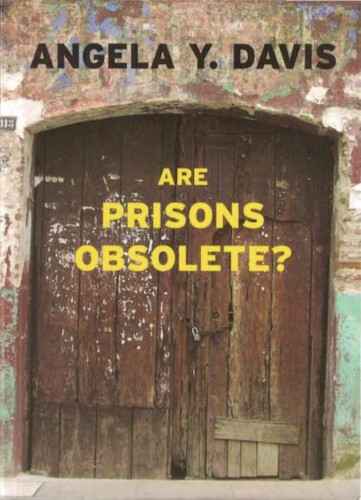
Angela Y. Davis · Buy on Amazon
"Or at least they should be made to be, yes. It’s partly for the reasons I’ve already mentioned. There are several abolitionist traditions. Davis presents abolition in the form that I find most compelling and makes me feel that I really do need to respond to the challenges this movement has presented. And that’s because she is situated within both the feminist tradition and the black radical tradition, and while her political philosophy is informed by Marxism and the Frankfurt School of critical theory, and even Foucault, she’s also drawing on a broader black intellectual tradition closely linked with radical feminist theorizing and practice. I find that synthesis of ideas powerful. I think of myself as in the black radical tradition and have been greatly influenced by Angela Davis’s work. I agree with her about many things, and so, naturally, I felt compelled to engage with her on this question. “While many existing prisons are deeply unjust, I don’t think that prisons are inherently wrong” Another aspect of this is that Davis is a philosopher, one of us, and so understands, in a way some abolitionists might not, the kind of thing I’m trying to do in my own book, where I’m thinking through the details of arguments, attempting to systematize ideas within a consistent set of basic principles, asking difficult counterfactual questions, trying to extract more general lessons from particular examples, and the like. The kind of thing philosophers like to do. She totally understands that. This common philosophical background makes her a more appropriate interlocutor than some other abolitionist thinkers. She herself, like some others we’ve talked about, has spent time in prison, as a political prisoner. She has been engaged in anti-prison activism for more than 50 years. I think of her as the leading abolitionist thinker in the black radical tradition today. I also feel that her work is too often ignored by philosophers, or not taken seriously enough. It’s important to engage with a figure like Davis, not least because she’s a black woman. How often do you find detailed, in-depth critical engagement with black women philosophers in academic philosophy? It’s rare, unfortunately. Davis is clearly writing for a public audience in a book like Are Our Prisons Obsolete? She writes as a scholar-activist, as an academic, but she’s not writing in a purely academic way. She is trying to raise political consciousness about this issue. And she’s not shying away from being explicit about what her political commitments are. She also draws on modes of argument and inquiry that don’t always have a natural place in academic philosophy, whether that’s memoir, personal experience, or using art, especially experimental art, or drawing heavily on history, to establish a conclusion. Some of these genres of writing are not commonly used in academic philosophy. That’s right. The most forceful arguments that she presents I would reformulate as arguments for a radical moratorium on the use of prisons in the US. By that I mean the view that we are faced with such grave systemic injustice in our society—as we’ve already discussed, so many of the people who find themselves in prisons are among the most marginalized, disenfranchised, and exploited—that we can’t justify using the prison system to control and confine them, at least not for many crimes. So we should dramatically ramp down — ‘decarcerate’ is the word abolitionists would use. We should really decarcerate, reduce significantly the number of people who are in prison to only the few who are causing great and irreparable harm or deep and lasting trauma. I think that a moratorium is different from a more radical abolitionist position, which would regard the use of prisons as always wrong, whether now or in the future. I think there’s also a question of whether in a fully just society, imprisonment would be a justifiable practice. Here I’m inclined to think it could be a justified practice, depending on how the prisons are structured and governed and provided due process requirements are followed. And I remain agnostic about whether we would in fact need prisons in a fully just society, whether we could actually make prisons obsolete, because I think it’s difficult to predict how big a problem we would face of serious aggression against others, even under much more egalitarian circumstances. So while many existing prisons are deeply unjust, I don’t think that prisons are inherently wrong. I believe they can be humane and used in a way that respects people as persons, and that in-prison services should be provided that will allow prisoners to reenter society as equals. We’re far from that ideal in many places. But I think it’s something that we could achieve, and there are some good examples that approach it in other parts of the world, particularly in Scandinavia. But we should also try to restructure our society so that we need prisons much less than we currently seem to need them, and experiment with other practices that are much less harmful to see if we can enhance public safety without resorting to such a severe and troubling practice. So I’m with Angela Davis on many things, but I don’t endorse the claim that a world without prisons would be the only just one."