Tanya Selvaratnam's Reading List
Tanya Selvaratnam is a writer, artist, and producer with more than 25 years of experience in the arts and social justice.
Open in WellRead Daily app →Domestic Violence (2021)
Scraped from fivebooks.com (2021-03-10).
Source: fivebooks.com

Rachel Louise Snyder · Buy on Amazon
"Rachel Louise Snyder has done groundbreaking work on this difficult subject and opened up a discourse about how domestic violence involves invisible harms. The bar at which domestic violence becomes a crime often involves visible bodily harm, but victims are broken down in many ways that are not visible. Abuse can be verbal, emotional and digital and legal. Snyder illuminates the failure of government to address this pandemic. There’s a statistic in the book, from the American Journal of Preventative Medicine, estimating that in the United States, the lifetime economic costs associated with intimate partner violence – including lost productivity from paid work, criminal justice and other costs – is $3.6 trillion. The United States spends 25 times more on studying cancer or heart disease than it does on the prevention of intimate partner violence, despite the enormous cost to our communities. Domestic violence is the number one reason for calls to 911, but it’s also one of the most underreported crimes. There is so much shame surrounding this issue in the South Asian community. It would be very difficult to get accurate statistics. And it’s very hard to talk about within the community. I know in my mother’s case, one of the reasons it was so difficult for her to get out is that she didn’t have enough resources, and there was so much stigma surrounding divorce amongst her generation."
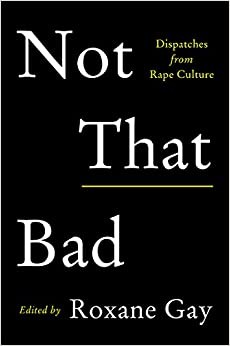
Roxane Gay · Buy on Amazon
"In the introduction to this collection of essays on rape culture, Roxanne recalls being gang raped when she was 12 years old and how she has learned to live with this trauma. She writes, “Those boys killed the girl I was, but they didn’t kill all of me.” She writes about what it is like to live in a culture where it often seems like it is a question of when – not if – a woman will encounter sexual violence. Not That Bad collects stories from multiple writers who have experienced sexual violence and highlights how prevalent it is and how important it is for us to share our stories so that we continue to take away the shame. The stigma comes from secrecy. Through storytelling, we realize that we are one of many, that we’re not alone, that we’re not crazy, and that this problem needs to be addressed. “She writes about what is it like to live in a culture where it often seems like it is a question of when – not if – a woman will encounter sexual violence” Part of addressing the problem is compelling media and social media to have more accountability for normalizing and facilitating sexual violence. When I heard from friends and strangers that they had also experienced slapping, spitting and choking, I thought these abusers are all steeped in media that glorifies violence against women . We need more female and feminist directors of porn that celebrate mutual pleasure and includes consent."

Evan Stark · Buy on Amazon
"Evan Stark writes, “To make contemporary women their personal property, the modern man must effectively stand against the tide of history, degrading women into a position of subservience that the progress of civilization has made obsolete.” Coercive Control is about a man getting his power fix through abuse and it’s about how intimate partner violence preserves patriarchy. My situation, with Eric, manifested this. He subjected me to his master-slave fantasies, which were flat-out racist. There needs to be a whole ecosystem change, that begins with education from a young age. Millions of women and men experience intimate partner violence before they turn 18. Parents need to talk to their children. We must make peace and kindness more exciting than violence and bullying. Female empowerment and anti-violence programs can play a role. On a legislative level, there need to be more repercussions for abusers. Laws need to be strengthened. I believe in restorative justice, when victims are willing. Law enforcement need to go through intimate violence training to have a more victim-centered approach. There also need to be increased government resources for organizations that provide shelter, legal services and mental health counseling for victims, survivors and their loved ones."

Carrie Goldberg · Buy on Amazon
"Carrie Goldberg is a warrior who was herself a victim of sexual violence. The stories she recounts of dates that turned violent in her own life are horrific. After one first date, she woke up with a swastika stitched into her bottom. Support Five Books Five Books interviews are expensive to produce. If you're enjoying this interview, please support us by donating a small amount . The book is about helping people deal with abusive partners, especially those who are victimized through digital means. It also calls out the technology platforms that proliferate violent and vitriolic content with total impunity. These tech companies are shielded from responsibility by Section 230 of the Communications Decency Act, which absolves social media platforms of responsibility for the content they disseminate. It’s either naive or nefarious that social media platforms, especially Facebook and Twitter, act as if they’re innocent. It is cognitive science 101 that the mind is malleable and repetitive messaging can twist minds. These social media platforms bear some responsibility for brainwashing. I think that there needs to be a class action lawsuit against them. There is a need for better education and public awareness about different forms of violence. This is something that Roxane Gay talks about in Not That Bad . She discounted what she experienced at ‘not that bad’ because others deal with more. I discounted my situation because I thought: what I’m experiencing is nowhere near as bad as what my mother experienced. She got black eyes while I just had a stinging cheek. I believe that the punishments should fit the harm. But there are not enough repercussions for the forms of intimate partner violence that don’t involve bodily bruises."

Gavin de Becker · Buy on Amazon
"De Becker witnessed horrific domestic violence as he was growing up. He felt guilty that he couldn’t protect his mother. As an adult, he made it his life’s work to protect others. This book is his effort to arm people with information to strengthen their physical and digital defenses. This book taught me about the difference between good fear and bad fear. Bad fear prevents us from living our best life. Good fear heightens our sensitivity to people, places and things that we should avoid. One might call it intuition. As de Becker explains, “when it comes to danger, intuition is always right in at least two important ways. One, it is always in response to something. Two, it always has your best interest at heart.” There need to be more governmental resources focused on gender-based violence. We need to look at the ways in which gender justice intersects with racial justice, with climate justice, with immigration justice. There is a lot of work to do, but it’s doable work. We just need resources to identify solutions that are more effective. To get those resources we need awareness. That is one of the reasons why I wrote Assume Nothing ."