Susan Jacoby's Reading List
Susan Jacoby is an independent scholar, speaker, and the author of a number of books on American intellectual history including the New York Times bestseller The Age of American Unreason and Freethinkers: A History of American Secularism. A new paperback edition of The Age of American Unreason will be issued in January 2018 by Vintage Books under the title The Age of American Unreason in a Culture of Lies.
Open in WellRead Daily app →Atheism (2013)
Scraped from fivebooks.com (2013-03-06).
Source: fivebooks.com

St. Augustine · Buy on Amazon
"St. Augustine is probably the most important father of the church. He is the person who most forcefully articulated the concept of free will when coupled with an all-powerful God, a philosophy which makes man solely responsible for bad things, and God and God’s grace solely responsible for everything good. Because there is also this argument that runs through Christianity historically about grace and what enables people to overcome their bad human instincts. In Augustine’s philosophy, which is the philosophy of the Catholic church and much of Christianity for a long time, it is only the grace of God. In other words the good things are attributable to God’s grace, the bad things are not God’s fault. That’s basically it. There were all kinds of early Christians who were later dismissed as heretics who didn’t believe in free will in the sense that Augustine did. This also meant they didn’t believe in an all-powerful God and it’s very understandable why they were called heretics. Yes, it’s one of those books that everybody talks about but nobody has actually read. It’s also a good book on abnormal psychology. When you read it, you realize Augustine was a brilliant, crazy person. It’s written in the form of a letter to God and where the personal narrative of Confessions ends is in a crazy place: Augustine is still very disturbed that although he’s taken a vow of celibacy (which he didn’t have to to be a Christian, at that point you didn’t even have to do that to be a priest) he still has wet dreams about women at night. One interesting thing is that Augustine also describes curiosity as the greatest of sins, but he’s curious himself. He’s very interested in the science of his day. So he comes up with quite a correct observation that your self-control when you’re asleep is not exactly what it is while you’re awake. Sleep puts a man’s mind into a different state, and he hopes that he’ll have enough grace from God eventually so he won’t even have these wet dreams while he’s asleep. That’s the note of hope he ends on. If you don’t think this is a little bit nutty for a man in the 4th century, a case of an overdeveloped conscience… The father of the church, one of the most important figures in founding Christianity, is really also a psychological case. And a brilliant man too. This crazy passage is preceded by a brilliant passage on memory in which he is asking some of the same questions that neuroscientists are asking today, but then he goes off on this tangent. Augustine was a psychologically disturbed person as well as a brilliant mind, which is, after all, not an unknown combination. The Confessions is a book that everybody should read. It is seminal, if you can excuse the expression."
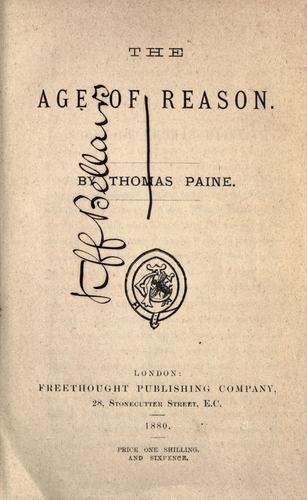
Thomas Paine · 1794 · Buy on Amazon
"Simply put, this book excoriates the idea that any religious book was written by God. They were all written by man, and while many of them have excellent principles, they are principles that any man can discern through his own reason. You don’t have to have all these supernatural events. He specifically mentions the Hebrew Bible , the Christian Bible and the Koran – the big three. These sacred books were written by man, and they can only be understood in terms of the period of history in which they were written. That’s all The Age of Reason is about, but it lost Paine all his positive fame. He was one of the most famous people in America because of his writing, which galvanized the colonists during the Revolutionary War . He lost all of that as a result of writing The Age of Reason , and he does die alone. No church cemetery will allow him to be buried there. The only religion he ever really admired were the Quakers and even the Quaker cemetery in New Rochelle New York wouldn’t let him be buried there. The Age of Reason ought to be uncontroversial today, but it’s not in America, simply because there are these 25% of Americans who believe that the Bible is literally true and that it was written by God. That’s the strange thing. The Age of Reason was on the Catholic Church’s index forever when there was an index, but I don’t think anybody would think much of it today in Europe. The idea that the Bible wasn’t something written by God is something that’s accepted by the vast majority of Christians. One of the things that’s useful about The Age of Reason – if you’re interested in the history of atheism – is that it really lays out the ground on which this battle was fought in the age of the Enlightenment. That’s really where the battle was joined. It lays out the grounds with its exploration of the Bible and who actually wrote it, and how it contradicts itself. He wasn’t the only one who did it, but he was the first to lay it out in large measure."

Richard Dawkins · Buy on Amazon
"Richard Dawkins is very funny. One of the reasons for reading The God Delusion is that it will disabuse you of the idea – which is a common stereotype of atheists – that they are utterly humourless. You hear this over and over again. I’m often invited to college campuses to give lectures, and often they’re religious schools – not fundamentalist schools, but colleges of a historically religious type. And very often I will hear: “Oh I expected you to be small and dark-haired and wear glasses!” The image of the atheist woman is kind of like what the image of the feminist used to be, someone too ugly to get a man. But part of it is also humorlessness. People will often say to me, “Oh you’re so funny.” “Well, yeah!” Dawkins also explains a lot about why he disagrees with people who reconcile science and religion. I agree with him on this. I actually do think they are irreconcilable. I know lots of people who have reconciled them, but that’s only because the human brain has this incredible capacity to believe two contradictory things at the same time. That is how people are able to reconcile science and religion. But really they’re hard to reconcile, and I think when you read Dawkins he explains that very well, why you when you say “I’m religious but I also believe in science,” you’re kind of avoiding the question of the ways in which scientific reality provable as by natural experiment comes into conflict with belief in events that contradict the laws of nature. At some point it becomes too great inconsistency. Well I really don’t see how you could be an evolutionary biologist and not be an atheist. But the fact is that among top level scientists there are some who aren’t. The head of the National Institutes of Health here in America is a devout Christian. That does not stop him from being head of the NIH and believing in scientific medicine. I’m not saying there aren’t people who live with these two ideas, I’m simply saying I certainly couldn’t, and I don’t think there’s any consistency to doing it. Richard Dawkins explains that very well, but I don’t call that being a strident atheist! Here is the exact analogy of someone who is religious but also “believes in science.” It’s like when we get married. We know what the divorce rate is in the western world, but we all believe that it doesn’t apply to us, that we’re going to be in love “till death do us part”, just like the Book of Common Prayer says. We know that a large percentage of marriages end in divorce, but when we take that step and get married ourselves, we are acting on quite another hope. I think people who are religious but are not against science are doing the same thing. They are, in a way, covering all the bases. But it makes more sense to believe in eternal love, even though you know that in most cases it doesn’t last, because there can always be an exception. There really are some people who stay in love forever. But you can’t give me any proof that anyone has ever risen from the dead. I’m always open. That’s why Ingersoll is right about the atheist being agnostic and vice versa – if you want to bring all of the dear friends that I’ve lost to death in the last 10 years to dinner tonight, and I’ll sit down and make spaghetti and we’ll all eat together, I will reconsider my stance on eternal life. Yeah, right. That’s why everybody was so tolerant in 16th and 17th century England, because they were Christians. I’m really glad you asked that question. The idea that some of the worst things happened under countries that were officially atheist, well firstly, lots of people never embraced atheism. The salient point about the Soviet Union, like Hitler’s Germany (which was not officially atheist), is that when secular ideology is treated as something that cannot be challenged and that need not be proven, then it becomes a religion. Stalinist Communism was every bit as much a religion as Roman Catholicism at the height of the Inquisition. Why? It was a religion because its tenets could not be challenged. And if they contradicted the laws of nature, they couldn’t be challenged either. An entire generation of Soviet biologists and agronomists were destroyed because Stalin had a favourite biologist named Lysenko, and Lysenko’s basic belief was – and this went right along with Communist ideology – that you could change species by changing their behaviour, in other words a new Soviet man, or a new Soviet cow, could be made genetically different by the teachings you gave them. Scientists who said no – and everything we know and have proved about science including Mendelian genetics says that it is not true – went to the gulags and were killed. Soviet science was two generations behind the West when it emerged from this era in the mid-1960s. So what I say is that in fact what is often used as proof that religion is good is proof that religion is bad, because religion doesn’t have to call itself Christianity, or have Yahweh or Jesus as its idol, it can have secular idols. The characteristic of a religion is that no evidence-based challenge is allowed. Soviet Communism fit that model perfectly, and as soon as evidence-based challenge was allowed, it took just 30 years to collapse, which may seem long, but as historical time goes is not long at all."

Rebecca Goldstein · 2010 · Buy on Amazon
"This is a novel. It’s about a professor who has written a book about atheism, and how religion and atheism play out in everyday life. It shows the thought processes of atheism and religion, what they do and don’t have in common. One of the things that’s interesting about it is that the author, Rebecca Goldstein, was raised in a highly orthodox, Jewish Hasidic household and this background makes its appearance in this book in ways that I won’t give away. But it’s a very fun book and there are very few novels with atheist characters who are presented in any of a kind of a positive or interesting way, so I think anyone who picks it up will enjoy it. Rebecca Goldstein is absolutely brilliant and, I might add, one of the few women writers on atheism, which is a whole other problem we can talk about some other time. Yes, but they’re wound around a story. The philosophical arguments for and against atheism are all in this book, but they’re not presented as philosophy, they’re presented as part of a novel and a romance. It’s also a romance novel ."

Christopher Hitchens · Buy on Amazon
"Oh for God’s sake! For everybody who was a prominent atheist – Voltaire, Paine, Ingersoll – these rumours always circulate, that they converted on their deathbed. The reason I recommend Mortality to everyone is that one of the things that’s always asked about atheists – and I think it’s a fair question – is how you can survive the terrible things that life hands out, if you don’t believe in a life beyond death. Well I think this book, which are essays of his year-and-a-half of dying and living with cancer, are among the best things he wrote in his long and prolific career. They directly address what I believe is the main reason for the survival of religion, which is not a desire to live a better life, but our fear of death, our fear of extinction. What all religion offers – whether it’s western religion with the idea of life after death or eastern religions with different forms of reincarnation – is a way to say, we do not die, we do not become just one with nature. It’s very strange in a way, when you think of the old service from the Book of Common Prayer, “ashes to ashes, dust to dust”, because that, of course, is the way a person of science looks at death too. Then it goes on “in sure and certain hope of the Resurrection to eternal life, through our Lord Jesus Christ,” so there atheists differ. One of the things Christopher inevitably does as someone who is dying is talk about what it is that’s worth living for. The fact that there is, so to speak, a deadline, highlights the importance of what we do on earth in the finite time we have. We don’t get a second chance in heaven to talk to our loved ones. If there is no life after death, far from making moral choice less important, it becomes more important because this is all there is. When you read these essays in Mortality this idea is not explicit, but it is implicit in his whole discussion of how he dealt with being diagnosed with an inevitable, near-term fatal illness. I think Mortality is an important book for another reason because there are so many people who say “Well, I don’t care, even if atheism is more reasonable, religion offers comfort in suffering.” I think what Christopher’s book does is that it shows atheism can be a comfort in suffering too. I personally feel very strongly about this. I lost a partner to Alzheimer’s disease five years ago and I thought of the time when he was first diagnosed with it and the years he lived with it, when he could still do things. I thought if I were a religious person I couldn’t stand this, if I thought that there was some design where there was a God who would do this to human beings, I would be beside myself. To believe that death is the end and there is not a divine plan is the only thing, in my view, that makes you able to live with these kinds of things, which happen because they happen in nature. Some of us will die in a very bad way, by losing the very thing that makes us human, our brain. This, in my view, is much easier for an atheist to deal with than a person of religion who has to come up with all of these twisted ideas about how a loving God must have a plan. Well, leave me out of that plan, loving God! And I think Christopher’s book offers that. The fact that it is less grim doesn’t make it more true. There’s all kind of things that I believed as a child that are less grim than the reality of life, like if you lose a tooth that the tooth fairy will pay you some money for it. I agree, if it were true, that we could meet and be frolicking with our loved ones in heaven after we die, it would be less grim, although I don’t know. What if you loved more than one person in your life? You’d have to design an afterlife so there won’t be jealousy, because if all the people you loved in your life would be up there, it would probably be a problem. Then you’d have to design a heaven in which people don’t have human passions, such as jealousy. Get the weekly Five Books newsletter But this Christian idea that all this suffering is intrinsically valuable because of this reward in heaven: you tell me what kind of a comfort belief is if what you’re believing in is a design for living and dying in which the most horrible pointless suffering is justified by saying “It’ll all be made right when the last trumpet sounds!” I find that vision, of a ruler of the universe who does that, far more grim than the reality, which is that all things that live die. We have our time on this earth, we have to use it in the best possible way, because it is limited. I don’t find that grim at all."