Stuart Turton's Reading List
Stuart Turton's debut novel, The Seven Deaths of Evelyn Hardcastle , won the Costa First Novel Award and the Books Are My Bag Readers Award, and was shortlisted for the Specsavers National Book Awards and the British Book Awards Debut of the Year. A Sunday Times bestseller for three weeks, it has been translated into over thirty languages and has also been a bestseller in Italy, Russia and Poland. Stuart lives near London with his wife and daughter.
Open in WellRead Daily app →The Best Murder Mystery Books (2020)
Scraped from fivebooks.com (2020-10-28).
Source: fivebooks.com

Raymond Chandler · Buy on Amazon
"I don’t know if this is true, but it always seemed to me to be the most unheralded of Chandler’s books. Everyone talks about The Big Sleep and The Long Goodbye . If people are really doing deep cuts, they’ll mention things like The Little Sister , but The Lady in the Lake never seems to come up, and it’s brilliant. Just as a piece of writing, it’s fantastic. It does all the things that Chandler’s known for, but it’s much shorter than these other books; it’s a far more condensed mystery. And it does that thing where every other page there’s a twist. Every character you think could possibly have done it turns up either dead, or is completely innocent, or when you meet them they twist the book around completely. “The method of deduction informs the character. What about their past makes them solve the mystery in this way?” I also love that this book takes Marlowe out of his comfort zone. We’re so used to thinking of him stalking seedy LA streets and clubs, but this takes him up into the mountains, into beautiful bright sunshine and clean air. You almost feel his discomfort, as though he doesn’t know quite what to do with himself. And the people he meets are basically just normal people for the course of the mystery – just folk living their lives: a groundkeeper, an unhappy wife…. Not the rich people he’s used to dealing with. It feels very different to the rest of the books. Also, it might be the best plotting of all his mysteries. The resolution is fantastic, just the way it all comes together. When I was finishing up my first novel, which is renowned for being a complex novel – – I honestly thought that I had made it too complicated, and was trying to work out what I could do to simplify it, by cutting some of the threads. In the end, I just had to commit to the idea that I was writing a complex murder mystery novel, and that there would hopefully be an appetite for that – people who would want to scour every single detail. So I think you can do that. But if you’re going to write a complex murder mystery, you need to be fair with your audience. You need to recap all the way along. We call them ‘anchor points’ in our novels – a point where the reader gets everything recapped: these are the important clues, these are the important characters, this is what was said. You have to have quite a lot of skill to do that without making it look like that’s what you are doing. It has to be fed in quite naturally, and that’s tricky to do. But I think if you want to write a complicated novel, you have to do that. It’s not fair to disguise the mystery, and hope that the reader just forgets the relevant details up to that point. That’s not going to be satisfying for everybody. What you really want is for them to have all the clues, and all the ideas, all the suspects, and be making their theories – but then get to the end and be wrong, in a satisfying way. You’ve just won the game, because you presented the board to them, and all the pieces. Yes. There’s also, like, a meta- thing that happens: because I’ve read all the novels I’m referencing – all the Agatha Christies, all the Sherlock Holmeses – I know what the readers are going to expect. So sometimes I throw the trope in and twist it around, and make it do something else. That can be a red herring in itself, the expectations of the reader. But as I said, if you’re doing that thing where you have, say, a character do something massively important on page ten, and you never reference it again, then that’s not fair. What I try to do is bring that thing up, but then try to subvert and undermine it, or lead it into a different avenue. So you think it’s been resolved. “What you really want is for them to have all the clues, and all the ideas, all the suspects, and be making their theories – but then get to the end and be wrong” So, you have to think through the novel at a meta level, in terms of audience expectation. How do I throw that in, but then undermine it? What’s the actual in-universe logic? What are the characters thinking at this point? You’re always trying to plot those two things, which can be infuriating but also brilliant fun when it works."

Terry Pratchett · Buy on Amazon
"This book is Pratchett at his best, for me. It’s a really solid thriller. What he does with the Vimes character is that he makes a policeman: just any copper. He’s a copper who thinks like a copper. He doesn’t trust clues. And because it’s the Discworld, he’s a copper who knows his frame of reference: he knows about Raymond Chandler, he knows about Poirot. He’s the type of character who’s constantly winking at the genre that he’s also a part of. Somehow, despite all that winking, he’s an actual brilliant character, who solves the mystery by being dogged, in the same way that Marlowe does, but has Sherlock Holmes-like abilities of deduction. He can also sit down and ponder things through like Poirot. So he’s got elements of all the best detectives. Support Five Books Five Books interviews are expensive to produce. If you're enjoying this interview, please support us by donating a small amount . But then, it’s a fantasy. It’s also a time travel book. And Pratchett does all these things brilliantly. He gives you everything you’d want from a time travel book – like, he goes back in time and intersects with a younger version of himself, who he has to train up to be the man he’s going to become. Because you’ve seen Vimes grow over the course of the books that he’s been in, in Pratchett’s Discworld, you know the person that this young man will become. Pratchett knows that – you keep getting to these meta levels, and he uses it all. It’s all warm and familiar. He knows exactly what you’re thinking – it’s almost a love letter to his own readers. I actually didn’t read this book until afterwards. When I started Evelyn , I didn’t want to read anything to do with time travel. I didn’t want to see any time travel movies, books, anything even vaguely in the wheelhouse of what I was trying to do, because I was so worried that someone could have already done it, or something so similar that I couldn’t carry on doing what I was doing – or that they would have some great idea that I couldn’t help but steal. And I love that genre! But I tried to recuse myself from as much of it as possible for two-and-a-half years. I found Night Watch on the other side of that."

Iain Banks · Buy on Amazon
"Not very much, but quite a lot, simultaneously. That’s what’s so great about this book, it’s a soup with a ton of ingredients in it. It dextrously moves between focus on any one of them. One minute you’re reading a book about a family, or a young guy’s journey to find himself… you read about him falling in love, and sex scenes that you’ve never read before. But then there’s this murder mystery: his uncle disappeared, and he will occasionally talk about it. And I’ve never read another book that’s done this – have a mystery, but it’s not the driving point of the story, it’s just one of the many elements. You come back to it whenever he wants; you get invested and interested in it, but somehow when he moves away, you don’t mind. In most mystery books, as soon as you move away from the mystery for anything, you feel, like: ‘just get back to the mystery, tell me who did it.’ This isn’t because it’s a dull mystery. It’s not even because it’s not a piece of the book that’s important. It’s because every element of the book is working perfectly together. They’re all interesting: I want to know about his relationships, I want to know what’s happening between him and his father, and with his new girlfriend, with his grandmother. “There must have been an agent somewhere saying, ‘Just carry on doing more space opera!’ And he’d say, ‘no, no, this one’s about capitalism’” Also: it’s not linear. It keeps hopping about – forwards, backwards, all over the show. Telling a story in a non-linear fashion is incredibly difficult. But to do that for a mystery at the same time, it’s an incredible feat. I think, actually, that this book would have informed Evelyn , because I read this book for the first time when I was 20-something. It’s utterly wonderful, brilliant. And different to a lot of Iain Banks’s canon as well. It’s very ambitious. I remember thinking: ‘Oh! You can do this with a novel! It can be this !” It doesn’t have to be about one thing, it can be about multiple things. It goes back to what we said earlier – as long as you’re fair with your reader, as long as you’re keeping them recapped and up-to-date, giving them some indication of where they are in the story, you can get away with that. So, it’s the structure, and the way it treats the mystery – and the way that dovetails with all the other elements. He took a swing, as well. He had solid hits, but then the next book would be something else entirely. Like The Wasp Factory, as a starting book. Then later he had The Business . He wrote all these books about different things, and he would mess with structure if he felt like messing with structure. I love that. I love how brave he was in his writing. There must have been an editor or an agent somewhere being like, ‘Just carry on doing more space opera.’ And then he’d say, ‘no, no, this one’s going to be about capitalism.’"
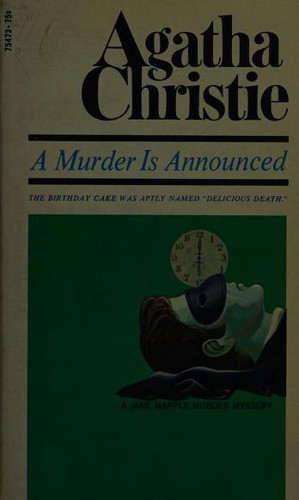
Agatha Christie · Buy on Amazon
"I think this might be the first Agatha Christie I read, and it might have the greatest premise I’ve ever heard in my entire life. I like to think about how the idea came to her. It would have been terrifying: how are you going to plot this, how are you going to live up to the concept? The concept is this: somebody puts an advert in the paper: “A murder is announced.” They say what time this murder is going to happen, in what place in the village and at what time. Then, unsurprisingly, everybody turns up looking to see if this murder is going to happen. And she pulls it off! She absolutely nails it. It’s not just a gimmick. She fully explores the concept and how people react to it. She uses it to explore psychology, to explore how people react to tragedy and imminent tragedy. You know – people just turn up to watch. It’s grotesque. She’s always fascinated by that, and this is the book where you see the idea absolutely coalesce: she turns murder into a spectator sport, and that is fantastic. When I was 23, I was killing time in Perth, Australia, and I went to the maritime museum, where I read about a real-life shipwreck called the Batavia, which was wrecked in 1629. It’s a terrible story – really gruesome and sad and brutal – but basically, the ship gets wrecked, and the survivors get put on this island. The captain leaves to go get help in Jakarta, which is 30 days away. He sails off in a little row boat, but he’s left them in the hands of a psychopath. And the psychopath proceeds to murder, maim, torture and rape his way through the survivors. It’s a sordid, brutal tale. But within it is all this great stuff – the captain of the ship sailed for help in uncharted waters, using celestial navigations, for a month. He couldn’t possibly know where he was going, yet somehow he got there and then managed to return with help. That’s incredible. There was a soldier on the island who was fighting and winning battles with improvised weapons. There was basically a cult on the island… there were all these little stories within it, and it stuck with me like a splinter. I never forgot that story. My book’s set in 1634. It’s basically a haunted house at sea. It’s an isolated boat, they don’t know where they’re going to, they don’t know what’s coming next. It immediately felt a very Sherlock Holmesian setting, more than a Christie setting. I didn’t mean to write my take on Sherlock Holmes and Watson, but it just felt immediately fitting. So that’s what I did. It took ages to work out that it was a much more interesting mystery if I locked my Holmes character up – took the focus off him and put it on the sidekick. After that it just flowed."
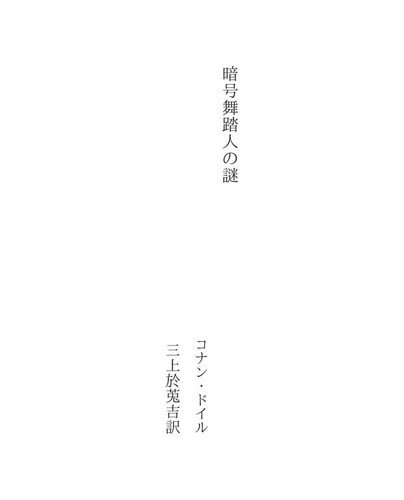
Arthur Conan Doyle · Buy on Amazon
"As I said, when I finished reading Christie , I moved on to Sherlock Holmes . I’m quite a completionist; if I discover a new author I have to read all of their books. So, I read all of Sherlock Holmes and this is the one that stood out for me, the one that got me most excited. It starts with pictures of dancing men being delivered, in a note, to a guy who seems completely harmless and lovely. He’s just married an American lady with a bit of a shady past, and the note scares her, even though it seems childish to him. That’s the thing about the story I love. These dancing stickmen are slightly ridiculous, but it ends up so horrible. It’s a very menacing story, with quite a grounded, down-to-earth resolution. It’s short and logical and real, which is not always the case in a Conan Doyle story. So, yes, that’s the one that I took with me – that, and The Speckled Band. They’re the two I thought of while I was compiling this list. They’ve always stuck with me. It brings order, doesn’t it? Somebody dies. Usually – or, not usually, but often – the person is revealed to have had it coming in some way. In a lot of mysteries, they’ve usually done something to bring this upon themselves, in some capacity. Then it becomes a board game, because a lot of these books make their characters such ciphers. You’re not killing a real person, you’re killing a collection of ticks and whims and plot secrets. Christie had a few books when she tried to do more. As she went on, she wrote strange books, where she spends half the book, almost, with the victim before she kills them. I really like that. I want the victim to be a person. I want them to be somebody who you can get to know. But also – it’s hard to explain – I like them to have a hand in the resolution of their own crime. A character who knows something’s going on, and is trying to do something about it, either by investigating, or knowing what’s going on around them and trying to stop it. That’s far more interesting to me than somebody who doesn’t see it coming, then dies."