Sophie Gee's Reading List
Sophie Gee is an English professor at Princeton University, and is currently the inaugural Vice-Chancellor’s Fellow at the University of Sydney. She is the author of acclaimed fiction and literary criticism, including The Scandal of the Season, Making Waste, and The Barbarous Feast. She is co-host of the Secret Life of Books podcast, which is dedicated to keeping the great books of the past alive and relevant.
Open in WellRead Daily app →The Best 18th-Century Novels (2025)
Scraped from fivebooks.com (2025-03-31).
Source: fivebooks.com
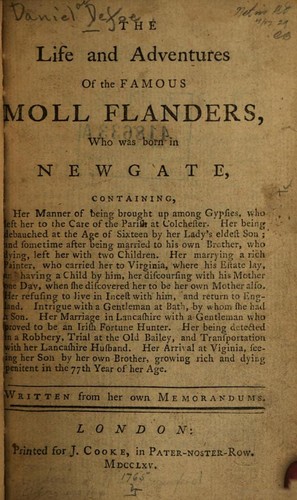
Daniel Defoe · Buy on Amazon
"Yes, his name wasn’t put on the book for several decades afterwards. The full title of the novel is The Fortunes and Misfortunes of the Famous Moll Flanders . So it’s trying to make the claim that it’s a true story, which is supposed to bring the punters in. But Defoe, from the outset, is always playing with the idea that people will know it’s a fiction; they won’t really think it’s true. The novel is based on an actual woman called Moll King who was an accomplice of a well-known organized crime boss in the 18th century called Jonathan Wild. Defoe found out about Moll King when he was visiting a journalist he’d collaborated with in Newgate Prison in the late 1710s. Moll King was irrepressible. She was constantly committing crimes—I think she was sentenced to transportation to America four times and went twice. On both occasions, she came back, which was illegal. She was also constantly making new marriages. Defoe adapted this story for Moll Flanders , which is the story of a woman who is born in Newgate Prison, where her mother was a prisoner, and goes on to lead a life of crime. What’s groundbreaking about Moll Flanders is that even though Moll is a criminal, a prostitute, a swindler, and a total scoundrel, she’s depicted as a kind of genius entrepreneur. She turns crime into a business, and she turns marriage into a business as well, always upgrading from one husband to another. She scatters illegitimate children across the globe. At one point, she even marries her half-brother. There’s a real interest in incest in the 18th century, and Moll Flanders is one of the novels it comes up in. Then, eventually, she returns to America and has a happy reunion with the one husband that she truly loved and makes lots of money. You could make the claim that Moll Flanders is one of the early feminist texts. She’s very likeable. She has huge amounts of energy and no mental health issues. She doesn’t seem to suffer from anxiety at all. Defoe recognized as early as Robinson Crusoe that he had to figure out how to break stories up into manageable units, and he did come up with ways to divide up the book, into his journal, into different locations he visits, and so on. But the idea of the chapter as a formal convention of novels hadn’t really kicked in. That actually comes with Tom Jones…"

Henry Fielding · Buy on Amazon
"People love Tom Jones because it’s hilarious. It’s the great mid-century novel. It’s intimidatingly long, but it’s another page-turner. It’s about an illegitimate foundling called Tom Jones, who gets adopted by the lovely, benevolent Squire Allworthy. Tom has a heart of gold, but he’s a total ne’er do well, and he’s always getting himself into scrapes. He has an evil half-brother called Blifil and one of the great tensions of the novel is, will Blifil’s misdeeds be discovered? Is Tom or Blifil going to end up with the upper hand? Tom is constantly taking lovers. He’s irresistible to women, especially older women. There’s a society woman in London who takes him on, so he’s a kept man. At one point, it seems he is in a love affair with his own mother, though she turns out not to be. Meanwhile, he declares his passionate devotion to Sophia Western, a neighbouring squire’s daughter, who is the heroine of the novel. Sophia is a delightful creature based on Fielding’s wife, who died before the novel was written. In pursuit of Sophia, and in Tom’s attempts to flee his home after he’s thrown out for drunken debauchery, he travels around England. So it’s a peripatetic novel that shows us England in the mid-century. The novel itself is really fun, but what’s fascinating about it is this depiction of England in flux in the middle of the 18th century. There is a huge amount of forced migration from land enclosures, from the European wars, and from the Jacobite rebellions that are going on. There are gypsies—Romani travelers from Central Europe—in the novel, there are vagrants and beggars. We have this full picture of the ways in which property and vagrancy law and international wars were creating this highly volatile social fabric in England. Plus there are lots of brilliant jokes about food…The book opens with a long riff about how authors are like restaurateurs serving up meals to fussy, discontented customers, who if they don’t like what they’re given to eat will “damn their dinner without control.” He sounds like someone complaining now about the comments they get on social media—Fielding was very ahead of his time."

Laurence Sterne · Buy on Amazon
"Tristram Shandy comes out only nine years after Tom Jones , but it really turns the novel on its head. It’s a massive turning point and the first experimental masterpiece. As it says in the film of Tristram Shandy , it’s a post-modern novel “before there was any modernism to be post about.” The movie is amazing, by the way. It’s directed by Michael Winterbottom. It’s ostensibly an (auto)biography, like Moll Flanders or Tom Jones , but it refuses ever to get to the life of the subject. The birth of Tristram Shandy and his actual development as an adult are constantly being hijacked by stories about his parents, about his uncle, Toby, who’s a very charismatic veteran from a war in Europe. There’s also Toby’s servant, the Corporal Trim, who’s a funny character, and the local obstetrician, Dr Slop. There’s Susannah, the maidservant, and Parson Yorick, who’s a very famous, colourful character. There are endless digressions with lots of sex jokes, like when Tristram gets an accidental circumcision after a window sash falls on him when he’s a child. It was denounced as highly scandalous and shocking at the time, including by Samuel Johnson, who famously said, “nothing so odd will do long.” But Johnson was wrong, because at the heart of it—among all the silliness and the digression—is this deep sense of the feelings and emotional roller coaster of being a human. Sterne innovates the post-modern novel, but he also innovates what was called ‘the sentimental novel’—novels that give us this deep snapshot of a person’s inner life as they experience it themselves, and which doesn’t necessarily match up with their outer life. It’s about the way in which we all have these profound emotional and unconscious impulses that we’re aware of—or dimly aware of—but which are very hard to communicate or make known to the world. That was what Sterne figured out how to do, to show people’s innermost souls in all their turbulence and chaos. So Tristram Shandy is both funny and outrageous and, frankly, quite hard to read, but it is also incredibly moving. You learn about someone’s struggle to be the hero of their own life, as he puts it. It’s very moving. It does take some tenacity, but there are passages about what it means to be human that are incredibly real and vivid. It’s about loving people, about having parents, about being a child. All these relationships are being explored for the first time through the lens of a person’s individual consciousness. That’s the link to Locke—plus the association of ideas, which gives Sterne license to make these wild leaps and links between unconnected things."

Maria Edgeworth · Buy on Amazon
"Yes, my last two choices only just sneak in. They were both drafted solidly in the 18th century, so that’s my justification. Maria Edgeworth was both a great novelist in her own right and a major influence on Jane Austen. She was Anglo-Irish, so she was thinking about the colonial relationship between Britain and Ireland . Belinda also coincides with the acceleration of abolitionism in England and is one of the first novels in English to depict an interracial marriage. There were two older books that touched on inter-racial relationships: Oroonoko by Aphra Behn in the late 17th century, which is a pseudo-novel, and a little-known novel by Eliza Haywood called The Adventures of Eovaai, which is a sort of Orientalist fantasy. In Belinda , and English farm girl called Lucy marries Juba, who is a Black servant from the West Indies. Belinda herself, the heroine, almost marries a Creole man from the West Indies called Mr. Vincent. So Edgeworth, partly because she’s Irish, partly because of the period in which she’s writing, is thinking about the impact of imperialism and colonialism on the state of the world, and she’s really opening up the possibility of interracial marriage, which is very radical. The other amazing part of the book is the character of Lady Delacour, who is this fascinating aristocratic woman who thinks she has breast cancer for two-thirds of the novel. A bit like in the Sterne novel, we see the inner torment of someone who believes herself to be dying. Part of what’s so brilliant about the way Edgeworth tells the story is that it’s always quite opaque. We never fully understand what’s happening. I think that reflects Lady Delacour’s sense that she can’t communicate the extremity of her fear and vulnerability to the world. There’s this extraordinary scene where she reveals what she believes to be her tumorous breast to Belinda, the heroine. Everything in the novel has this slight quality of possible fantasy or speculation about it. How do you blur the line between what’s really happening on the page and what the characters are just imagining? There’s also a character called Anne Percival, who’s an older woman in the novel. Edgeworth is experimenting not just with representing women, but women in phases of life that no one’s previously been particularly interested in. The last thing to point out is that in the list in Northanger Abbey —where Austen defends the novel as this incredibly important form—she belatedly added Belinda . She mentions two novels by Fanny Burney and then added Maria Edgeworth. And rightly so. Belinda is a page turner. I’ve made it sound a bit too worthy, and I’ve been calling attention to what’s interesting from a literary history point of view, but it’s first and foremost a great read."
Jane Austen · Buy on Amazon
"It’s Jane Austen’s 250th birthday this year, so I had to include an Austen novel. It was published in 1811, but she wrote it during the 1790s and probably started writing it when she was 18 or 19. The thing about Sense and Sensibility —and anyone who’s seen the Ang Lee film will also know this—is that it doesn’t read like a Jane Austen novel. It’s incredibly passionate and overwrought and full of intensity of feeling. It’s organized around two sisters, Elinor and Marianne. Theoretically, Elinor is the more restrained one. She has ‘sense’—she’s the rational, reasonable one. Marianne is the overwrought, hyper-emotional one. But actually, when you read the novel, what you realize is they both have equally intense, tortured personal lives. It’s not light and bright like Pride and Prejudice: it’s quite a dark novel. It’s still very fun, and it’s got social satire, but the condition of the women in the novel is of suffering and anguish at the hands of men who treat both of them incredibly badly. They’re given happy endings, but the driving force of the story is female suffering and the intensity and difficulty of female feeling that can’t really be recognized by the worlds that they’re living in. It’s a beautiful novel. It has a depth and complexity to it that Pride and Prejudice also has, but as Jane Austen said of Pride and Prejudice , “it wants shade”. Sense and Sensibility has that shade and so to read it alongside Pride and Prejudice is an amazing experience. In many ways, they’re the same story: of two sisters who are almost prevented from marrying men that they love but it all comes right in the end. The Sense and Sensibility version of it is very melancholic, with disaster hovering right there, and the Pride and Prejudice version is much more joyful and playful and Bridget Jones-like. Austen drafted them both in the 1790s and then went through a period of huge turbulence when her family had to leave their house in Steventon, in Hampshire. After her father died, she had a period that’s been described as “genteel homelessness” for about 10 years. Then her brother, Edward Austen Knight, who’d been adopted by a wealthy family, gave her Chawton House, which is where they lived for the rest of her life. So Sense and Sensibility also tracks a period of huge precarity and anxiety in Austen’s life. It’s a stunning read. I highly, highly recommend it. Yes, that’s an important point to make. They read like modern novels, and the characters feel modern. Belinda and Sense and Sensibility are the ones to start with, I would say. They’re a lot of fun. One final pitch for 18th-century novels: if you’re serious about reading and you read through these five, you will see the novel’s evolution. There’s nothing in the modern novel—or even the post-modern novel—that isn’t in these early examples of the form. Writers obviously realized fairly early on that this play between the novel’s ability to get inside the mind and also stay outside it was crucial. The juxtaposition in early novels is about isolation and togetherness or community being in constant tension. I’d make the case that’s still what most novels are about today."
The Enlightenment (2009)
Scraped from fivebooks.com (2009-05-19).
Source: fivebooks.com

Sir Isaac Newton · Buy on Amazon
"Yes, I put those books in an order – not really an historical order, nor precisely thematic – more a way of describing how I’ve come to think of the Enlightenment. Some of the ways in which I think it’s interesting. Exactly, and about seeing. The idea of light and vision seem to me to be behind the fundamental breakthroughs of the Enlightenment. They can be taken as the principles or the maxims of almost all moments in intellectual history where people see themselves undergoing a revolution or transformation. “The classic symbol of the Enlightenment is simply light – truth emerging from darkness.” The idea that you are seeing something familiar differently, even as capable of changing the world, seems to be the essence of all intellectual and social revolutions. So we’re taking the Enlightenment here as the single most important of all intellectual revolutions in the West and I picked Isaac Newton’s Opticks as my first text in order to flag the main themes of this revolution. Yes. Newton’s a genius whose most obvious contribution to science was to formulate the laws of motion and of gravity and to come up with breakthrough theories about light, colour, vision and so on. But in the Queries to the Opticks he treats these questions as philosophical problems as much as scientific problems. He sees his work not simply as changing the way that scientific inquiry is going to happen for the next 300 years, but also the way that people think about what it means to be human. So if we’re using optics as a key figure for how people think about revolution then Newton gives us another word: ‘Query’, the idea of questioning, investigating, of opening up problems to people at large."

John Locke · Buy on Amazon
"Locke’s a very interesting figure in many of the same ways that Newton is. They’re both coming out of a century of revolution and dissent in England; a century in which the church and the state have been questioned in the most profound ways. A century in which absolutism has been seen as an insupportable political position, where the old regime government in Britain was no longer viable. The 17th century saw a dawning of parliamentary government, and a commitment at least to popular social participation in the life of the state. That’s the political backdrop against which both of these men are working. “ So instead of a supreme, authoritative, monarchic figure being the presence that describes what power is like in the world, the authority of the individual takes over.” Locke’s a political philosopher, Newton’s a natural philosopher or scientist. But really both of them were responding to this idea of popular participation, the will of the people, as a way to think about philosophy and science in radically different ways. Newton’s work on vision and light and sight and Locke’s ideas about the emotions and the mind establish the consciousness and perceptions of the individual at the centre of human life. It’s a secular view. So instead of a supreme, authoritative, monarchic figure being the presence that describes what power is like in the world, the authority of the individual takes over. Newton establishes the validity of human perception, Locke establishes the validity of individual consciousness. And these two things, the ability to see or think authoritatively really become the cornerstones of the Enlightenment, and from there of all modern thought. They establish the individual at the centre of collective life."

Immanuel Kant · Buy on Amazon
"Yes, Answering the Question: What is Enlightenment? by Immanuel Kant. Kant is responding to a lot of same questions as Newton and Locke, but a century later. Each of those three thinkers have come up with the idea that human beings are going through and must go through a fundamental transformation, and the fundamental transformation that each thinker is committed to is from humans being controlled by a higher authority to human beings being capable of autonomous individual decision making and thought. We’ve already talked about what that means for Newton and Locke. Kant, I think, sees the Enlightenment as a way of thinking which liberates individuals from what he calls immaturity. He’s interested in mature decision making, independent social and political decision making springing from individual Enlightenment. And in order to encapsulate the essence of what he means by this he uses a phrase coined by Horace: ‘Sapere aude!’ – dare to know, dare to be wise! Absolutely. The looking through the telescope is a symbol for all this. But none of these thinkers were suggesting that the universe was fundamentally different or radically altered from the universe that people had thought they were living in. They weren’t heretics in that way. What they were saying was that if we look properly at things, if we examine things rigorously, we will see things that were previously invisible, a series of truths that were previously hidden. And this is why the classic symbol of the Enlightenment is simply light – truth emerging from darkness. But another symbol of it is the telescope or the microscope, instruments that revealed things that had been their all along but hitherto had been invisible. So the idea is of a world that might be infinitely dense, infinitely complicated, made infinitely visible actually by looking more and more carefully at familiar objects. And by looking carefully both making them strange and yet also more completely known."

Michel Foucault · Buy on Amazon
"I wanted to recommend a couple of Foucault books here. He’s going through a less fashionable phase now, but I think he’s one of the most exciting, innovative thinkers of the twentieth century. I also wanted to show that part of post-structuralist thinking in the twentieth century – i.e. what went on to become cutting-edge modern philosophy – was still deeply indebted to the Enlightenment. Something amazing happened in the last years of the seventeenth century that somebody in the 1960s was still thinking through. And I suppose that the question Foucault asks is, how, after the catastrophes of the twentieth century— the Holocaust , the world wars, the economic depression—are we going to reground ourselves? How are we going to find an intellectual framework from which we can understand what we’ve done to ourselves and establish the foundations of an ethical life? There were cultural turns that Foucault was considering that had not yet become central issues in Kant’s time: the historic and philosophical meaning of insanity, of poverty, of certain kinds of deviant sexuality. So Foucault is daring to know, but what he wants to look at are the margins of cultural life, what the rejected parts of life look like. He’s inserting what had previously been unknowable narratives into our understanding of what it means to be human. Lots of things are interesting about this book. Neal Stephenson has this unbelievably capacious and exciting mind that links things in entirely unexpected and convincing ways. This is a book about late seventeenth century and early eighteenth century Europe and also America, and is really the template for me of what an historical novel should be. It feels completely contemporary. The research is just unbelievably detailed and perceptive, yet is presented in a way which feels entirely familiar and vivid. It’s a great historical novel. It’s also not the easiest. It’s intellectually very dense. Newton’s one of the main characters in the early part of the book and basically what Stephenson’s doing in the Baroque Cycle book trilogy in general I think is to draw together all the threads of the Enlightenment – the scientific Enlightenment, the philosophical Enlightenment, revolutions in finance and credit. At the same time the English colonial adventure is reaching its height and in particular the relationship between England and America is approaching its revolutionary crisis. He has a magisterial understanding of how all these different ways of understanding the world are coming together, resonating with each other, and yet at the same time how each requires a different form of expertise. So that in the Enlightenment the idea of the renaissance man, the well rounded man, the man accomplished in all branches of art and science, is replaced by admiration for the expert or specialist. This is what intellectual rigour comes to look like. Yes, I think this novel makes you understand why people felt that they were standing at the beginning of a new age, the modern world… Why it felt like a series of changes were taking place that fundamentally altered what it meant to be human – altered what it meant in a good way. It was a profoundly optimistic period in many ways. Leviathan and the Air Pump . Yes. A history of science book. It’s a brilliant title that perhaps doesn’t perhaps draw you into reading the book, but to me, this is perhaps the single best history of science book that’s ever been written. It’s a fantastic book, though again it’s gone a little out of fashion. But at the time it fundamentally changed the way that people saw the history of science. Support Five Books Five Books interviews are expensive to produce. If you're enjoying this interview, please support us by donating a small amount . The claims that the authors are making in the book are essentially that the political philosophy of Hobbes and other contemporaries, including Locke, and the scientific breakthroughs of Boyle who did the first set of experiments using an air pump – that these two bodies of thought weren’t developing human understanding in parallel. They were part of a cultural shift that was interlinked and that was going to produce a new account of what it meant to be a human being. So in other words what this book really did was to show that changes taking place in apparently different areas of human understanding were actually linked to one another and that the Enlightenment, while dependent on immensely talented individuals and specialists, was a kind of collective commitment – a commitment which paradoxically transcended the individual."

Michel Foucault · Buy on Amazon
"The Order of Things. Yes, it begins with a painting: Velasquez’s Las Meninas. Foucault does a reading of that painting to show that at any particular moment in culture, the way that something gets represented and the ways in which we analyze representation – what we choose to see, what is emphasized, what occluded – is governed by a world view peculiar to that age. What he does is to track changes in the way that knowledge and ideas get organized from the Renaissance onward. And for my purposes what’s really extraordinary about this book is Foucault’s description of the renaissance world as being a world of infinite connectedness, infinite analogy, where it seems that everything is analogous or equivalent to everything else. So that if you think about the world of a Shakespeare play you realize that the world of finance and of magic and of the professional classes and of the aristocracy – poets, madmen – all of these worlds are knowable and fundamentally the same. But what happens with the Enlightenment is that suddenly it occurs to people that perhaps, rather than everything being comparable to everything else, rather than analogy being the system of understanding, that perhaps distinction and discrimination might be a better way of understanding the complete human experience. What’s particularly compelling about Foucault’s approach is that he recognizes that we are always struggling with the same problems: how to understand the world around us; how to connect different aspects of experience and give them meaning. This impulse to order is what we do when we think and Foucault recognizes the same impulse in every age; but by creating an anatomy of each distinct period since the renaissance he helps us to grasp the way in which people are looking and representing things differently even if they are asking very similar questions. That’s right, Habermas, like Sartre – and Foucault, and also Locke – is saying that when you describe something you’re also giving an account of your own political ideology. Locke happens to be writing about the operation of the consciousness in human understanding, but he’s really talking about the same kinds of ideas that he’s talking about in his treatises on government. Similarly, Habermas is talking about this emergence of what he calls the public sphere during the Enlightenment, but he’s also explicitly thinking about what the ideal state would look like. He comes up with the idea that in the eighteenth century the public space is transformed, becoming a potentially neutral, ambiguous, commonly held realm. A forum in which individuals are able to interact with one another without class or personal narrative getting in the way of being able to forge a collective life. The public sphere becomes a place in which collective life can take place untrammeled by the gory details of people’s private affairs. During the Enlightenment, the icon of this would have been the European coffee house, where everyone could come together whether they were a member of the nobility or a working man or a servant or cleric or lawyer. Everyone could come into this collectively held space and become a citizen rather than a person whose individual circumstances determine their identity. It’s a deeply idealizing notion, and Habermas has been strongly criticized on this score by other political philosophers, but the idea is of a sphere which permits possibility and change, rather than the early modern idea of a public space where individuals were dominated and determined by the social, political and economic roles which had already been assigned them by the existing order. Public life becomes about openness, argument and change. The private individual becomes effaced in the interests of the collective world. One of the problems of the post-Enlightenment world is that the irony of individual freedom, the irony of creating a state that is responsible for individuals, but also individuals that are responsible for the state, is the visible evidence of that freedom and responsibility: the catastrophes of totalitarianism, Stalin’s Russia, Hitler’s Germany, and also the infringements of social freedom that come with establishing things like the welfare state. So I think that part of the reason why modern thinkers tend to come back to the Enlightenment is that after the events of the first half of the twentieth century it starts to feel like a dangerously naïve position to take, to advocate for the kind of statehood that the Enlightenment seems to have produced. Get the weekly Five Books newsletter The second half of the twentieth century represents a sort of backlash against the Enlightenment, a profound disenchantment with what it promised but did not deliver. Whereas now, in the twenty first century, in the context of climate change, globalization, a global economic melt down, I think that people are going back to the sort of claims that people like Newton, Locke, Kant and Descartes were making. How can we revisit these questions? Because these are still the questions. What does it mean to be an individual in a society? What is the role the individual plays? What is the role society plays? Yes, how can we emerge from immaturity? What does it mean to be capable of asserting reason? Of transforming the world we live in through the power of our own consciousness and imagination."

Vic Gatrell · Buy on Amazon
"I wanted to put a book in that showed that the Enlightenment wasn’t just about people having big ideas. It was also about people having a good time. And I suppose that one of the consequences of political and social optimism was collective pleasure, and that’s really what this book’s about. It’s about people being libidinous and bawdy and sexually free in a big city. Feeling for the first time that they were living in a modern world. What’s coming across in this book is that the Enlightenment is a period of excess, of luxury, of feeling as though people have more than enough to go round – piles of bottoms and breasts – a celebration of life and plenty. And an acknowledgement as well of the other side of that which is a plenitude of filth and lewdness and disenchantment and poverty and vice. In other words the overflow of the other side of life."