Simon Johnson's Reading List
Simon Johnson is an economist and author. He is former chief economist for the IMF, Ronald A Kurtz Professor of Entrepreneurship at MIT’s Sloan School of Management and a senior fellow at the Peterson Institute for International Economics. He is co-author, with James Kwak, of 13 Bankers and White House Burning . They also co-founded the economics blog The Baseline Scenario
Open in WellRead Daily app →Why Economic History Matters (2012)
Scraped from fivebooks.com (2012-05-11).
Source: fivebooks.com

Richard Sylla & Sidney Homer · Buy on Amazon
"This is one of my favourite type of books, which are just about data. You can argue all kinds of things about the past, but then you have to go back and look at the actual numbers. The interesting thing about interest rates is that you have these decade-long swings. It’s important to try to situate today in that historical context. We are in the fourth decade of a very long bull market in bonds – meaning rates have gone down and bond prices have gone up – and at some point that will switch. We need to be aware of that. It’s a very simple observation. I don’t know when rates are going to turn against us, but Homer and Sylla’s history shows us that interest rates can go down – and they can go down for a very long time – and then they go the other way, they go up. This means that you can’t build your public finances on the view that, “Oh yes, today’s rates are going to be the rates in two decades.” You can’t bet on the US being able to borrow indefinitely, an infinite amount, at 2% interest. Exactly. The cool thing about Homer and Sylla is it’s such a great book – it costs nearly $50 on Kindle. I take that as an indication of the market realising the intrinsic value of a ridiculous amount of data about interest rates. You have to go to it with a question. You have to say, “I want to know how much it costs to borrow, in this or that time period, for this or that government or the private sector.” If you just read it, it’s a bit overwhelming, I agree. But then facts have a tendency to overwhelm people. You should try and be aware of the facts as much as possible. The US national debt right now is nowhere near what it was at the end of World War II. This is the sixth debt surge in American history. Five of them were all about war. This one was partly wars – it was also the Bush tax cuts, Medicare Part D [prescription drug coverage] and the financial crisis. What’s different about this surge is that it coincides with a rather difficult demographic transition – the baby boomers are retiring. Also, we don’t have healthcare costs under control. The demographics were much more favourable, and healthcare was not this kind of an issue, after any of the previous surges. So there is an unfortunate convergence – this combination of issues is not something we’ve dealt with before. Yes, in the modern era, that is since we moved away from the gold standard. There were certainly episodes under gold, first in the UK and then for the US, when interest rates were very low. But interest rates have come down and they’ve kept coming down. I’ve refinanced my mortgage five times since 1997. Each time I thought, “Wow, that’s a great deal, I guess I’m done now.” We’ll see how long they stay low. If you read this history, you’ll see you have to take a pretty agnostic view of the short term, at the same time as not taking a long-term bet, from a public finance point of view, that interest rates stay low."
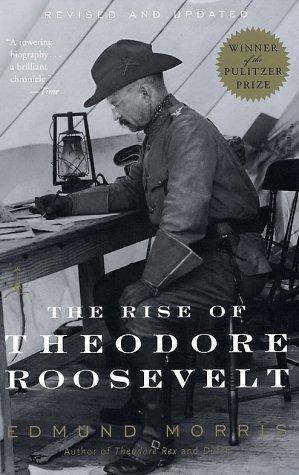
Edmund Morris · 1979 · Buy on Amazon
"This is one of the great political biographies. Teddy Roosevelt was like a character out of a novel, so it’s not surprising that his biography reads like one. This book is the exact opposite of Homer and Sylla. Homer and Sylla are all facts all the time, the long swing of history. This book is about admiration for an individual, a man who rises through a series of remarkable – if not incredible – coincidences. Within 10 years, he goes from being a somewhat unsuccessful chief of police in New York City to being president of the US. You have to read the details to understand how he did it. The key thing is that he channelled the times. He channelled a lot of the progressive objections of the day to the political and economic system into the heart of the Republican Party. He forged an alliance across the political spectrum that really confronted concentrated economic power and changed it absolutely and completely, most directly using the anti-trust laws. He was remarkably successful and very popular when he was done, though after he left office and tried to come back it didn’t go so well. But in his day, Roosevelt’s achievement was profound. When you look at this history, and see how he got there and how he held and exercised power, you realise that it’s not easy to find such individuals, who really want to break with the system. We need another Teddy Roosevelt. He’s certainly not another Teddy Roosevelt. We’ll see whether or not he gets a second term. Roosevelt did not wait for his second term to confront JP Morgan and Northern Securities. He took the opportunities when they presented themselves. He took a lot of risk to do that, but built a very strong coalition opposing concentrated economic and financial power. “Roosevelt did not wait for his second term to confront JP Morgan and Northern Securities. He took the opportunities when they presented themselves” He was tapping into a broad American tradition – with support from the right and the left – but it was a distinctly Rooseveltian coalition. It didn’t long survive the end of his political career. No. If you read this book, you’ll see how tough it was for him. Nobody expected him to become president."

Daron Acemoglu & James Robinson · Buy on Amazon
"Why Nations Fail is by two of my favourite economists, two very close friends and co-authors of mine, Daron Acemoglu and James Robinson. They’re tackling a subject that I’ve worked on with them, and they do a great job of bringing it to life and making it vivid. Why Nations Fail is like Jared Diamond’s Guns, Germs, and Steel – which I didn’t mention because it’s such an obviously famous book – one of those books that stretches your mind and gives you all these examples and connections between them, so that you come away from it saying, “Wow. I didn’t know that.” It’s really, really interesting. By the way, it turns out they’re even better on Twitter than they are on their blog. So, there’s no limits to the genres these guys can master. Yes, I have not exactly a beef, but a constructive dialogue going, particularly with Daron, about whether or not the US is already in a period of having, in their language, more “extractive” institutions and less inclusive ones. I recognise there is a big gap between the US and, say, Sierra Leone or Haiti, or whichever troubled country you want to pick from the book. But – and this is going back to Teddy Roosevelt – I fear that we have let the concentration of economic, financial and political power go too far. This is really bad for democracy and for the opportunities of most people in this country, and it’s exactly the kind of thing they mean by extractive institutions. Get the weekly Five Books newsletter I don’t know if you saw it, but Matthew Yglesias gave a wonderful and hilarious review of Why Nations Fail , in which he compared it to The Hunger Games . His point is that the dystopian view of the world, which is rather chillingly and vividly portrayed in The Hunger Games , is not that far from things we’ve seen in history and things we see around the world today. It’s actually a very extreme form of extractive institutions in which a few people live very well and most people live in squalor. You could say, been there, done that – not for the US, but for many countries. So could the US go down that path? Is our democracy forever? Are our institutions so strong that we have republic-long immunity from those problems? I don’t think so. Ben Franklin was accosted by a stranger upon leaving the constitutional convention in Philadelphia in 1787. She asked him, “Well, Doctor, what have we got – a republic or a monarchy?” And Franklin said, “A republic, if you can keep it.” I would say I’m more of a realist, but yes, they would say I’m more pessimistic. Their experience with this book has been like our experience with some of the papers we did together, which is that, at some level, people on the right and the left like the thesis. People on the right say, “Aha! You mean that you don’t have secure property rights!” which is exactly what part of the message is. People on the left say, “Aha! A few people have too much power in society” which again is part of the message. At that level it’s not controversial – in fact it’s an unusual book in that it appeals to people across a broad spectrum. However, when you start talking about a particular country, say the US, becoming more extractive in this or that specific way – and I would say the Paul Ryan budget will push us towards a more extractive society – then of course people find that amongst the most controversial things you can say in American politics today. I haven’t been accused of not being a patriot, but I have been accused of lots of other things that aren’t fit for public consumption. Though when you write a book and start blogging you become a bit immune to that kind of thing."

Arvind Subramanian · Buy on Amazon
"This is by another good friend of mine, Arvind Subramanian. He’s a senior fellow at the Peterson Institute where I work part-time in DC. I remember saying to him at one point, “Arvind, you should be careful about predicting that China is going to overtake the US, because lots of times when people predict that kind of thing it doesn’t come true.” He replied: “Don’t worry, Simon. I’m actually saying they’ve already overtaken us.” Arvind is a very historically minded person. He has dug up a lot of relevant data, and has some wonderful stories that illustrate his points. The most vivid, and my favourite, is about the Suez Crisis in the 1950s. At that moment, the British thought they were still top dog in the world. They invaded the Suez Canal with the French and Israelis, and the Americans were not happy. The British were having problems with the pound and their balance of payments, and Eisenhower would not agree to the IMF lending to them until they withdrew from Suez. This was an extraordinary reversal, an extraordinary fall of the position of the British pound in the world economy. Arvind’s point is that this could absolutely happen to the US. There’s no law of economics or physics that says the US dollar is the world’s reserve currency indefinitely, irrespective of what America does. No, he’s fairly agnostic on that. He has an institutionalist view of history, so you have to take some points off China on that score. He’s just arguing that it’s a very large economy, it’s going to be an increasingly important part of the world and it trades a lot. These things will naturally bring it the status of safe-haven asset or currency, and that will tend to displace the dollar. “There’s no law of economics or physics that says the US dollar is the world’s reserve currency indefinitely, irrespective of what America does” It’s more about the long-term impetus of economic growth, though I’m sure he will tell you there will be ups and downs along the way. But there will be a rebalancing of the world, so the share of income is more like it was in 1700, when the West was nowhere near as important as it is today. China and India will be more important, and, of the two, China is a bigger, more open trading nation, so its currency is more likely to contest or replace the US as the predominant reserve currency. Yes. I actually disagree with Arvind in that I think China is going to have a lot of problems – it won’t overtake us exactly in this fashion. But ideas matter, and it’s a well-argued, nicely balanced wake-up call. It’s also selling a ton of copies in China. Anyone in Washington who is paying attention and trying to think strategically must read this book. They have to think about what happened to the British and why. “Anyone in Washington who is paying attention and trying to think strategically must read this book” My argument would be that if we don’t put our fiscal house in order, the US dollar will lose its role in the world. US treasuries will no longer be the ultimate safe haven, our interest rates will go up, and we’ll absolutely have a decline of the kind Arvind talks about. Arvind’s thesis is more that China will take over, there’s not much we can do about it, while I think the future of America is much more in American hands. That’s the message: Don’t panic, we can fix it. The good news is that when I talk to audiences around the US, people on the right and the left get really intelligently engaged with the issues and the numbers. We have a fantastic discussion, admittedly up to the point where I say that their taxes will likely have to increase. Then they get upset and I have to sneak out the back. But this is progress. The war of 1812 is a good example for me. It relates to the theme we’re discussing, of using history to try to say something about policy today. In the war of 1812 the Americans were trying to get their government to deliver in terms of defence, but they weren’t willing to pay for it. You get what you pay for and you pay for what you get: Washington was burned. The US did not default on its debt, but there was still a fiscal disaster of the first order. That’s something we should seek to avoid at all costs. I don’t think that discredits the people who raised the alarm. On the contrary, those warnings were pretty timely. Exactly. Politicians swung back to being more careful. Unfortunately that was just on the surface. Beneath the surface the right wing of the Republican Party was moving further away from caring about debt as a fiscal responsibility and much more towards cutting taxes and reducing the scale of government. That political shift – which has been going on since the late 1970s – was masked by the fact that the 1990s had relatively good fiscal outcomes. It’s that movement of the Republican right that gave you the Bush tax cuts, the idea that deficits didn’t matter in the 2000s, and a lot of the political deadlock today."

David Wessel · Buy on Amazon
"This is my competition. I chose it because I think we need more of these intelligent, thoughtful, well-documented books that scare the pants off you and convince you that action is needed. Not panicky overreaction – that’s not what David is arguing for – but more, “Let’s change the policies now, figure out a way to bring the debt under control, and let’s do that in a reasonable and responsible manner.” His message should appeal to people across the political spectrum. I wish him luck and will do everything I can to promote his book as a way to help educate everybody who should care about these issues. We agree on a lot of things, but our book is much more about raising revenues than almost anybody else’s. I claim that we are consistent with the views the Eisenhower Republicans had, which are that we have to protect social insurance, including social security, Medicare and Medicaid, and we want to bolster revenues to do that. Other reasonable people are not so focused on revenue, and that’s a good discussion to have. I’m happy to have that discussion in an analytical way, in a historical way, in a non-emotional way, and I think it’s terrific that people like David are advancing alternative visions. What we really need is an educated, well-informed debate. No, no, he’s not that extreme. But he’s less in favour of increasing revenue than we are. So is almost everyone. Why don’t you come down to Washington and talk to people about that? We need to get your voice in the mix! Yes. That’s my view too. But I know you have a European background, and continental Europeans in particular have a different view towards government and towards revenue. I’m actually more on the side of limited government than a lot of my European friends, but I think we should defend and stick up for the basic social insurance programmes we have in the US. I don’t want to see them gutted. I think healthy scepticism is the right attitude towards government, and what you said about financial regulation and its ineffectiveness or failures is exactly right. I’m not expecting government to fix all the problems. I think a better solution to the banks would be to break them up and let the markets sort out who is going to succeed and who is going to fail. That’s a view some people on the left like, and I have plenty of libertarian friends who agree with that also. “I think a better solution to the banks would be to break them up and let the markets sort out who is going to succeed and who is going to fail” The government services that are problematic in the US are often provided by state and local governments and I have plenty of issues that I’m not happy about with my local government. But the federal government doesn’t do that much. As we discuss in the book, the things it does do are pretty high value and, while you can squeeze it a little bit, that’s not the big money. The big money is social insurance and healthcare. Healthcare is the toughest problem of all to deal with, and it’s one where Americans are very divided. To a lot of Europeans this is strange, but it goes back to the issue of a deep distrust of government. I think the interesting question over the next 100 years will be whether this deep distrust of government is going to serve Americans well, as it did previously, or whether it will increasingly become a handicap. I voted with my feet and I became an American, and I’m happy to be an American, but we’ll see where this tradition takes us. The healthcare experience in Europe varies. Costs have been controlled better in some places than others. The only countries that have really been able to hold those costs down – and which look likely to be able to hold them down going forward – are those with single-payer systems with more or less universal coverage. But the Americans don’t want to hear this. It’s not a popular message. Scandinavia. You can look in the back of the IMF Fiscal Monitor , the latest to come out. They have a table, I think it’s table 9a, which gives you projected healthcare costs and the impact on the budget over a 20-30 year period."