Ruth Reichl's Reading List
Ruth Reichl, who was editor-in-chief of Gourmet magazine until 2009, has been writing about food since 1972, when she published Mmmmm: A Feastiary . Since then, she has been the restaurant critic for The Los Angeles Times and The New York Times , and the host and executive producer of Gourmet’s Adventures with Ruth and Gourmet’s Diary of a Foodie on PBS. Her books include four best-selling memoirs
Open in WellRead Daily app →American Food (2012)
Scraped from fivebooks.com (2012-11-08).
Source: fivebooks.com

MFK Fisher · Buy on Amazon
"MFK Fisher was a wonder and a huge influence, and someone I got to know pretty well at the end of her life. She had this epiphany when she went as a young bride to France and discovered food – to me, in the best possible way – and brought that back to America. What I love about her is that she’s really a wonderful writer. She’s very thoughtful about the subject of food – it’s a subject that she embraces and takes on. For someone like me, growing up in the 1950s, if you wanted to read this kind of stuff about food, there wasn’t anybody else. If you go back in American history, oysters were the food of poor people. New York was filled with oyster saloons in the 1800s. They were so abundant and so plentiful that we ate them all up – and they went from being the food of the poor to being almost impossible to find. No, it’s a book about taking pleasure in food."

AJ Liebling · Buy on Amazon
"This is the male version [of the MFK Fisher]. To me, they have always walked hand in hand, Mary Frances and AJ. What I love is the contrast to Mary Frances. He is an unabashed glutton. His famous phrase is that the primary requisite for writing well about food is a good appetite. But what he is not saying is that, really, the primary requisite for writing well about food is the ability to write. He had both. He’s such a beautiful writer that you can pick this book up at any point and there’s something wonderful that you want to quote. It’s an old man’s yearning for the joys of his youth. It’s also about women – that wonderful last chapter, “Passable”. It’s about being able to appreciate the small things in life. For me, all these books – with the exception of Diet for a Small Planet – are really an exhortation to pay attention to the little things in life, to get pleasure out of this thing we all do every day, three times a day. That’s what attracts me to them. Yes. He talks about how much he loved Paris in the 1920s, but he later finds out that in fact he missed the golden age, which was before World War I. He laments that he didn’t get to see that. There’s also a wonderful passage in there about how glad he is that he didn’t have a lot of money. When I first read it, I didn’t have any money either. Liebling did not go to Paris as a rich person, eating three-star meals, and he says that helped his appreciation. That’s an important point. This isn’t about eating caviar and truffles. MFK Fisher does a whole passage on eating a tangerine. It’s one of the most beautiful passages in food writing – about taking these sections of tangerine and putting them on the radiator, until they almost crystallise on the outside, and the burst of flavour, the warm juice in your mouth. That’s a very important thing to me. You don’t have to be rich to eat well. The person to go to for that is really Pellegrini, who goes on and on about offal and eating the guts of chickens and is appalled by what Americans don’t eat. Yes, and he trapped rabbits. There’s also a wonderful passage about his father taking the intestines of chickens and washing them very carefully and leaving them to soak overnight. His Sunday morning ritual was cutting them into little pieces and frying them crisp and then folding them into an omelette. He talks about how Americans won’t eat these things. It’s still one of the really high hurdles for Americans. I happen to love tripe, but getting Americans to eat tripe or kidneys or even sweetbreads… When I was at Gourmet , we once counted how many offal recipes there were in the 1940s. There were lots of them. In our last year [2009], I think we printed just two."

Frances Moore Lappé · Buy on Amazon
"This book was a real game-changer for my generation. When I read that book, I had not thought about any of these things – the fact that we were feeding 20 pounds of useable protein to a steer, to get one pound of useable beef. It absolutely galvanised me and many people like me. It’s a book that was ahead of its time, the kind of thing people are doing now, and thinking about now. But when this book came out in the early 1970s, it was revolutionary. I feel this is a book that hasn’t gotten its due. It was very important for the Berkeley Food Movement – so much of it came out of Frances Moore Lappé, who brought the politics of food to the attention of the anti-war generation. I think it was, in many ways, responsible for much of what happened later. And it’s a cookbook. Exactly, and it’s definitely not vegan. To me it’s really interesting to take stock and look at where we were – this was almost 40 years ago – and how much things have changed. People are much more aware now. Her recipes are very fat-heavy, very dependent on cheese and eggs. Probably if she were doing those recipes today, they would be vegan. Because these days many of the young people who are food activists tend to be vegan . I don’t know this for a fact, but my instinct is that a modern version of the book would be vegan. In fact things have got worse. She was the canary in the mine. We didn’t pay enough attention. The industrialisation of food and the vertical integration of agriculture just galloped forward. She’s not even talking about things like confinement animal facilities. The difference is that the political food movement was a fringe movement in 1970 and now it’s very mainstream. Frances Moore Lappé was sounding a call to battle which was not picked up for three decades. So now you have people like Michael Pollan and Eric Schlosser saying, “Wait a minute! It’s time we really started taking a look at this!” And their timing was right. People were ready to hear it. It’s remarkable. This book was written before the obesity crisis, before the diabetes crisis. The American government policy on what we supported and subsidised in agriculture was a social experiment on a whole generation of children. Now we’re paying the price for that. She pointed out we were going to have problems and we do. She says eat a plant-based diet, it’s better for you. Forty years later Michael Pollan writes Food Rules and says essentially the same thing. Good for them! I have to admit I’ve never had a Fruit Loop. Are they really loathesome? I don’t know. If you really taste a doughnut, it’s pretty disgusting. They taste of grease. I bought one a couple weeks ago – I hadn’t had one in a really long time. I thought the only way you can really eat this is if you’re not paying attention. The same goes for Coca-Cola. If you really taste it, if it’s not ice cold, I don’t think anyone could get it down. I think part of what happens is that if you start training yourself to actually taste food, you turn away from a lot of stuff. A lot of the recipes are actually quite nice. There’s one called “Rice con queso” that I haven’t had in years, but I used to love it. Rice and beans and cheese and ricotta. It was pretty heavy – I would probably modify it now – but we used to make it all the time in the 1970s. I can taste it in my mind. Delicious. Oh God no! Are you kidding? I couldn’t live without butter. Butter is probably my single favourite food. No, not at all."
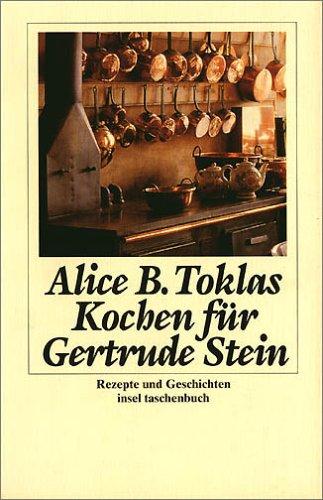
Alice B Toklas · Buy on Amazon
"If you ask most people about the Alice B Toklas cookbook, the recipe that comes immediately to mind is marijuana brownies. It needs to be rescued from that. One of the things that I love about this book is the wonderful way she writes the recipes. If you’re used to Elizabeth David, it’s not so strange, but if you’re used to most American recipes, there is something lovely and conversational about them. I wanted to include a book that had really good recipes. I defy anyone to read this and not get hungry, and not want to go into the kitchen and start cooking. It’s just a wonderful ode to food, and a cookbook. It’s one of the first cookbooks that I really sat down and read and found myself cooking from, as a kid. So it’s important to me that way. But again, it’s one of these books that’s about appreciating life, eating everything and living with the seasons. As a kid, when I read it, I thought, “Why isn’t my life more like this?” This is a book that, again, I feel has been unfairly overlooked and is a great ode to the fact that there were Americans who loved food even in the 1950s. Yes, it’s what Picasso likes. If you’re feeding artists, you have to feed them well. Get the weekly Five Books newsletter Yes, but that’s not really American, it’s kind of bohemian, which is another reason that I love the book. It’s this conjunction of formality of food with a casualness in the way it’s served. In the 50s in America, there were a lot of rules about how you ate and how the table was set. In the book, there is a lot of thinking about how you’re setting the table, where you’re eating, picnics and so forth. Again, a kind of, let’s appreciate it, and think about how we’re going to sit down at the table. There is a lot of throwing out the rules – which, for me, is an important part of cooking and eating. I could probably open the book at any point and find a recipe I really love. Let’s see… her way of scrambling eggs [Oeufs Francis Picabia, named after the artist] is perfect. She does it in a double boiler so it is never directly on the heat and it’s very slow, but it’s fantastic."
Angelo Pellegrini · Buy on Amazon
"Pellegrini is, in many ways, my hero. He’s such an advocate for paying attention to life. There is a point where he says what a lost opportunity it is if you bring someone in to do your cooking or your gardening. There’s real joy to be found in doing these things for yourself. The pride in making your own wine, growing your own food, sitting down at the table and serving people something that is really the fruit of your own hands. He has this connection to the earth, and at the same time he’s an intellectual. His lectures on Shakespeare were legendary. I’ve actually met his granddaughter. They’re a wonderfully close-knit family. To me, it’s the ideal life. He does. We’re all addicted to leisure. We all want to sit and watch TV at night or whatever. He’s making bread or is out in the garden. He’s not wasting one minute of his life. It is. It’s called The Unprejudiced Palate , but in fact it’s the most prejudiced palate that ever walked the earth. The idea that this book came out when it did [1948], and that he was living like this, in a city [Seattle], is remarkable to me. It was so against the grain of American life in the 1950s. People didn’t live like that then. Lots of people are trying to live like that now, but he really was out of step at that point, but held on to his convictions. But now you can get good bread! In those days you couldn’t. But yes, if you want an apple, unless you have a farmer’s market, you’re probably getting apples that were picked a year ago in China. They’re either Delicious or McIntosh, which can be picked green, ripened with ethylene and left forever. It was starting when Pellegrini was writing and it got worse. That tends to be true until they adopt the American diet. When they get enough money suddenly they’re eating at McDonalds instead. His recipes are terrific. You could pick just about any recipe in the book. One thing he makes a huge push for is eating the kinds of greens, the bitter greens, that Americans tend not to like – so he has recipes for cardoons and chicory and dandelion greens, all of which are terrific. Any of the pasta dishes he talks about are really good. I find all his recipes just really, really inspiring. I was talking earlier about the omelette with intestines. I desperately want to make that now. I don’t think so. I think they are easy. My basic belief is that cooking is easy. We’ve made it complicated, because everybody wants to be able to make everything. But if you’re not demanding of yourself that you make chef-quality food, or that you know everything about French, Chinese, Japanese and Indian cuisine, cooking is what we do naturally. November 8, 2012. Updated: November 15, 2022 Five Books aims to keep its book recommendations and interviews up to date. If you are the interviewee and would like to update your choice of books (or even just what you say about them) please email us at [email protected] Support Five Books Five Books interviews are expensive to produce. If you've enjoyed this interview, please support us by donating a small amount ."
By the Book: Ruth Reichl (2019)
NYT By the Book column (2019-05-02).
Source: www.nytimes.com

David Foster Wallace · Buy on Amazon
"I just reread "Infinite Jest," and as always David Foster Wallace blew me away."

Rachel Kadish · Buy on Amazon
"On my last trip I took "The Weight of Ink," by Rachel Kadish, and I was actually sorry when the plane landed; I would happily have kept flying till the book ended."

Michael Lewis · Buy on Amazon
"reading Michael Lewis's "The Fifth Risk" I found myself constantly throwing the book across the room in fits of rage."

Unknown · Buy on Amazon
"I fell in love with Mary Poppins when I was a little girl because she was so smart, confident and basically badass. She was nothing like the saccharine character portrayed on the screen — she did exactly what she wanted and always got away with it."

Unknown · Buy on Amazon
"It is an extraordinary exploration of the alternate universe inhabited by the mentally ill. Better still, it offers hope that they might someday be released."

William Carlos Williams · Buy on Amazon
"I just bought "The Autobiography of William Carlos Williams"; I've always loved his poems. Since I borrowed one for the title of my latest book, I decided it was time I found out more about him."