Robert Jones's Reading List
Robert Jones is a strategist at Wolff Olins, one of the world's leading branding consultancies, and visiting professor at the University of East Anglia, where he teaches a unique postgraduate course on brand leadership . At Wolff Olins, he has helped build brands like Barclays, National Trust, Oxfam, Tesco, and Virgin. Robert also created a free online course, The Secret Power of Brands , for FutureLearn and is on the editorial board of the Journal of Brand Management.
Open in WellRead Daily app →Branding (2017)
Scraped from fivebooks.com (2017-11-28).
Source: fivebooks.com

Marty Neumeier · Buy on Amazon
"It’s partly because it’s got a nice, informal definition of what a brand is. Marty Neumeier describes it as a person’s ‘gut feeling’ about a product or a service or a company. It’s that almost instant, non-intellectual sense that people have of products and services. I like that definition. The other reason that I like it is that Marty Neumeier is a designer by background and has a design-thinking way of looking at things. That means the book is very beautifully designed. There are very simple, really clever, useful diagrams in it, and the whole thing has a kind of intellectual beauty to it… “Branding is a very powerful force, and like most powerful forces, it can be used for good or ill” What he’s interested in—and the reason it’s called The Brand Gap —is the gap between the left-brain deliberations of strategy people and the right-brain creativity of design people and the need to bring those two together. So when branding is successful, it uses creativity, right-brain stuff, in order to help an organisation achieve its strategy, left-brain stuff. It’s a nice clear thought. That’s what I always like in a book: clarity of thought, and when that thought is visualised in a helpful way, I really love that. It’s very readable, and in fact—I’m not sure it’s even out yet—but most recently Marty is writing a novel about business. So he’s absolutely, instinctively, a storyteller. Given how interesting branding is, it’s surprising how many unreadable books there are on the subject. This one is really readable. Yes, which is right. For a very strong brand like Apple, what they say it is is very close to what Apple says it is. For a weak brand, what they say it is is a long way away from what the company wants it to be. So you can think of branding as the task of trying to bring those two things together so that what ‘they’ think is is as close as possible to what you think it is. Yes, but it’s an indirect thing. You can’t directly manipulate—at the moment anyway—what’s in people’s minds, but you can influence that through a whole range of branding activities: from designing a logo through to thinking about communication, the design of the product itself, the culture inside the company that produces the product. All of those different branding activities will, over time, have an influence on what ‘they’ say about you. Our particular view is that branding has to be an expression of the truth—because consumers will see through it very rapidly if it isn’t—and that that truth comes from inside the organisation. So it’s natural to spend a lot of time with people inside it. When we’re working on creating a brand, that’s not done by us deciding what it should be. It’s done by us running workshops that are sufficiently stimulating and provocative to help the client formulate what it is that they’re all about."

Martin Kornberger · Buy on Amazon
"This is by Martin Kornberger, who is a branding practitioner as well as an academic. What I like about his book is that most books on branding still talk about it as a way of influencing consumers. But that is only half the story and the fact that we’re spending two-thirds of our time working with employees is the other half of the story. What Kornberger does is give equal weight to the two halves. So yes, branding is about influencing consumption, but it’s also about influencing production. It’s about consumers, but it’s also about employees. It’s about lifestyle in the outside world and it’s also about management inside organisations. He very deftly operates in both of those worlds while all the time bringing in references to everybody from Nietzsche to Banksy in a very engaging, affable way. He’s a collector of ideas and maybe that’s one of the reasons the book appeals to me. It’s very much about the power of ideas in consumer society and in the management of organisations, and for me that’s part of the excitement of branding—that it has those two roles. Maybe he almost thinks that. Brand Society as a title doesn’t quite convey the internal/external thing. Maybe it’s not the ideal title and, also, it makes it sound like it’s a sociology book. It has sociology in it, but it’s much more than that, it’s much more readable…Can I tell you a bad joke about sociologists? —What happens if you cross a gangster with a sociologist? —He’ll make you an offer you can’t understand. So this book is not the kind of sociology you can’t understand. It’s very interesting the way that he defines branding as a phenomenon that links and reorganises the two spheres of consumption and production. That’s an unusually sophisticated way of thinking about branding and a really good corrective to some of the more one-dimensional books on the subject. If you work for Google, you’re very, very conscious of the Google brand, and you’re very conscious of the level of detail, perfection and precision that you’ve got to live up to. So Google doesn’t have to manage its people to constantly play their best game day, after day, after day. They just know that they have to because the brand is out there setting a standard for them. Get the weekly Five Books newsletter Another example would be John Lewis, consistently voted Britain’s favourite retailer. There’s a John Lewis brand out in the world, which we all know and love, which guides the people inside John Lewis in terms of how they should behave with customers. They don’t have to be told. It just becomes a natural thing. IKEA is about making good design affordable to the many. The whole spirit is about being frugal. Nobody would ever dream of booking a business class flight, but nobody has to be told that. So the brand creates a spirit that is more powerful than traditional command-and-control management inside organisations."

John Berger · Buy on Amazon
"John Berger was a great Marxist art critic who died earlier this year. This was originally a television show in the 1970s with this very serious, slightly grisly art critic talking about art and culture. It’s just one chapter of the book, but he makes some very interesting branding points about how many oil paintings in the past, particularly portraits, when they were commissioned by the subject, were designed to show the subject and his—usually his—possessions. He then moves from talking about that to talking about contemporary advertising. This is in the 1970s but it’s still just as true now. He talks about publicity. I think nowadays we would probably use the word ‘branding.’ He talks about consumer culture and says that publicity is the life of this culture. So branding is at the essence of the consumer culture that we live in. He is then critical. “To brand is human, and when you look at the history of branding, you can easily get back to ancient Egyptian times” He’s a Marxist and in this book says that the role of publicity or branding is to make people marginally dissatisfied with their current way of life. So you show people an image of something aspirational—whether it’s a shiny car or a bubble bath or whisky—and they feel, ‘I wish I had that,’ and that fuels consumer society. Berger’s view is that it’s a dangerous force that makes millions of people dissatisfied in the interests of capitalism. I think that’s a very telling critique of what we’re up to in branding. We spend a lot of time, on my university course, on the ethics of branding. Those of us who are in the business do need to take the ethics of it seriously. Branding is a very powerful force, and like most powerful forces, it can be used for good or ill. If your position is that of a comprehensive critique of capitalism, then there’s going to be very little branding that you’re going to like. I’m not as extreme as that, but I do think that there are areas where branding has a very bad effect on people—and, at Wolff Olins, we try and stay away from. We don’t work for tobacco companies. We don’t work for weapons manufacturers. Those are clear, but of course most of life is a grey area. A couple years ago we had the chance to work with the manufacturer of one of the most successful but also very violent computer games. We had a long debate about whether we should do that or not, and eventually we didn’t because we felt that it was using branding to encourage violence. We didn’t think that was the right thing to do. Well it is. When you think of the days when cigarette manufacturers were allowed to advertise, it was very potent advertising. If you smoked Marlboro, you’d feel like a cowboy. When you put it down in cold print it’s completely absurd, but at the time it was very powerful. Yes. I think it’s very, very important that there’s always a critical voice in what we’re doing. I suspect that compared with 10 or 20 years ago, there is a much stronger critical voice in the room—not least because consumers are so much better informed. It’s also much easier to switch from one provider to another. All over the world, many consumers are now prosperous enough to be able to make their purchasing decisions partly on ethical grounds. So I don’t think the ethical questions are really avoidable now."

Yuval Noah Harari · 2011 · Buy on Amazon
"This is the one I’ve read most recently and I’m sure other people will have recommended this book. It is. What I discovered a couple days ago from a colleague is that Yuval Harari, the author, meditates for two hours before writing anything and, once a year, goes off on a two-week silent retreat. That does help explain the almost crystal clarity of the thinking in the book. He has an extraordinary way of taking the complexities of history and saying, ‘Oh, it’s about this, this, and this.’ I found that captivating. The particular thing that links it with branding is that, early on in the book, he talks about the beginnings of Homo sapiens—of humanity—as the cognitive revolution. He characterises the cognitive revolution as the ability to start to work with what he calls ‘fictions’—but we might call abstractions or concepts or constructs. One of the examples he uses is the Declaration of Rights and another is Peugeot, the car company. You can’t ever touch Peugeot. Yes, it’s got factories, but the company itself is a fiction: a legal fiction. What he’s saying is that the essence of humanity is to build our lives around fictions, and that, I think, is what branding is. It’s creating fictions around ordinary tangible objects—like a can of fizzy drink—or sometimes around things that are themselves fictions like a corporation. So that made me feel that although branding has become a big thing that we all talk about only in the last 30 years or so, it is actually a very human thing. To brand is human, and when you look at the history of branding, you can easily get back to ancient Egyptian times. There is a metal brand in the British museum, from 1500 BC, that ancient Egyptians used. You would heat it up and burn a mark on your cattle to mark ownership. That’s creating a fiction about property and ownership around a tangible object, a cow. But I’m sure you could trace it much, much further back. So although contemporary, clever branding is relatively new, this thing goes right back into the origins of humanity. It’s the same with the Coca Cola brand. Is it the product? No, the brand is a different thing from the product. Is it the name? No, it’s more than that. Is it the design? Is it the packaging? Is it the advertising? It’s not really any of those things. It’s more than that, and so it’s a fiction, if you like, that’s larger than any of those. It’s connected with those things but larger than any of those things. There is something in the way the brain of a human being is wired that makes branding a natural thing to do. We don’t normally talk about this, but there’s a lot of anxiety in being a consumer. It might be a difficult, big choice where you’re paying a lot of money—or it might be a difficult, tiny choice where you’re in the supermarket faced with 40 or 50 different toothbrushes. Or you land in a strange city. It’s 11pm and you’re hungry. Where can you rely on to eat something? I’m sure we have all found ourselves going into McDonald’s in that situation, because at least you know what you’re going to get. The function of branding in reducing anxiety is a very interesting dimension. I do the same thing. When we moved to Bayswater, they had to open a new Pret to satisfy demand from the Wolff Olins people. But I’ve also tried the little local places in the area and you do get a better sandwich at Pret. If Pret A Manger suddenly started buying cheap ingredients, the brand would evaporate pretty quickly. It’s not entirely a trick. You’ve got to keep delivering something really good—and one of the good effects of a brand is that it creates something that the company has to keep living up to literally day, after day, after day, after day, after day."
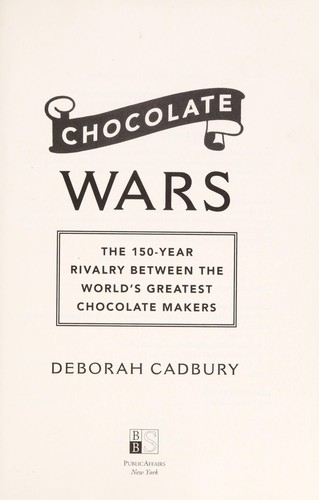
Deborah Cadbury · Buy on Amazon
"We were just making the point with this book that branding goes back into the mists of antiquity, but what we would recognise as contemporary branding also goes back further than I’d imagined before I looked into it. The concept that you can take an ordinary product and associate it with a bigger idea isn’t something that comes from the 1980s or the 1960s. It goes back to Victorian times, and my favourite example is Cadbury. There’s a wonderful book about the brand story of Cadbury, called Chocolate Wars , by Deborah Cadbury, who’s a descendant. The Cadburys were Quakers and the original Cadbury—John—wanted to sell cocoa as an alternative to alcoholic drinks. His son, George, was worried because cocoa has a lot of fat in it, which you have to get rid of, and the way that tended to happen was by putting unpleasant additives in it, like sawdust. So George went to the Netherlands and came across a machine that was like a centrifuge. You would whizz the cocoa around, the fats would go to the edge, and you’d end up with really pure cocoa. He brought that back to Britain. He wanted to make money, but he wanted to make it by having a better product. “Companies come and go but brands, which are these fictions, are bigger than the products and bigger than the company, and outlast them.” Then, without, I think, ever using the word brand, he created a brand and publicised—to use John Berger’s word—not just the cocoa but its purity. He used images. He used paintings of children to express innocence and ‘absolutely pure’ was the slogan. He even started a campaign for pure food. These are all things that you associate with contemporary branding, but he was doing it before World War I. I’m also very interested in the Quaker approach to business. We were talking about ethics. The Quakers—by instinct—had an ethical view of business. It was important to provide something good for the customers but also to look after your employees. They were just as important as your shareholders were. That’s once again becoming a mainstream view about business—after decades in which the only person who mattered was the shareholder. The Quakers were doing it 100 or more years ago. Cadbury famously built a whole village (Bournville) for his workers, and had nice, well-lit factories. He gave people paid holidays, built schools, and so on—because he knew that if he did that the workers would work better and he would make more money. It’s not philanthropy at all. It’s a more rounded view of business that says that business works when all of the people affected by it benefit from it. For me, it is much more that than a mechanism for exploiting the masses and making rich people even richer. It’s bigger and more interesting than that—or should be. They’re fighting against the big Swiss chocolate companies, and then later on with Hershey in America. It still does—and the longevity of brands is interesting. Brands generally live longer than the companies that start them. A business can die, but the brand comes back again. Another example is Polaroid , which has returned making a whole range of consumer electronics. The brand is still working, even though the original Polaroid company is long dead. Companies come and go but brands, which are these fictions, are bigger than the products and bigger than the company, and outlast them."