Philippe Legrain's Reading List
Philippe Legrain was economic adviser to the President of the European Commission, José Manuel Barroso, from 2011 to February 2014, and head of the team that provides the president with strategic policy advice. His earlier career spanned academia, policy advice (as special adviser to World Trade Organisation director-general Mike Moore), journalism, political campaigning (at Britain in Europe, the pro-European campaign) and independent commentating, consultancy and advocacy. He is the founder of OPEN : the Open Political Economy Network, a new kind of think-tank functioning as an international
Open in WellRead Daily app →Europe (2014)
Scraped from fivebooks.com (2014-06-23).
Source: fivebooks.com

Norman Davies · Buy on Amazon
"For me, this book was an eye-opener. We’re normally told the history of Europe from a nationalist perspective or from the perspective of the various kings or monarchs. It’s all an inevitable progression to the countries we have now. This tells a completely different history. It’s about a rich tapestry of peoples and regions and different forces which are much more messy and certainly don’t inevitably lead to where we are now. For example, it corrects the misperception that the Hundred Years’ War was a war between England and France because those nations didn’t exist at the time, and so on. So it’s a helpful corrective in terms of understanding our history and therefore understanding Europe today. The insight it gives is that the nations that exist today are not some kind of enduring reality. They are partly the product of chance and they are ever-changing. One of the conclusions one can draw from that is that one shouldn’t assume that 50 or 100 years now, it will just be a linear progression of the nations that happen to exist today. There’s likely to be more mixing, and more changing, then we like to think. Yes – there’s that and the backlash. There are some people who are more and more international and there are other people who are intensely local. And the people who are intensely local sometimes feel threatened by that change. The other thing about this book is that Norman Davies started off as a historian of Poland. Again, our sense of Europe tends to be very much western European focused, especially in Britain. We tend to think of Europe as Western Europe and that was exacerbated by the Cold War. This again reframes us, and makes us realize how Central and Eastern Europe are just as important and influence the continent’s direction too. It’s 1365 pages, so it’s longer even than Piketty! But you can dip in and out of it, you don’t have to read it sequentially. Also it’s got all these boxes on a variety of topics that don’t fit into the main narrative. It’s fascinating. If you haven’t read it, I really highly recommend it."

Geert Mak · Buy on Amazon
"This is a fantastic book. It’s by a Dutch journalist and writer who spent a whole year — 1999 — travelling around Europe. He weaves together the history of Europe with modern cultural observations. It’s fascinating, both in terms of how Europe’s history remains alive today, but also how much has changed. So he starts off in Amsterdam, which is his native city, and then goes off to Paris, which is where the World Fair of 1900 captured the excitement of the new century. At the end of his journey, he ends up in Sarajevo, which played a crucial role in 1914, but at the time, in 1999, had just come out of the terrible Bosnian war. Yes he’s partly describing and then talking to people who are there now. He’s almost like an artist, in the sense that he just paints pictures and he brings the past alive through people speaking now, which is a rare gift. It’s like the best of documentary television. It’s hard to do justice to it. Again, if you haven’t read it, I highly recommend it. It’s another doorstopper: this book is 876 pages. If your readers are inspired by my selection they’re going to have a whole summer’s reading. Or maybe even several summers’ reading…"

John Peet and Anton La Guardia · Buy on Amazon
"Having had two historical culture books, this is fast forward to today’s economic and political crisis. As befits Economist journalists, it’s a very perceptive, crunchy, and, mercifully, short book. If you omit the notes and appendices, you can actually, in 180 pages, get an overview and perceptive analysis of what’s gone wrong and how to put it right. Their conclusions overlap quite a lot with mine, so I’m particularly keen on the book. They argue that Germany needs to play its part in resolving the crisis, which is something about which Germany is in denial. Like me, they believe that you need to resolve the issues in the banking sector and to write down unbearable debt. Germany needs to play its part in the adjustment within the Eurozone, and the democratic deficit needs to be narrowed. Undeniably many southern European countries were badly governed in the pre-crisis years, and, as a result of that, they would have suffered in any case, once the bubble was burst. But my argument — and indeed that of John Peet and Anton La Guardia — is that the financial panic was largely caused by policy mistakes in Berlin and Brussels. Therefore, the misery inflicted on those countries has been unnecessarily great and they remain crushed by unsustainable debt burdens. Yes, of course, they need to reform, but the false notion that this is all their fault and that this has nothing to do with decisions taken in Brussels and Berlin these two authors, like me, are trying to correct. Greece’s main problem is an unbearable burden of public debt. That debt should have been written down in 2010, as IMF officials advised. Instead, in order to avoid losses for French and German banks, EU policymakers decided to pretend that Greece’s debts were sustainable. They lent Greece still more money to bail out those banks and then imposed barbaric austerity in order to try and get as much of that money back as possible. As a result, Greece has suffered a longer and deeper recession than Germany in the 1930s. Yes, of course Greece has very serious problems which are the fault of domestic policymakers and, indirectly, the voters that voted for them. But German and EU institutions must take a huge share of the blame. One can argue, with hindsight, that Greece shouldn’t have joined. But now it is in there. Even now, most Greeks want to stay in the Euro. Then the onus should be on trying to make the Euro work — and work for all its citizens, not just for the banks in France and Germany. Yes it’s slipped a bit back, but the Euro itself, its external value remains strong — which is a problem for southern Europe because it makes it harder to export. But the fact you have more than 25% unemployment in Greece and Spain, nearly 3 out of 5 young people, the fact you have stagnant economies and so on, actually I think is a bigger sign of failure of a currency than its external value."

Hugo Dixon · Buy on Amazon
"This book is good because Hugo Dixon is making a case for Britain to stay in the European Union from a liberal conservative perspective — and in Britain Euroscepticism, or even anti-EU feeling, is mostly on the right. That’s really, really important because David Cameron has pledged to hold a referendum on Europe in 2016. A book such as this is essential reading for anyone casting a vote. Most of these books tend to preach to the converted, whereas Hugo Dixon is actually trying to reach out to those people who might, currently, be persuaded by anti-EU arguments. First of all, he argues that the single market, and EU membership more generally, is economically beneficial to Britain. It would be crazy to deny ourselves the right to trade with Europe on anything else but the best possible terms — which is what the single market gives us. He argues that outside the EU we wouldn’t be freer — we would just have less sway in the world. He also makes the case that by staying in, Britain has a strong chance to reform the European Union, in particular to complete the single market in a way that would please market-minded people in the Conservative Party. So it’s very much directed at that cross-section of the population. It’s brilliant because it’s targeted at exactly the people who need to listen to those arguments. There are lots of talented pro-Europeans who would have written a different book which might persuade you or me, but wouldn’t reach those people. I should add that the book is also a lot about the benefit of freedom of movement within Europe – which is an important part of the backlash here in the UK. Yes, he used to be at the FT , then he set up Breaking Views , so he’s a very talented financial journalist. He really knows his stuff and writes concisely and wittily. It’s also a very short book. Yes, he’s clear-eyed in terms of criticising the flaws of the European Union, which I think you need to do if you’re going to defend it. You need to say “There are things wrong with it, but overall the benefits outweigh the costs and here’s how we can reform it for the better.” I think that is the right way. Those pro-Europeans who try to defend the EU warts and all aren’t particularly credible. No. France has a veto on changing that. It’s a unanimity decision. So unless such time as you could offer France something that it really wanted in exchange…"
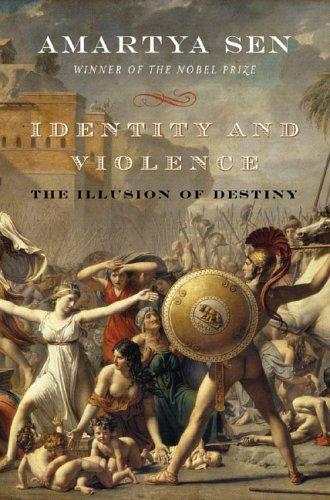
Amartya Sen · Buy on Amazon
"This book is an antidote to the nationalist backlash and the temptation, which we thought we had buried, to put people into nationalist boxes and say that nations are homogeneous and national identity is what uniquely defines us and sets us apart from others. Amartya Sen argues that that is an easy and extremely dangerous trap to fall into. Actually, we all have multiple overlapping identities — so that you can be both British, a Londoner, a husband, an Arsenal fan, a Christian, a liberal and so on. These rich overlapping identities are something to treasure. So while this book is not specifically about Europe, given firstly, Europe’s history and secondly, the current nationalist backlash I think it’s a really, really important book. Yes. The danger is, if you start defining someone in a certain way, that provokes a counter-reaction which in turn can reinforce that. So say you label someone as Moroccan and set them apart from the rest of Dutch society. Then even someone who wants to fit in feels rejected and may then start to define themselves as more Moroccan than Dutch. You can bring about that polarization that didn’t exist before. That’s the real danger of it. Ultimately, if you push it too far, you can end up in violence. Yes it’s a book everyone should read. But it’s particularly relevant now for Europe. The model for the future ought to be a diverse global city like London where part of what makes people proud to be a Londoner is the very diversity there. So diversity is not seen as in opposition to local identity, diversity is seen as part of local identity. I think that’s the wave of the future."