Peter Temin's Reading List
Peter Temin is an economist and economic historian, currently Gray Professor Emeritus of Economics, MIT and former head of the Economics Department. His most recent book is The Vanishing Middle Class .
Open in WellRead Daily app →An Economic Historian's Favourite Books (2018)
Scraped from fivebooks.com (2018-04-05).
Source: fivebooks.com

Thomas Piketty · Buy on Amazon
"Piketty clearly chose the title to make you think of Marx . He wanted to make the point—so that people could hear it—that the inequality of income was very dependent on an inequality of wealth. He talks about the importance of inheritance in older societies and makes that point throughout. He ends up with an argument that, if you want to try to change things now, taxing income has very little effect. Taxing capital has more effect. In contrast to a lot of the books about inequality, he ties together both inequality of income and inequality of wealth. “If you want to try to change things now, taxing income has very little effect. Taxing capital has more effect” This book was enormously important in changing thinking, certainly in Western Europe and in America, about inequality, and bringing it to the fore. He does say that, but it turns out not to be quite so critical in his formal analysis. He suggests some fundamental laws of economics and then puts this in as a very simple exercise. But the point that he’s making is the point he makes well—and other people have made also—which is that as growth slows down, that is a good setting for inequality to increase. The r > g formula that he uses [meaning: returns on capital ( r ) will grow faster than the economy ( g )] is a good, simple way to express that, but it’s not a very firm rule. It does well to explain the flowering of the middle class after World War II , but there are other explanations as well. And so, the r > g is a very attractive way to say this, but one shouldn’t take it as a theorem because it doesn’t seem to be derived from a complicated model. It’s saying that if you have capital it can grow faster than income and therefore increase its share. That’s really the substance of it. I agree with that, yes. Walter Scheidel has just written a book claiming that the only way to really deal with inequality is to have a world war or a plague like the Black Death, neither of which we want to go through. He argues that the best thing to do at the moment is to live with this—rather than look for some cause. Get the weekly Five Books newsletter Now, if there was a change of heart of the very rich—and there might be, they’ve gotten into power in the United States now and they don’t quite know what to do with it—if the political winds change and people can institute a capital tax as Piketty recommends or even some more income taxes as Obama did in his healthcare promotion, then there may be an accommodation between rich and poor. The rich might accept a rather small tax on their income or wealth in return for helping out the poorer members of society. But we’ll have to wait and see if that happens anytime soon. The point is that if you want to reduce wealth you have to have a tax. At the moment the Republicans, who are the party of the wealthy, are talking about eliminating the inheritance tax. That would work in the opposite direction. That would work to increase the longevity of wealth and make it harder to better the situation. That’s why I say these things depend on the politics. Yes, the British did a very good job after the wars and tried to break up the bigger estates. The French had taxes to help. But the United States, having gotten itself in this position of extreme inequality, may have trouble pulling itself out."

Michelle Alexander · 2010 · Buy on Amazon
"That’s on my list because it’s very important for America. One of the ways that America differs from Western Europe is that we have the legacy of slavery in our history. It turns out that racism —or race-craft as some people like to call it, to deny that there is even something in race, that it’s all just mystical thinking—is very, very sharp in the United States. It’s also being promoted politically, which is adding another complication. “The rich might accept a rather small tax on their income or wealth in return for helping out the poorer members of society” The new Jim Crow that Michelle Alexander is talking about is mass incarceration. This comes from the drug wars supported by presidents Nixon and Reagan, which singled out African Americans. There were very severe penalties for drugs that were used by black people—and much lighter sentences for the same kinds of drugs, in different forms, that were used by white people. Blacks are only about 15% of the population but they are about 40% of the prisoners in penitentiaries now. They are heavily overrepresented, about three times as much. The argument in this book is that this is like the Jim Crow policies—after the failure at the end of Reconstruction following the Civil War —which kept blacks down in a second-class situation in a permanent way. It’s a kind of polemic. It’s written very vividly and it’s quite a good book, yes. One out of three black men can expect to go to jail now. That’s a very startling figure in the United States. It destroys communities and makes education of children, particularly black children in inner cities, very difficult. We need more resources going into urban education but, instead, we have fewer resources going into urban schools than we have going into the suburban schools. This is a long story that comes about because the blacks were predominantly in the south. Then, as I explain in my book, there is the great migration that came up to the north. When blacks from the south came into the north and moved into cities to find industrial jobs, the whites moved out into the suburbs. “These books all fit together into a picture of rather sad race relations in the United States. Sad and very durable” Then, you have various Supreme Court decisions. A famous one was the 1974 Milliken decision about Detroit. People sued and said the difference in funding between the urban, poor school districts and the suburban—now white—school districts around there, was unconstitutional. The Supreme Court ruled no, that it would be unconstitutional if the intent of drawing school boundaries was racist, but if a school boundary became racist by the moving of population rather than by the formulation of the law, then it was not unconstitutional. So that’s a court decision that condemned black, urban school districts to poverty and the suburban schools to have more prosperity. Now, there are some states where the state courts have ruled that poor funding for urban schools is unconstitutional. And so, there has been, in a few cases, some amelioration of this federal rule. But the federal rule is still the stronger one in the country as a whole."

C. Vann Woodward · Buy on Amazon
"Now we’re going from these very recent books by Piketty and Alexander to historical books , because I’m an economic historian. I like these. C. Vann Woodward wrote a book that has become a classic, about the origin of this system that we have in the United States. It’s not the Civil War, not slavery, it’s taken way back in my book to understand where it’s coming from. But then, after the Civil War and then after Reconstruction, white Southerners recreated a system of laws and social repression called Jim Crow laws. C. Vann Woodward wrote what is still the most compelling account of that, in the late 19th century. That’s the framework that still survives today in many ways. And, of course, that’s the reference in Michelle Alexander’s book, which she’s taking off C. Vann Woodward, just as Piketty was taking off Marx. These books all fit together into a picture of rather sad race relations in the United States. Sad and very durable. The name is rather mysterious but I think it comes from a minstrel character. It’s not an actual person. But it’s quite common now to represent racist repression. I have that example in my book, partly because I live in Massachusetts. It’s really very upsetting and a little surprising. It’s almost as if people in the FTE sector—the upper sector of the economy—have forgotten about mass incarceration. This is a major social experiment, characterised that way by criminologists, and it has just vanished from sight. That’s true in Massachusetts, which is a great academic centre. There are people who study it and I read their books. But in public discussion, it’s almost invisible. In the presidential campaign that we just went through, it wasn’t even mentioned—by either candidate. “One might say that what has replaced Marx and his thought about industry dominating the economy is finance” I’ve just written a paper —with the aid of Robert Solow, a 92-year-old Nobel laureate in economics—about how we’ve gotten to a new equilibrium of mass incarceration. Unless something is done to shock the system, we’ll just carry on with this kind of mass incarceration and destruction of urban communities. We’ll see the effects, but we won’t be going back to the causes of it. That people become conscious of it, that they read these books and understand it. Also, that politicians get more concerned with what’s going on. There might be some event at a prison. It’s very difficult to know—once it gets put on the backburner—how to get it back up into our consciousness. One possible way is if we have a recession—which we may well have, inevitably, in the next some years—and then states may be looking at how to save money. When they discover that they are spending large amounts of money keeping prisoners in state prisons, they might say, ‘We really have too many people here. We’ve put them in for long sentences, they’re all growing old, and we’re supporting them. We can’t afford it anymore.’ That might be a push. But the push has to come to change the law. There was a bill in 2010 to reform sentencing procedures. That made a start. You could have more laws like that, that would try and get us out of this bad equilibrium back into a better equilibrium."
John Hicks · Buy on Amazon
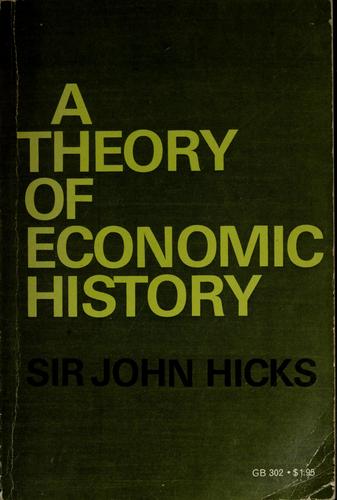
"John Hicks is another Nobel prize winner in economics. It’s a short book making sense of economic history . I love it when scholars can take a mass of information and then simplify it, to make a narrative of it, and give some shape to it, so that you have a way of understanding it. This is a book I read some years ago and I’m going to say the same thing about the final book I chose, by Marc Bloch. Get the weekly Five Books newsletter John Hicks was known as a theorist and not at all as a historian. Somehow, in talking to people and reading about it, he had a sense of how you could just make a kind of thought experiment about how things developed and how one thing led to another. It’s not so much that it’s right— because, you know, it was written a while ago and we’ve learned a lot more about how things develop now—but that it really provided a framework for people to think about this long view. I love it. I recommend it to everybody. It’s a short book and a very good read. I recommend it highly. It’s about starting out with being farmers. Then a few people get interested in commerce. Then there’s a long description of how you have an agrarian society with commercial activity stuck onto it as a little ornament. But then the commercial activity grows. It has increasing influence and eventually it begins to have some political influence. Then it becomes a larger and larger part of the economy and the political framework and that lasts for quite a long time. And then, when you begin to get industrialisation and what we call modernisation then, in fact, agriculture declines and you have commercial activity that really takes over the economy. It’s a way of putting that whole sweep of history together which I find very appealing. I like the way he did it. Nothing has really replaced Marx in that way. Piketty expects to do something along those lines. Hicks’s book also talks about the changes in the economy. “What’s replaced Marx’s theory of capital, you might say, is the modern theory of finance” I think, today, one might say that what has replaced Marx and his thought about industry dominating the economy is finance. People think that finance will be the new capital that will run the world, but it’s not a Marxian class notion. As part of this, I put the class back into it in my book on the dual economy. But what’s replaced Marx’s theory of capital, you might say, is the modern theory of finance. That would be the short answer to that question."

marc bloch · Buy on Amazon
"This is just a book I’ve always loved. I read it as a young man. It is also making sense out of a very complicated period—the medieval period. This translation dates from 1961 but the book was written in the 1930s, because Marc Bloch was a member of the French Resistance and he didn’t survive the war. “I bought it well over fifty years ago. It’s just a joy forever” It’s an older book but, again, it’s taking a mass of information that has no shape and tries to put shape on it. In contrast to Hicks—where it’s an economist trying to be very economic and very briefly stating the essence of his theory—Marc Bloch is a historian who loves the details and goes into how everything fits together. In my own research, I’ve always remembered a phrase used by Marc Bloch. He’s trying to explain how he got things out of this very incomplete information in the medieval period and he says. ‘Now I must take you into my kitchen to explain how this was done.’ Just this image—of taking you into the kitchen to explain what he was doing, in the background, to make this sumptuous banquet that he’s put in front of us—has always struck me as the essence of what people like me do. Marc Bloch tried to make sense of the ancient world; I’ve tried, now, to make sense of the current word. I just love his very graceful phrasing of this, and so I love to go back into that book. When you asked me about my five favourite books, I just couldn’t resist putting that book on the list because I’ve known it—I bought it well over fifty years ago—and I’ve had it on my shelf and I go back into it. It’s just a joy forever. This interview took place by telephone on March 15th, 2017"