Paul Tucker's Reading List
Paul Tucker is a research fellow at Harvard’s John F Kennedy School of Government, writing at the junction of political economy and political theory. He is the author of Global Discord: Values and Power in a Fractured World Order and Unelected Power: The Quest for Legitimacy in Central Banking and the Regulatory State .
Open in WellRead Daily app →The Administrative State (2018)
Scraped from fivebooks.com (2018-10-19).
Source: fivebooks.com

Jason M. Landis · Buy on Amazon
"That’s exactly right. Landis is one of the high priests of the administrative state as it developed in the United States during the New Deal under President Roosevelt. He was a commissioner at the Federal Trade Commission, which is the competition authority in America. He was one of the architects of the Securities and Exchange Commission, and I think chair it for a while. Later, in the 1960s, he was an advisor to incoming President Kennedy on all of these things. For a while, he was the Dean of the Harvard Law School, but his career unravelled as a result of various personal disasters. “That is what the debate about the administrative state is ultimately about: its dryness belies its importance to how we govern ourselves.” In the mid-30s he wrote this book, which was, in a sense, the manifesto of the administrative state. It’s a book I suspect is not terribly well known outside of America, but ought to be. It captures a number of the main themes of the debate that continues to this day. At the heart of Landis’ argument is the idea that the economy and society have become a lot more complicated: that expertise capable of comprehending that complexity therefore matters above all else, but that we can’t expect our elected representatives to have the necessary expertise. Part and parcel with that, he envisages regulatory bodies which make policy, write rules, investigate compliance with those rules, and adjudicate enforcement measures. That, of course, looks like a complete violation of the doctrine of the separation of powers. Get the weekly Five Books newsletter In other words, he seems to advocate a system of regulatory agencies that almost sweeps away the standard separation of powers between legislature, executive and judiciary because, somehow, he sees that as outdated. Instead, you need to divide government by subject matter: competition policy, labour market policy, capital markets, monetary policy, and so on. Each subject would have a specialist agency responsible for (more or less) everything in that field, with decisions made by a group of commissioners: hence the Securities and Exchange Commission , Federal Trade Commission , Commodities and Futures Trading Commission , and so on. At that stage, in the 1930s and 40s, I think he regarded it as largely benevolent. Nor did he pay much attention to the prospect of capture by industries. Later, when he was advising president-elect Kennedy, he changed tack. He concluded that these agencies should be led by a single head to give them greater dynamism, and that the single head ought to be closer to the president, so that the president can coordinate policy across the various agencies. That’s a rather different vision. Again, I think he didn’t foresee the pitfalls. In a sense, much of the subsequent debate about the administrative state, and about even about central banks, revolves around finding problems with Landis’ vision."

Theodore J. Lowi · Buy on Amazon
"That’s right. Theodore Lowi was a political scientist in the United States. He published two versions of this book, one in 1969 and one in 1979. The subtitle of the second edition is called ‘The Second Republic of the United States’. What he wants to argue is that the old liberalism of the nineteenth century has been transplanted by a new liberalism—Landis’ New Deal new liberalism—and he hates it. I want to quote a couple of sentences: “Policy without law is what a broad delegation of power is.” Elsewhere, he writes “a government of statutes without standards may produce pluralism but it is a pluralism of privilege and tight access.” He’s arguing that there are big problems with Congress and parliaments passing laws with vague delegations that just hand over the power to decide high policy to unelected technocrats—regulators—who then consult the various interest groups in society. He claims that that is just a battle of power, with policy and other outcomes turning on who has the greatest lobbying power. He wants to get back to a world in which the legislature—the people that we’ve elected—debates the common interest. And, yes, they might delegate to technocrats, but they should not delegate on the basis of a vague mandate. Those themes are absolutely central to my book."

Giandomenico Majone · Buy on Amazon
"Majone is probably Europe’s best thinker on these issues. He is neglected in the United States, to their cost I think. Although Dilemmas is partly about Europe, this book also usefully summarises the account Majone developed in earlier work of the warrant for delegation to technocrats. He distinguishes very helpfully between two types of delegation. One is to an agency that is literally the political principal’s agent, whose job is to do what the elected politician wants done but doesn’t have the time or technical expertise to do him or herself. So if the politician has set the agent a vague mandate, the agent must consult back on what the politician wants them to do or, if they can’t do that, the agent has a duty to make a judgment about what their political boss would want them to do. The risk here is that, rather than faithfully sticking to their duty, the agent may wander off the ranch, pursuing either their own self-interest or their own view of the public interest. Support Five Books Five Books interviews are expensive to produce. If you're enjoying this interview, please support us by donating a small amount . Obviously that is not a model for an independent agency at all, because their leaders are not meant to keep going back to their political principal. The other type of delegation Majone describes is quite different, involving what he calls is a fiduciary relationship (and in my book I call them “trustees”). The idea is that the elected politicians want to commit to a particular policy but, as elected politicians, they can’t be trusted to stick to that objective themselves because the imperative of being re-elected, of being more popular than the opposition political party, will always dominate in the short-run. So instead the politicians appoint somebody who is obliged to stick to the trust deed—the legislated mandate—but is not obliged to go back and consult the politicians on what they should do on particular decisions: they have delegated discretion. Therefore, the politician can’t change his or her mind about policy without changing the law. This is exactly how independent central banks are set up, and the general arguments for choosing between day-to-day political control or delegation have been formalised by economists such as Alberto Alesina and Guido Tabellini. Majone brought those arguments into broader political science debates, and without the algebra. What is more, Majone’s writings explicitly connect these choices to questions of legitimacy. He does not get into that deeply, but crucially does ask under what circumstances this type of fiduciary delegation can be legitimate. He answers that we should (or may) delegate to trustee-type agencies the pursuit of economic efficiency (making the cake bigger), but we shouldn’t delegate distributional issues (how the cake should be shared). I broadly agree with that, but he doesn’t say very much about how you do it. And he assumes that the dividing line is clean, but it’s not. So far I’ve picked books by three political scientists: one of them, Landis, celebrating the administrative state, one of them, Lowi, attacking it (and in particular vague delegations), and the third, Majone, slightly more nuanced, distinguishing different types of delegation. If we follow Majone, you want some parts of the administrative state close to day-to-day politics but others at a distance. Suddenly, we’re confronting deeper questions. What do we want our politicians to do on our behalf when they structure the administrative state? How should they decide where to draw the lines—and on their own ongoing role—so as to maintain the legitimacy of the system of government? At this point, we have to move away from political science and turn to political theorists."

Jeremy Waldron · Buy on Amazon
"Absolutely. Of the two contemporary political theorists I’m going to talk about, Jeremy Waldron and Philip Pettit, Waldron (who is also a legal theorist) comes from an explicitly liberal tradition and perspective. As you said, he places great emphasis on what he calls ‘the circumstances of politics’: that in politics, disagreement is not only pervasive, but also goes to the deepest issues (what is just, which ‘rights’ we should have). In this respect, he stands aside from the school of political thought that descends from John Rawls, the dominant political theorist of the past 50 years. Rawlsians suggest that, somehow, we can conduct a thought experiment about a preconstitutional moment when all the big things about justice and the pursuit of justice are agreed. Waldron wants to argue that, no, actually, we disagree even about basic rights. This leads him to be much more interested than most of today’s political theorists in parliaments and legislatures as lawmakers. Support Five Books Five Books interviews are expensive to produce. If you're enjoying this interview, please support us by donating a small amount . It also puts him outside a lot of legal scholarship, which barely looks at legislatures, compared with courts, on the grounds that since statutes are vague and indeterminate, it is the judges who later decide what the law is. Waldron says, no, that is a mistake, because the legislature is the public forum where our debates about public policy are and ought to be resolved (for the time being). This is what I really value in his work: it underlines that questions about the structure of the administrative state, and in particular about delegating to independent agencies, must be settled in the elected legislature. He gives us a principled case for this given some of our deep political values. Some of the essays in Law and Disagreement are really interesting on how to think carefully, within the liberal tradition, about the processes of legislating. Well, he doesn’t talk about them very much, but one of the chapters of Law and Disagreement does explore the central idea and value of credible commitment, which was at the heart of Majone’s (and my own) case for fiduciary delegations. Waldron discusses commitment in the context of constitutions and, in particular, constitutional courts. Should the Supreme Court have the right to strike out legislation passed by the Parliament/Congress? Amongst many other things, he is famous for really disliking judicial review of legislation which, of course, America has but we don’t have in Britain. He mounts a very eloquent argument. But when we come to apply this to the administrative state and, especially, independent agencies, Waldron’s discussion of pre-commitment is limited because it is binary. Either a commitment device is entrenched all the way down, or somehow it is not, and we (the people, or, more accurately, our representatives) can change our minds. Actually, it’s not like that. While I completely agree with Waldron about the deep importance of the legislature, his model of commitment is too thin. Making commitments credible is about raising the costs of reneging, and so comes in degrees. Even without full constitutional entrenchment for a particular law, we can put visible obstacles in the way of government changing course. In that sense, all law and especially legislated law is a commitment device: otherwise government officials could go into work each day and just decide whatever they want to do there and then. Legislation constrains them, as it takes a public effort and some costs to repeal or amend legislation. So primary legislation that delegates to an independent agency can both deliver the values associated with legislative debate and help to embed the mandated policy."

Philip Pettit · Buy on Amazon
"I think this is a really great book—a profoundly important book. There’s a more popular version of it ( Just Freedom ), which I think didn’t reached the big audience that it deserves. I want to say a few things about Pettit. The first is that, even more than Waldron, he departs from the dominant strain of political theory over the past forty or so years. His message is that it’s not just about justice; it’s about legitimacy, too. Part of Pettit’s project is about giving legitimacy equal rank with justice. That happened to be the entry point for me into my own project: under what conditions can the extraordinary powers of unelected central bankers and regulators be legitimate in our democratic societies. The mainstream liberal principle (on both the political left and right) is that we as individuals should be free from interference, with politics revolving around disagreements about what that involves. Pettit, the historian of ideas Quentin Skinner, and others want to draw on a different part of the West’s political history: the republicanism of Rome, some of the Italian city states, and some of the U S Founding Fathers. This prioritises freedom from domination: if I’m a slave with a completely benign mistress or master, I am still a slave. Pettit argues that we can only be free in that sense—free from domination—if there is some kind of popular control over our governance, with the capacity to shape our government and contest government’s choices, policies and actions. He thinks that representative democracy is important to achieving this, provided there are venues for challenge and plenty of public debate. In terms of thinking about the administrative state, this leads him to the idea that the public, after debate, might want to put certain things beyond the day-to-day reach of politicians. Where the people’s purposes are clear and have been legislated, but elected politicians have incentives to depart from pursuing those purposes (say, pursuing a higher rate of inflation), the lack of constraint on the politicians means the people are exposed to domination. In those circumstances, we might want our elected representatives to constrain themselves by delegating to an independent body, such as to an independent central bank for price stability or an electoral commission for the integrity of the electoral system. Get the weekly Five Books newsletter Going back to Majone’s distinction between agents and trustees, what I take from this is that a trustee-like independent agency must be given a clear objective (as otherwise how can we tell whether or not they are sticking to the people’s legislated purposes), and its leaders must have incentives to pursue that objective. That harness depends on their valuing the public and professional esteem accruing from doing their job. So here we find a modern version of the old republican idea of being honoured for public service. In Pettit’s account of our inherited republican values, therefore, we now, finally, have some grounds in political theory for squaring institutional commitment devices with representative democracy: it is credible commitment to the people’s purposes that matters. “It is credible commitment to the people’s purposes that matters.” Bringing Waldron back in, the crucial thing is that the public can always change its mind. They can go back and press their elected representatives to repeal or amend the law that delegated to the central bank (or regulator). But the politicians themselves can do that only in a very public way, through a debate and vote in Parliament or Congress. The legislature is there to be seen, and so can’t undo the delegation surreptitiously—Congress can’t just ‘un-delegate’ to the Federal Reserve in secret by decree, overnight, without telling the American people and without going through the normal parliamentary process. “Everything comes back to the elected legislature” So, with Landis, we’ve ended up distinguishing between different degrees of insulation, with independent agencies looking quite distinct from other agencies that are under day-to-day political control. Meanwhile, with Lowi, we can find the beginning of solutions in Majone, Waldron and Pettit. Lastly, compared with Majone, we discover some grounds for different types of delegation—rooted not just in economics, but in our political values, drawing on both liberalism and republicanism. What my own book attempts to do is weave all of that together, bringing the economics of incentives (or institutional design) into line with democracy, the rule of law and constitutionalism. Yes, I completely agree. A few years ago, somebody from the Bundesbank said it’s very important that central bank independence isn’t debated, whereas I think that is absolutely the wrong way around. It is very important that it is debated. That feature of constitutional democracy is not something that, if you like, is timeless. It’s something about our particular political values… Yes. For us, legitimacy “now and around here”—to quote the late British philosopher Bernard Williams—entails public debate and accountability. Central bank independence or the independence of regulators is not something that’s okay if we never actually discuss it. It has to be discussed. That’s why testifying to parliamentary and congressional committees isn’t an ordeal, but the very lifeblood of an agency’s legitimacy. This is where I completely agree with Waldron. Everything comes back to the elected legislature, because our system of government ultimately depends upon the legislature drawing lines between the pursuit of efficiency and of equity, reconciling our disagreements on various fronts for the time being. Legislation itself is a commitment device. You can’t flick a switch and it’s no longer law; you have to go through a process to change it, and it’s done in more or less bright sunlight. We debate legislative change, which is terrific. My book is trying to draw on both our liberal traditions and our republican traditions. The problem with the liberal tradition, as Lowi saw, is that it too easily ends up saying that vague delegations are inevitable, and therefore we must have these technocrats overseen by the courts and we must make it easy to challenge their rules and decisions via the courts. “The problem with the liberal tradition, as Lowi saw, is that it too easily ends up saying that vague delegations are inevitable” I don’t want to argue against those processes, but they can’t suffice because they amount to no more than one group of unelected officials (judges) overseeing another group of unelected technocrats (central bankers and regulators). So, if we have legislatures that just pass vague statutes—in effect handing over their power and responsibility to set high policy—and then say that judges will see it’s all okay, then something has gone deeply wrong. Yes, exactly. That’s why I wanted to draw attention to Pettit’s book, because I think the traditions of legal liberalism, as people sometimes call it, just cannot be sufficient given our political traditions and values. In the technocracy versus populism debate, part of the reason—but by no means the only reason—why there’s a public backlash is that a world of technocrats overseen by unelected judges is not what our system of government is meant to be. Undemocratic liberalism will not do for us. It is. Echoing US Founding Father John Adams’ description of aristocracy as ‘the few’, an expression I use in Unelected Power is ‘the new few’, where the new few is central bankers, top judges, and top regulators. That wouldn’t be a safe, sustainable place to end up."
Geopolitics and Global Commerce (2023)
Scraped from fivebooks.com (2023-10-27).
Source: fivebooks.com

Bernard Williams · Buy on Amazon
"Bernard Williams, who died just over twenty years ago, was one of the very top late-20th-century moral philosophers . Towards the end of his truncated life, he started writing political philosophy . It’s a great pity for all of us that he didn’t have time to write more. He was mostly focused on the state but with a realism that does not junk morality, and in ways I think important for international political theory. He does something tremendously important. For half a century, most political philosophy has started from John Rawls’s famous question about what conception of justice we should have. Williams says that we can’t start off with any off-the-shelf external conception of moral obligation, be it Utilitarian or the Kantian theories that Rawls and his followers adapt. Instead, we ought to start by recognising that basic order—what he calls the First Political Question of how to establish and maintain order, safety, protection, degrees of trust—is a precondition for cooperation of almost any kind, including debating and pursuing justice. Since basic order is today invariably established via the state having a monopoly over coercive powers, we need to start with how that can be legitimised to the people in their particular circumstances. This means the hierarchy of authority being broadly accepted on the basis of reasons and justifications that make sense to people. Otherwise—and I don’t think Williams says enough about this—there will be resistance, which could be either passive or active. “Part of the attraction of this for me is that it avoids problems in the standard schools of international relations” Going back to your question, although Williams writes about the state in the context of the challenge of achieving domestic order, his approach can be—and I think needs to be—applied to international relations and cooperation. What does maintain order in the world as a whole? And, for a given order, what are the legitimation norms that powerful states—superpowers, great powers—go along with in accepting each other’s power, or in living in the presence of a leading, hegemonic power, such as the United States over recent decades? How is any order justified to states that cannot project power? Why should they go along with the order they find themselves in (or under) rather than quietly resist it? So, Williams’s way of thinking about the question of domestic order and the legitimation of domestic authority, can be taken to international relations. As you said, for Williams, and I agree, this doesn’t eject morality because the legitimation norms that hold any kind of order together, domestically or internationally, have moral content, and also some moral force to the extent that they are internalised by people and states. But they emerge from the circumstances of politics rather than off a pre-political morality shelf. Get the weekly Five Books newsletter Part of the attraction of this for me is that it avoids problems in the standard schools of international relations. Caricaturing somewhat, for realists everything is about power, with the focus on war and peace. At the other end of the spectrum, for idealists, everything is ultimately about values, with the focus on human rights, poverty and development. And for a group in between, everything is about how interdependence affects interests, with the focus on economic regimes, especially trade. By starting with both order and legitimacy, Williams helps us step around a rather stale ‘realism vs. idealism’ debate, and so is more realistic in the ordinary sense of the word. For some years now, there have been active debates about Williams’s realist political theory, but not much actual application of his ideas and framework to particular fields. He would have hated the word ‘framework’, but he’s certainly laid out things that can be applied fruitfully, and that yield tangible insights. Both my books are basically attempts to do that. It’s true that he was especially focused on the role of liberalism in modernity—now and around here, as he liked to say—but I think he would have been very interested in what the Chinese people feel about their own system, and whether they feel free to discuss it among themselves. He wasn’t keen on our reaching judgments about the legitimacy of historical regimes (such as medieval feudalism or the Athenian regime with its slavery) even though questions of legitimacy would have been just as relevant to them, within their circumstances and the norms that had some grip in their circumstances. But, for states today, I think he would have thought that, as well as being curious about local legitimacy in China, we should reach our own view as China presents itself to the world as a realistic alternative. In a sense, commercial society brings those confrontations, as well as potentially promoting the convergence we discussed earlier. Essentially, that’s what’s going on geopolitically now. People aren’t worried about whether or not China thrives for itself as such, and China, presumably, isn’t worried about whether we thrive for ourselves, but each is worried about whether one set of powers will press or even force the other to be like them when they don’t want to be."
David Hume · Buy on Amazon
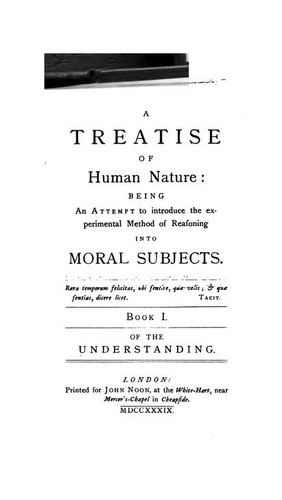
"Hume is widely held to be one of the greatest philosophers of all time, and I suspect features as such on Five Books . He wrote his first book, A Treatise of Human Nature , while in his mid-twenties, which is mind-boggling given its brilliance. For very good reasons people typically focus on Books I and II of the Treatise, but Book III, Of Morals , contributes something that Williams lacks: an account of collective action and, therefore, of institutions. Hume effectively does that in ways that, I suspect, were hard fully to comprehend until game theory had developed and advanced to levels bringing people like Roger Myerson a Nobel Prize. In doing this, Hume talks about how some collective problems and opportunities are addressed with conventions. Some are obvious: all drive on the right (or left). Others, less obvious, blunt incentives to free ride on others’ efforts, and so help cooperation. He sets out how some such conventions are rooted in habits, while others develop into habits and even become social norms. If we then internalise the value of the social norms, they develop some moral force even when their original functional purpose has fallen out of view. These are stylised stories or, as people call them these days, vindicatory genealogies (not the subversive genealogies Nietzsche was fond of). A great example is the institution of promising and keeping promises, which Hume analyses in Book III . But to the extent that all that’s been picked up by scholars in our lifetimes, it’s been mostly by social scientists who can make Hume seem as though he’s purely a rationalist, whereas he’s nothing of the kind. “Hume talks about how some collective problems and opportunities are addressed with conventions” Anyway, we become attached to some of these norms, which can be useful if it helps us stick to our considered longer-term objectives. Ultimately, they are mechanisms for channeling our passions and redirecting our interests. So, he has interests and values intermingling, but we can also reflect on these norms—artificial virtues, as Hume calls them—and see whether they withstand reflection, and he wants to argue that many of them do. What’s unique and useful about this is that Hume, even more than Williams, manages to bring power, interests, and values into a coherent story; one that is explanatory but can also be normative. But he does a lot more than high theory. He wrote many essays about topics ranging from the balance of power (which is explicitly about power and international relations) to money and trade (including how the jealousy of trade drives states into mistakes). And yet what eventually made him famous in his own lifetime was something that’s barely read these days, his History of England in many volumes. It’s a narrative history but also a political science, even philosophical, history of English governance. Hume is stupendously interesting. There are few questions where he doesn’t have something important to say. And yet, the main schools of international relations scholarship I mentioned earlier follow Hobbes , Kant, and Hugo Grotius (the early international lawyer), with Hume not featuring much at all. I think he ought to, and that we need him right now. Mainly the state (princes, as he calls them), but with observations on relations among them. He talks about how the institutions of government itself are based on conventions to help address problems facing really large groups of people, and about how we learn to give government allegiance except when it is horrible or abject. In his hands, legitimacy is a matter of opinion, but he doesn’t say enough about the things that get weighed in forming an opinion on whether a particular system of government is legitimate. Williams says more about legitimation than Hume. He was evasive about his relationship with Hume. He started off his career pretty Humean but in a late interview commented that he found Hume, who was a jovial man, too optimistic. In a deeper sense, though, in my view William remained indebted to Hume. But in any case, he needed Hume, and I think he filled some gaps left by Hume concerning legitimation itself which involves offering justifications and, I would add, making compromises. I think there is, and it comes back to the point about commercial society. Hume talks about international law and—I can’t remember the exact words—says something to the effect that relations among princes reflect the same kind of interests and forces that underpin domestic governments and law but tend to be much weaker because they depend on each other much less. I’m confident Hume would have been open to the idea that that was a contingent fact about the world in which he lived, and that the more interdependent and the more integrated states become, the more their leaders (but not necessarily all of the public) internalise norms that help underpin, constrain, shape degrees of cooperation. What’s nice about this in Hume is that it’s historically contingent, with norms related to what goes on in the world. Expanding commerce will draw on existing norms and, over time, maybe change some of those norms as well. You might need new inter-national conventions because you face new problems, but that generates tensions because, for most of us, order and cooperation at home are more vital. “Hume thinks that institutions and norms frameingpractices that have grown up spontaneously are more likely to endure” Some people love and others hate the mushrooming of international organisations and international treaties since the Second World War and, in particular, since the end of the Cold War . Some of this has been a process of norms and institutions following the emergence of things in the world that people had shared interests in shaping or constraining or doing something about. Also, however, some of it has been people pushing treaties and organisations to further their own agendas about global integration. There’s a sense in Hume that he thinks that institutions and norms helping to frame practices that have grown up spontaneously are more likely to endure. But, unlike some followers of Hayek (but perhaps not Hayek himself), Hume does not rule out design at all. In fact, he talks about the assumptions that should be made when devising a constitution, which I suspect we will come back to later when we discuss an ancient Chinese writer."

Stephen Neff · Buy on Amazon
"First of all, this is just a lovely book, as well as being one I happened to learn lots from. It’s a history of international law that, in keeping what we have been discussing, gives a place to power, events and wars, but also to ideas and values, and to interests. Most people, including myself, would regard Hume as trying to escape from various natural law theories that had been promulgated and circulated over the previous 150 years or so before he was writing, but one can give a Humean explanation of why the natural law he wanted to reject had grown up. That is a story that Neff tells wonderfully well without framing it in Humean terms. In the Old Christendom, before the Reformation (and Renaissance ), disputes among peoples, princes, nobility, might be settled in the canon law courts of the church, with ultimate authority resting with the Pope—or, for large parts of continental Europe, in the institutions of the Holy Roman Empire, culminating ultimately in the authority of the emperor. However well that worked, and it worked tolerably well in some respects, it could not work after the Reformation because, crudely, the Protestant states, princes and peoples weren’t going to accept the authority of either a Roman Catholic pope and his institutions or a Catholic Holy Roman emperor and his institutions. And yet, disputes and various kinds of conflicts still needed resolving if war was to be avoided. Natural law grew up—very much, in a sense, as part of the history of international law—as an attempt to address the question: what common norms do we have that we can apply irrespective of where we stand? Neff tells that story really well, as a story about power and as a story about norms and ideas. In other respects, the development of international law was, as modern scholars have pointed out, part of the history of colonialism. Right from the beginning, when Spain was taking control of parts of Latin America, there were debates in the University of Salamanca about whether it was permissible, and on what grounds it was permissible. Was it permissible if the emperor or the pope said so? Very roughly, did the emperor or the pope have ultimate authority over the seas and lands? And then, as trade expanded, was it permissible to interfere with another European state’s trade in the Far East? “Neff tells that story really well, as a story about power and as a story about norms and ideas” Grotius wrote one of his early contributions to what became international law in the context of a Dutch ship having clobbered a Portuguese ship in the East Indies. All those circumstances are morally ugly, but the people concerned found themselves confronting what they saw as problems for them , developing institutions and norms to help them maintain order among rivals. So, again, the development of the natural law tradition in international law comes from a set of problems that a unified Christendom could no longer resolve. Neff tells another story that is tremendously important for us. During the 19th century, the commitment to positivism in all its forms, including legal positivism, was such that morality came to be seen as a separate realm from the concrete law. There are various ways of thinking about positivism in international law but to pick just one, it amounts to a series of contracts between states, with their force depending upon serving the parties’ interests. And then, that broad way of thinking about international law was thrown into crisis after the Holocaust . Crimes against humanity (the language of Nuremberg), and of genocide (a term used in the Nuremberg indictment but not formally a crime in itself until a bit later) were things that seemed to transcend anything that positivists could fit into their broad framework. We were back to some values that we couldn’t imagine life without. It was like a revival of the natural law tradition, or a part of it. I think that fits with an explanatory story along the lines of, ‘my God, we did that to each other. That mustn’t happen. That’s a problem for the world.’ Values help us address the problem but only so long as they are instantiated in some kind of positive institution. Stephen Neff tells all those stories, and many others as well. His blending of the intellectual history and the institutional history and the power relations around them makes for a great read, hugely educative and at times moving. Not right up until today, but he tells the history of international law as it bears on trade and commerce, including in and on China, in a really interesting way. To put it very crudely, the changes in international law as it applies to the economy are quite extraordinary. Again very roughly, in the 19th century, as a last resort, war was permissible as a form of debt collection. You had to try everything else first. If you had tried everything else and it hadn’t worked, then force was permissible in international law. From the first quarter or so of the 20th century, that became the opposite: an act of aggression, and so illegal under international law. The other way around, once again in broad summary, there were probably more constraints on applying what we call sanctions, and secondary sanctions, in the 19th century than today. Physical war is more legally constrained than in the past, but de facto economic combat less so. Oona Hathaway and Scott Shapiro at Yale have a wonderful book about that turn. It is also part of Neff’s broad canvas. Some of these things were quite startling for me. To realise that the international norms that govern trade and investment have, in some cases, changed enormously. In others, there’s continuity. Today’s cross-border investment treaties, which are mainly bilateral treaties without an international organization, codify a much longer-standing customary international law that you can’t just go around taking foreigners’ property. Neff helps us to see very concretely how the past informs today’s norms and institutions, which is a big theme in Williams and Hume."

Ian Clark · Buy on Amazon
"I see this as another book in the tradition of Hume and Williams, without that being up front in the book itself. In fact, given scholarly criticism of the English School of international relations lacking a principled grounding, we can say the English School needed a Scotsman. The first thing to say is that Legitimacy in International Society is a fascinating read. I read quite a few history books, and many histories of wars or conflicts are devoted to the causes of the conflict and the navigation of the conflict. Then the conflict comes to an end, there’s a treaty, and everyone goes home. End of book. Alternatively, people sometimes write about the circumstances and negotiation of particular treaties (as in Margaret MacMillan’s book about the post-WWI Versailles Treaty). Thank goodness those books are written, but books that put a series of treaties in the broader context of the evolution of international law, norms, and order are rare. Clark’s book takes some of the key moments of the past half-millennium—Westphalia, at the end of the Thirty Years’ War ; Utrecht, at the end of the war of Spanish Succession; the Congress of Vienna, after the Napoleonic Wars; Versailles; and then the collection of treaties after the Second World War—and sets out descriptions of the negotiations, the contexts of the treaties, and most important the evolution of norms of legitimacy among powerful states. It’s not a long book. It says that what’s always going on in these really big international pacts are questions about legitimacy, which are: who has to be included in the ‘we’ for order to be restored and sustained, and what are the norms they will sign up to, to try to sustain peaceful coexistence in the period ahead? This shows that norms are both tools and something that we live with, but then can be found wanting if a new crisis arises. The book also tells the story of a familiar but still vital point for our generation. Whereas the Vienna Congress brought France back into the fold pretty quickly after Napoleon was defeated, that didn’t happen with Germany after the First World War and the Versailles Treaty, which of course didn’t bode well. Clark also makes slightly less familiar points. After the Vienna Congress and the treaties that came out of it, some of the great powers (including Austria-Hungary, led by Metternich) wanted to agree a substantive principle of legitimacy that underpinned absolutist monarchy. Castlereagh, for Britain, didn’t want that at all. He wanted norms of peaceful coexistence, but he wasn’t going to sign up to their way of governing themselves. “Clark effectively shows how norms and institutions can grow out of particular situations involving the interaction of power, accommodation, and compromise” Although Castlereagh was trying to solve some of the problems the French Revolution had led to, one of which was continental war, he wasn’t trying to set up the norms of legitimacy in ways that prescribed the Austrian, Prussian, and Russian way of governing themselves under absolute monarchy. He wanted to avoid revolution but didn’t want to go further than that. Clark effectively shows how norms and institutions can grow out of particular situations involving the interaction of power, accommodation, and compromise. For example, in some respects, the practices of the balance of power with a norm of consensus among the Powers ended up being crystallized and codified around the Treaty of Utrecht and afterwards. Another interesting development, setting in train a process that accelerated during the 20th century, is that at the Congress of Vienna, the leading powers agreed to meet quite regularly. That met with some scepticism from some of Castlereagh’s colleagues in London, but it went ahead. It was successful on the whole, for a little under a century, at least until the Franco-Prussian War. Of course, it’s done for by the time of the First World War. But the key thing for us, I think, is that this practice of meeting regularly starts to spawn other fora that are recognisable to us. For example, in the latter decades of the 19th century, there were international conferences on subjects beyond war and peace, including on the monetary system, essentially held under the auspices of the system of international relations that Vienna had ushered in. The system had the capacity to broaden participation, with the United States initiating some conferences towards the end of the century. Earlier, after the Crimean War in the middle of the 19th century, the Ottomans had kind of joined the Concert, but not wholeheartedly for uncomfortable reasons. Both Neff and Clark describe a distasteful international hierarchy, in which the Chinese, the Japanese, and differently the Ottomans, were regarded as civilised but incompletely civilised in what, god protect us from ourselves, was known as a ‘standard of civilisation .’ They’re participants in international law but not at the top table. That’s deeply unattractive, but we live in a world where there is still a top table, and not everyone’s there, which is a product of the conditions of some kind of basic order being sustained (power, not values). In fact, we live in a world where there’s a contest going on right now about who should be at the top table. I think Clark’s book is instructive in the way that in the real world of policy-making power, order, norms, interests, commerce, war, and peace all come together, underlining the utility of drawing a higher level framework from Hume and Williams.."

Xuetong Yan · Buy on Amazon
"Before discussing the book, let me say something about Professor Yan. He is a Beijing-based realist (in western terms, roughly Hobbesian) international relations theorist, who is very well-versed in Western political theory. He’s also a Chinese nationalist who in 2011 wrote a piece headlined (in the English translation) “How China Can Defeat America” but, it seems to me, is also someone who might have slight qualms about Beijing’s tactics of over recent years as he seems to prioritise political leadership ahead of military or economic might. Anyway, he knows about us, if I can put it crudely, including the history of our thought, and he has been an influential voice and actor there. The book is fascinating because it’s a description (inevitably, selectively) of the history of ancient Chinese thought on politics, governance, and the ethics of governance, with a read across to international relations. It contains several chapters written or co-written by Professor Yan, and also chapters in which other authors respond to his descriptions of Chinese intellectual history, plus finally an interview with him. As a device for Westerners to learn about ancient Chinese thought before unification under the Qin, which Yan believes is instructive for both theory and today’s global contest, it’s fascinating. In reading the exchanges, we don’t see just a single view of Chinese political thought; the back and forth is instructive. But there is also a message: that China can be a “humane authority” (elsewhere translated as “true kingship”) for the world, and hence an improvement over US (bad) hegemonic power. The second substantive chapter of the book is about an ancient Chinese figure called Xunzi. This is after Confucius . Xunzi is more hard-line than Mencius (or Mengzi, as the Chinese know him). Xunzi thinks that good governance depends pretty much entirely on the character of leaders, and that institutions just aren’t going to do the job. “Yan’s book on ancient Chinese thought is useful for westerners because China is a great power, and it’s going to carry on being a great power” This is almost the opposite of what Hume says. Around two millennia later, he says that when designing a constitution you must base it on the assumption that all the men and women involved are rogues, even though that is untrue. He makes a point of saying that they’re not all rogues, but you’d be most unwise to design your constitution on the basis that they are all going to be benevolent all the time. You can see there the seeds of James Madison, who of course had read Hume. Xunzi, also a profound thinker, is saying that institutions aren’t going to do the work because institutions comprise bunches of people, and if these people have bad character, the institutions aren’t going to deliver for you. Interestingly, both Xunzi and Hume end up talking about the importance of education, as does Williams when discussing legitimation. That raises its own set of issues about whether education can be used to program people to support the regime they’re in (which brings to mind the Frankfurt School of Critical Theory). What a good system of education looks like forms an important part of thinking about politics. Xunzi makes us pause about Hume, and Hume makes us pause about Xunzi. Hume would say, even though all these people of good character have been trained, and the emperor has appointed good people around him or her, are they going to manage to be good every day? Are they going to manage to be good when the short-term rewards are so much more tempting than the long-term rewards can be? Likewise, Xunzi can say to Hume, how are you going to avoid these supposedly robust institutions becoming an empty shell? Both sides of this argument speak to us today. Think of the United States, whose institutions have been jeopardised by failings of character (and still are, in some parts of the system). But also, the institutions have functioned up to a point against flawed characters, so far preventing utter disaster. A reasonable conclusion is that you need both, and so, what does that mean? This is just one example I found, while reading Yan’s book, of an ancient Chinese theorist prompting us to think more carefully about some of the things that are central to today’s predicament. In economics, the importance of institutions was emphasised by Nobel economist Douglas North more than a quarter of a century ago. From that starting point, political economists have gradually moved on to looking at culture. I predict that they aren’t very far from colliding with questions of the normative validity of values and even questions of character (virtue). When they reach that point— and if they do, it will be in formally very clever ways —they will have returned us to the middle of the 18th century, when Hume was both a political economist and a political philosopher. But whatever the read across, Professor Yan’s book on ancient Chinese thought is useful for westerners because China is a great power, and it’s going to carry on being a great power. In any case, the history of Confucian states is extraordinarily rich and interesting. Either way, we ought to be more curious and know more about the history of their thought, as well as the history of power in China. By ‘we’, I don’t just mean the people sitting in the State Department or the British Foreign Office, but people who are interested in the world. In that sense, the publication of Professor Yan’s book in English is welcome. The world order may or may not change profoundly, but it’s certainly being contested at the moment. The people whose books we’ve been discussing are all saying that norms and institutions are partly a product of the order that supplies stability but also shape that order. Today, we’ve happened to live in a stable order for quite a long time. Now it is under stress and the era of silos, in which you can be a monetary policy maker without knowing much about trade policy, or a trade policy maker without engaging much with the laws of war and peace, or, more prosaically, with security policy, is finished. That is for lots of reasons but one of them is that when questions of order are up for grabs, states will use all the instruments at their disposal, and some of them are economic. Blackwill and Harris’s book describes geoeconomics as the use of economic instruments to pursue political and geopolitical foreign policy ends. Examples include seizing somebody’s foreign exchange reserves, throwing them out of the SWIFT international payments messaging system, and applying trade and investment sanctions of some nature. It is not an economics book, nor quite a textbook. It’s a really excellent book for finding out about all the varieties of economic instruments that states can use, defensively or offensively, against each other. It was published in 2016. Less than a decade later, almost everything in the book is happening. Oddly, that was the year that I first set out my thinking and scenarios in the Tacitus Lecture in London. I am not terribly optimistic in the short run. As I describe in the book, this is a contest that I think will go on for decades, maybe a century. It’s everywhere and in everything, neither side can knock out the other, and it is ideological—as evidenced by Beijing’s 2013 Document 9 , which far too few people have heard of. The main powers face each other with two completely different views of how states should be governed and how the world should be ordered. On the other hand, and this is where my book ends up, I think it is vital that we, in the so-called free world (including the Confucian heritage constitutional democracies), don’t forget who we’ve managed to become, that this is an achievement, and that while our values aren’t necessarily values we should impose on other people they are very much values we should hold on to. Order may be the most precious thing, but a way of life that maintains domestic order in ways that most people accept, even if of course they don’t like policy all the time, is a tremendous achievement. You can’t name the people who achieved it because it happened gradually. I’m not terribly optimistic, but I do think we should be very conscious that our way of life is one that is important for us to hold on to. At one level, my book is severely practical. I predicted what has come to be called de-risking, and I wanted some of that to happen even while accepting that there is a risk of overshooting, which would make people poorer, and that obviously would be a bad thing. But we mustn’t leave ourselves overly dependent upon or exposed to what could be a hostile state. I don’t say it is, but it could be. These considerations are symmetric, so there is bound to be some degree of decoupling. In the practical parts of the book, I argue that I don’t think the business community has got its head around that at all, and nor, in a way, would I expect it to. In a similar vein, we see the large international organisations—for example, the WTO and the IMF—struggling. In a sense, they’re bound to struggle because they are creations of the order that is being contested. They’re a manifestation of a particular kind of world order, and they aren’t going to provide the solutions. But the current order has also produced informal fora, like the G20, which can be incredibly valuable because they provide low-cost opportunities for the leading protoganists to meet each other. That, by the way, is why it was quite significant that Xi didn’t go to the Delhi G20 summit, which has extra resonance because India will most likely become a great power. The West has been slow to grapple with this situation, hobbled as it was by the Hegelian myth of an end to history and a kind of myopia that you can be hegemon without being engaged with and having friends across the whole world. I don’t think the contest is going to go away any time soon. If China’s economy stumbles, as well it might, it will be a mistake to compare that with Japan in the 1990s. Even if the Chinese economy moves sideways for a decade, the PRC could probably continue to expand its hard power. A worthwhile strategy for coping—for maintaining peaceful coexistence without giving up on our way of life—needs to avoid both amoral “realism” and idealism. I think the books I have listed can help us with that great challenge, including at home."