Paul Theroux's Reading List
Theroux is an American travel writer and novelist, whose best known work of travel writing is perhaps The Great Railway Bazaar (1975). He has published numerous works of fiction, some of which were made into feature films. He was awarded the 1981 James Tait Black Memorial Prize for his novel The Mosquito Coast on which the 1986 movie is based.
Open in WellRead Daily app →By the Book: Paul Theroux (2015)
NYT By the Book column (2015-11-12).
Source: www.nytimes.com

Apsley Cherry-Garrard · Buy on Amazon
""The Worst Journey in the World," by Apsley Cherry-Garrard"


Rebecca West · Buy on Amazon
""Black Lamb and Grey Falcon," by Rebecca West"


V. S. Naipaul · Buy on Amazon
"My rereading of V. S. Naipaul's "A House for Mr. Biswas.""


Frank Buck · Buy on Amazon
""Bring 'em Back Alive," by Frank Buck, which I read when I was perhaps 10, made me want to leave home, go to Africa, and take risks in the bush. My life as a writer, as a man, began when I left home."
The Best Travel Books (2012)
Scraped from fivebooks.com (2012-06-15).
Source: fivebooks.com
Apsley Cherry-Garrard · Buy on Amazon
"This is a great book because it was a terribly difficult journey – an ordeal. Apsley Cherry-Garrard was 22, the youngest and in a way the frailest member of Scott’s expedition [to the South Pole in 1911-1912]. The worst journey in the world which he describes isn’t Scott’s race to the pole, it’s Cherry-Garrard’s trip with two other men to find the emperor penguins. The book is framed by Scott’s expedition, but the quest for the penguins is the centre of it. It’s a book about a young man who is inexperienced, not particularly strong and with bad eyesight, travelling with other men who are great explorers, mentally very strong, physically powerful and who have travelled to many places before, both hot and cold. Among the many things that appeal to me about the book is the extreme precision of the writing – the scientific poetry of it. Cherry-Garrard also had the major advantage of being a neighbour of George Bernard Shaw. He writes about the weather, the quality of the snow, and all aspects of the trip there in this old banger of a boat, a coal ship called the Terra Nova . The book starts very dramatically, and gets better and better. It’s not grandiose. This is about going to the last frontier, the last undiscovered place. No one had gone to the South Pole. No one had seen the emperor penguins. No one had endured that sort of cold. They record a temperature of minus 79 Fahrenheit. It’s a form of hell – the bottom of Dante’s hell is ice, if you remember. The trip was not just about enduring and surviving this, it was a scientific expedition, unlike [Roald] Amundsen. Amundsen was a skier, and his only mission was to get to the pole. He wasn’t interested in penguins, he just wanted to get to the prize, and he did. The Scott expedition was not as focused. It was a group of men with different notions and personalities, and the leader, Scott himself, was a problem. He was mentally frail, he cried very easily, and he was something of a manic depressive. He got sad and stayed in his tent for long periods. A lot of explorers were like that – [David] Livingstone for example. And in the Antarctic winter there is no sunshine, it’s dark 24 hours a day, which isn’t good if you’re depressive. No, it wouldn’t. A blissful travel book is much less appealing than a travel book which is about an ordeal, because we like to see people tested to their limits. War stories, stories of captivity and escape, or survival, are compelling because those are problems that people face in their lives, to a much lesser extent. The ideal travel book is about someone pushed to their limits, and overcoming the obstacles rather than succumbing to them. A lot of the best travel, and the best travel books , are about suffering. They’re about the ordeal. The human element is so strong in that. There’s no dodging it. It’s as though we are creeping along the ledge of a building. And The Worst Journey in the World has all of that. It was really the only book that Cherry-Garrard wrote. He published it himself, and it’s still in print all these years later. I still pick it up sometimes, and read it the way you read passages in Madame Bovary or Moby Dick , because I think the writing is so vivid and you know he is telling the truth."

Mark Twain · Buy on Amazon
"All of these books that I have chosen helped me on my way, and made me want to write a book myself. These are books that inspire writing. Mark Twain is always taught as the man who wrote Huckleberry Finn and Tom Sawyer , not the man who wrote Following the Equator . It’s the book of a man who loves to travel and loves meeting people. His is an enormous trip. He travels all around the world by steamship on a lecture tour, largely around the British Empire – stopping off in India, Australia, South Africa. He had travelled in Europe before, but Europe doesn’t figure in this book. It’s more the tropical, equatorial world. He was bankrupt because he made a bad investment. Twain always had a lot of schemes, but his major one was a typesetting machine. That was actually a great idea, and if he had put more money in and had more time it probably would have panned out and become profitable. But it didn’t, he lost almost all of his money and went on this lecture tour. I like the humour in the book, and the roominess. He is open to a lot of new experiences, whether it’s in Hawaii or India or South Africa. He’s open to anything, and it’s that receptive mood of the book that I liked. It’s also a book which I discovered myself. I found an old copy, I read it and I asked English professors about it, who dismissed it. But it influenced me deeply, because I thought: I’d like to take a long trip, leaving London, going to Paris, taking the Orient Express, going through Turkey, Iran, Afghanistan – which became The Great Railway Bazaar . That all came from this book. That’s right. There are short stories within the narrative. Every travel writer who is worth the name makes his own book. One of the problems with the travel book is that no one knows quite what it is. It’s a very insufficient form, unlike the novel which is a fairly specific thing. The travel book can even be like a novel. Bruce Chatwin said that Songlines should be read like a novel. I never took it as such, but he claimed that he invented and fictionalised a lot. Well, Chatwin was very exuberant about the fact that he was making this up. He was one of a kind, and a master of concealment. I had this conversation with him several times. I don’t think he particularly liked the kind of books that I wrote, and I felt that the books he wrote were an expression of his own forms of concealment – but even in concealment there is a truth. In a way, you know what he is leaving out. In the end, he just wanted to write his own kind of book, and I don’t think that is a betrayal. He was self-dramatising, though, and tended to make a meal of things. He got arrested in Dahomey once, was only held one night in a jail, but you would think he was Alexander Solzhenitsyn from the way he wrote about it. To hold someone’s attention you find yourself either repeating certain things, or embroidering. That’s the nature of storytelling. You are always going to be leaving something out, because who wants to hear about someone standing in line? Who wants to hear about how difficult it is to get a visa, or about your tummy upset? If you lost an arm and a leg, that’s worth talking about, but there’s so much boring stuff that you leave out."

Anthony Trollope · Buy on Amazon
"But he’s funny about it. Did you notice the common denominator in my book choices? Three of them – Naipaul, Trollope and Twain – are novelists. That is first of all because I am. A novelist should be a good traveller. And second because the ability to write fiction – to describe someone, to write dialogue – is helpful to someone writing a travel book. It’s what Conrad said about his intentions in writing: “To make you hear, to make you feel… before all, to make you see ”. Trollope has that ability in spades. He is tremendously gregarious and very funny. He wrote The West Indies and the Spanish Main on the trip itself, and when his ship arrived back in Britain the book was done. It is a vivid portrait of a lot of different places – Cuba, Jamaica, Trinidad, Nicaragua – and he had a great ability to describe people, both in a physical sense and in how they talked. He is a wonderful writer of dialogue, both in his travel books and in his novels. Twain had that too, whereas Cherry-Garrard didn’t. I don’t think there’s the temptation to fictionalise. There might be a temptation to over-describe. You want to make the characters live. It’s like what I said earlier about leaving the boring bits out. The poor travel writer puts everything down. The good travel writer is selective. And the travel writer who is also a fiction writer knows how to choose what matters in the journey. Naipaul knew that, Trollope knew it, and I hope that I know it. Because the last thing that you want to be is a bore. The problem with people talking about their travels is that they tend to be pretty boring. There are those who are great raconteurs, and have people on the edges of their chairs, but most people are terribly boring when talking about their holidays or year abroad. We did this, then we went there – you can edit that all out. Yes, Trollope was there on a job, to do a survey in Jamaica and Cuba on how to send letters from the Caribbean to Britain. He was a serious civil servant and postal employee, not just some functionary in the post office who also wrote novels. Did you know that he invented the red pillar box? It was his idea. That they are still using them in Britain is amazing."
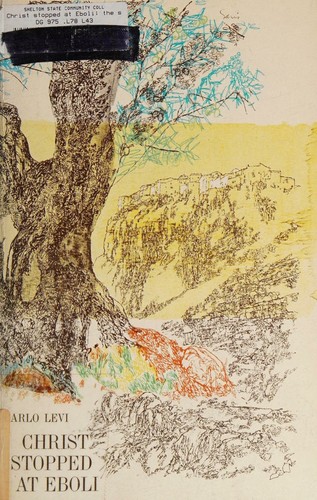
Carlo Levi · Buy on Amazon
"I chose this book because not many people know it – it’s hardly on every bookshelf. Carlo Levi was an Italian Jew from Florence, banished in the 1930s by the Mussolini government for criticising the war in Ethiopia. He is sent to the ends of the earth, and it happens that the ends of the earth in Italy is southern Italy – a hermetic hilltown village called Aliano which at the time was the edge of civilisation. It’s not Eboli – the point is that Christ stopped at Eboli, and Eboli is some distance away. He never got as far as Aliano. The locals had never seen strangers before. They believed in dragons and were superstitious. When I wrote my book The Pillars of Hercules I went to the village, and they remembered Carlo Levi as “the Jew”. Levi described them as living the old way. His sister comes to visit him, but can’t live with him because in the village no man can live with a woman who is not his wife or his mother. But he’s a doctor, so he’s helpful. And he is very observant. He sees their traditions, their language, the way they look. These are the original Italians, he says, and they look Italic – they’re not descendants of the Ostragoths, the invaders and the Greeks. Levi is buried in Aliano. The grave is very obscure, and the town hasn’t changed much. Certainly. That’s also why I chose this. Cherry-Garrard’s trip is an ordeal, an exploration. Trollope’s is a sort of sideline – he writes about these places while doing a job. Whereas this book has resonance, and a strong sense of place that you could only get from living there. While Carlo Levi was there for an extended period of time, though, he also never lost sight of the fact that he was an alien. The police used to visit him. But sometimes you can travel through a place and sum it up, seeing it clearly in a way that you might not if you had lived there – because in order to live in a place, you have to close your eyes to much of it. When I was in Angola, a lot of people who lived there couldn’t bear to look at it because it was so difficult, dysfunctional and improvisational. I found it hard talking to people in Angola about Angola, because it was like living in a smoke-filled room. They lived in a society where people were just trying to get through the day. So both sides are true. Christ Stopped at Eboli could only have been written by someone who lived there, but there are also ways in which someone who lives in a place for an extended time can see nothing."

V.S. Naipaul · Buy on Amazon
"I read this before I met VS Naipaul , in East Africa. I have known him very well over the years, as you might know from my book Sir Vidia ’ s Shadow . This book really impressed me, and meeting him I then saw how he travelled – how he provoked people into saying things. His manner of travel was to put someone on the back foot, to ask questions like “Why do you do this?” and demand answers. He was very provocative in general when he was in East Africa. He was exasperated, discouraged – he’s a depressive person, and an angry one. But the book is wonderful. He knows how to write about landscape. He knows how to write dialogue. He’s funny. He has novelistic gifts that he brings to his nonfiction. Obviously he left a lot out – the main thing being that he was with his wife. He never mentions her. Absolutely. It’s a book about an Indian who goes to India and realises that he has no place there – it’s an area of darkness for him, because he’s lost his sense of caste. Naipaul writes well about being wrong. He goes on a pilgrimage and quarrels with people, and those quarrels are part of the book. A travel book is never all roses, and he writes very candidly about his foibles. Not all of them, but many of them. And that was helpful to me – like all of these books it taught me something. But knowing the writer, and having both the book and the person to compare it against, is different. No, of course not. Half of the time in Africa, Naipaul was so rude and provocative that I thought somebody was going to hit him. You can see a writer’s personality in their books, but the writer themself never matches up to it. They’re not all tall as you think they are going to be, or as urbane. They have foibles. They get cranky. They’re fussy. But the book itself feels whole, and you can’t help but think: How did this weak, flawed person manage to write this book? The writer as a person is more like the valet to the person who wrote the book. How could it be me? It’s a novel, and a man that I have invented. I’ve been there, but not in the same circumstances. I see it rather as a book about captivity. A man whose life is up the wall goes to Africa with good intentions, and isn’t allowed to leave. Get the weekly Five Books newsletter That too. He describes his marriage as a digression – his real life was in Malawi, when he was alone. That’s the other thing about travel. You are, and can be, yourself. People don’t know you, so their expectations aren’t the same. He felt captive in his job and in his marriage, and he travels back to Malawi. But then he can’t get away. That’s the nightmare of a lot of travellers. You go to a place, and then they say you can’t go. You’re stuck."
Favorite books (2023)
Favorite books recommended by Paul Theroux, as compiled by radicalreads.com. Source article: https://radicalreads.com/paul-theroux-favorite-books/.
Source: radicalreads.com
Gustave Flaubert (also rec’d by David Bowie , Ernest Hemingway , Kim Gordon & Philip Roth ) · Buy on Amazon
"Emma Bovary, married to a good-hearted drudge, has a healthy libido, a shopping addiction, and an unhealthy sense of romance. Flaubert’s landmark work is both a romantic novel and a critique of romantic novels, and in its writing and observation it is modern and memorable."
Elias Canetti (also rec’d by Brian Eno ) · Buy on Amazon
"This is one of those books that explain everything — in this case, the way humans gather in groups, how they seize power, and the symbols they value. It is a study in tyranny and in other forms of domination — among them, a mother serving food. Canetti put 30 years into writing it, and he deserved the Nobel Prize in literature he won decades later."