Norman Naimark's Reading List
Norman Naimark is an American historian and author who specialises in modern Eastern European history, genocide and ethnic cleansing. He is a professor in the history department at Stanford University, and a senior fellow at the Hoover Institution. Naimark has been awarded the Officers Cross of the Order of Merit by Germany. His most recent book is Stalin ' s Genocides
Open in WellRead Daily app →Genocide (2011)
Scraped from fivebooks.com (2011-11-15).
Source: fivebooks.com
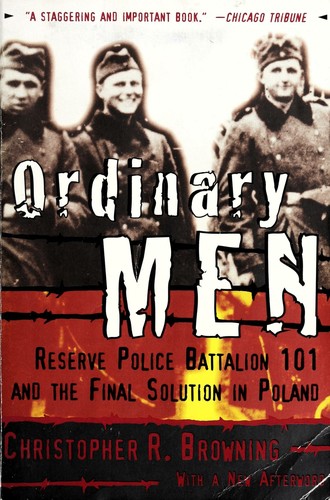
Christopher Browning · Buy on Amazon
"Ordinary Men is a real classic of Holocaust and genocide studies. Christopher Browning is a professor of history at the University of North Carolina. He examines the history of the Hamburg Reserve Police Battalion 101 – as reconstructed primarily from the later trial materials of its members – and demonstrates that these individuals who committed mass murder were not necessarily vicious racists or active Nazis. They were mostly apolitical, middle-aged men of working class background who, on the whole, were not heavily influenced by Nazi propaganda. On the eastern front, a small minority even chose not to kill Jews and suffered no punishment as a result. But the overwhelming majority gradually became accustomed to their tasks of conducting mass murder and participating in the Holocaust. The essential lesson of Ordinary Men is that genocide is not the exclusive preserve of fanatics, racist thugs and homicidal maniacs. It is part of the human condition, especially of humans living in society. It is far too easy to go along with authority and social norms, even when undertaking morally reprehensible deeds, rather than to refuse to participate – despite the fact that, as in the case of Reserve Police Battalion 101, it was unlikely that punishment would accompany a refusal to comply. This kind of conclusion is backed up by earlier social-psychological studies, like the Milgram experiment at Yale and the Zimbardo experiment at Stanford. The sheer power of authority figures and the need for social conformity among humans can turn otherwise peaceful and humane individuals into aggressive criminals. I have no problem with thinking about Hitler and his chief helpmates as evil men. Their ideology was morally reprehensible and was used to justify their application of German state power to destroy the Jewish people – a criminal act of unprecedented proportions, for which they were responsible."

Saul Friedländer · 2007 · Buy on Amazon
"Friedländer, a professor of history at UCLA, was born in Prague and his family moved to France in 1940. He himself survived the war in a Catholic monastery, even converting temporarily to Catholicism. But his parents were caught and eventually killed by the Nazis. His experiences surely influence the way he writes about the Holocaust. The Years of Extermination is a book of enormous erudition, brilliant exposition and emotional sensitivity. It weaves an analysis of the Nazi campaign to eliminate the Jews with the story of the life and death of the Jews themselves. The voices of the victims are unforgettable as they are crushed by the racism of German society and overwhelmed by the power and determination of the Nazi racial state, both of which were determined to be rid of them. You feel the hopelessness of the persecuted Jews, and shudder with terror at the Nazi assault. I think about the Holocaust as the most extreme case of genocide. After all, it gave rise to the concept of genocide in the work of Raphael Lemkin and the international law against genocide, passed unanimously by the UN. But other cases of genocide were also relevant both to the thinking of Lemkin and to the framers of the convention. In order to understand the origins, processes and effects of genocide, the Holocaust needs to be compared with other episodes over time and space. I do not think the Holocaust is “unique”, as some scholars do, or that comparing it with other cases diminishes its impact or importance. Comparison – including identifying dissimilarities – is at the core of explanation. It seems that every case of genocide contains within itself the sources of denial. Perpetrators immediately try to hide the enormity of their crime and deny its existence. At the same time, there is no one explanation for Holocaust denial. There is a kind of perverse pleasure that some writers take in denial. There are also those in both victim and perpetrator communities who simply cannot abide Jewish claims to special victimhood in the Holocaust. There are anti-semites and anti-Zionists who shroud their hatred of the Jews in Holocaust denial, and so on. I personally don’t think that Holocaust denial should be against the law. Of course I’m not happy about it, and I think deniers should, depending on the circumstances, be criticised, vilified, ignored or marginalised. But I don’t think, for example, that it was a good thing for David Irving to be convicted of breaking the law and sent to jail in Austria for Holocaust denial."

Timothy Snyder · Buy on Amazon
"In Bloodlands , Timothy Snyder has painted an impressive and veracious historical canvas of murderous ideologies and mass killing in Eastern Europe between the Ukrainian famine in 1932-33 and the Soviet anti-Zionist campaign after World War II. The perpetrators are chiefly the Soviets and the Nazis. The victims, in addition to the Jews, are Ukrainians, Poles, Belarusians, Balts and Russians. Snyder links historically the Nazi depredations with the Soviet without sacrificing the differences between them, and makes clear that the peoples who lived in that ill-starred neighborhood had to deal with repeated occupations, repressions and mass killings on the part of their totalitarian neighbours to the west and east. Snyder, in this book, is not interested in the question of genocide per se. But he is very systematic about presenting the numbers killed, usually choosing the most conservative estimates. This is an effective way – not unlike his avoidance of the question of what and what is not genocide – of keeping himself and his readers focused on the narrative of the bloodletting itself, the actions and motivations of the perpetrators and the strategies of resistance and horrible suffering of the victims. There is considerable disagreement about how many were killed as a result of Stalin’s policies and actions. This depends a great deal on what one counts as “mass killing”. Do we include, for example, the Ukrainian famine – the Holodomor – which took the lives of some three to five million Ukrainian peasants? Or the deaths by disease, hunger and exposure in the special settlements, which took the lives of millions more? Do we believe the recently available, and by now thoroughly analysed, NKVD [Soviet secret police] figures for the numbers killed and who died? There are some historians, myself included, who think that these figures do not represent the real numbers of those killed or who died as a consequence of Stalin’s policies in the Gulag and other internment facilities. Get the weekly Five Books newsletter In Stalin’s Genocides , I used the fairly standard figure of up to 15 to 20 million dead as a result of Stalin’s policies from 1928 to 1953. Others use higher figures; Snyder estimates fewer. In the end, we need to go beyond the NKVD data to understand better the murderous character of the Stalinist regime. For that we need better access to the secret police archives and a deeper understanding of the processes of arrest, internment, interrogation, torture, exile, resettlement and forced labour – each of which had murderous dimensions, sometimes reported, sometimes not."
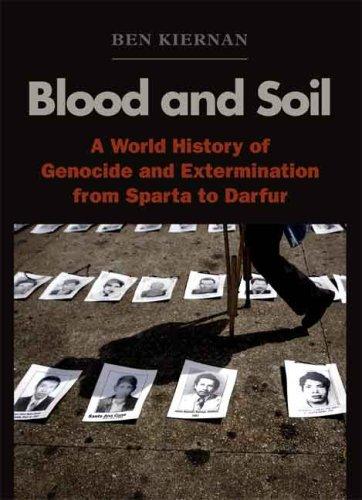
Ben Kiernan · Buy on Amazon
"Blood and Soil is an important and courageous attempt to write a world history of genocide “from Sparta to Darfur”. Many historians have argued that genocide is a form of mass killing that began only in the 20th century with the advent of the modernist state, extreme nationalist ideologies, mass media and experiences of industrial killing during the world wars. I think Kiernan is right to call this analysis into question, and to describe some episodes of mass killing in earlier centuries as genocide. He also broadens our excessively eurocentric focus on the history of genocide to include Asia in particular, as well as South America and Africa. From Kiernan’s point of view – and I agree with him – there is plenty of evidence from the study of prehistoric remains that mass killing was part of human history from the time people first began living together in groups. It’s hard to know, of course, whether this would fit a reasonable historical definition of genocide. But certainly some of the episodes described in the Bible or from Homer in ancient Greece can be called genocidal. The characteristics of genocide are fairly consistent over time. War is an important precondition, though not a necessary one. Highly controlled authoritarian states, whether modern or pre-modern, have the capacity – one could even say the inclination – to carry out mass murder of a genocidal nature. The tendency of human societies to stereotype groups within or outside those societies as inferior “others”, and then blame their problems on those “others”, creates groups of potential victims that political elites can seek to isolate and destroy for their own purposes. Racism and national exclusivity, which are not exclusively modern phenomena, also breed genocidal ideas and actions. If societies stayed out of wars, protected the rights of groups of “others” through the rule of law, refused to tolerate racism and extreme nationalism and maintained democratic checks and balances on their political elites, one could imagine a world without genocide. Alas, very unlikely indeed!"

Samantha Power · 2002 · Buy on Amazon
"This was an extremely important and timely book in calling attention to the deep-seated hypocrisy that lay at the heart of American policies when facing genocide over the past century. Power’s criticism of the devastating combination of American timidity and wishful thinking in face of mass killing, especially in the mid-1990s in Bosnia and Rwanda , is palpable throughout the book. Through historical and political analysis, she sought to mobilise American citizens to place pressure on the US government to act. I think she made a genuine contribution to the heightened awareness of genocide in the US, and to the emergence of an array of NGOs that pay close attention to genocide issues. I am sure she is fighting the good fight inside the White House. She is very able, very convincing and deeply committed to genocide prevention and interdiction. Get the weekly Five Books newsletter One never knows, of course, what the future holds. Something unanticipated will certainly happen. That said, I worry most about sub-Saharan Africa and the continuing tensions and ongoing killing in the Rwanda-Congo-Burundi corner of the continent. The wars in Iraq and Afghanistan – and the fighting in Pakistan – could also trigger episodes of mass killing and even genocide. Parts of Central Asia also remain, in my mind, areas of great concern for the future. Who can be sure that the forces unleashed by the Arab Spring will turn out to guarantee the rights of minorities and groups of “others”? We continue to live in an unstable world. I think there is no question that the Armenian genocide of 1915-16 should be considered as precisely that – a genocide. There are already a number of Turkish intellectuals and academics who have made it clear that they believe so as well. I also think we will see changes in the views of the Turkish government on this issue in the coming years. The most recent scholarship, based on increasingly broad access to essential Ottoman Turkish archival materials – notably A Question of Genocide and a forthcoming new book by Taner Akçam called The Young Turks’ Crime Against Humanity – has made it impossible to defend the denialist position."