Nicholas King's Reading List
Fr Nicholas King SJ has taught the New Testament at Oxford University for many years, where he is now assistant Catholic chaplain.
Open in WellRead Daily app →The Bible (2019)
Scraped from fivebooks.com (2019-12-23).
Source: fivebooks.com

John Barton · Buy on Amazon
"Yes. It came out earlier this year and it is a general introduction for the non-specialist reader (though that does not mean that it has nothing for members of the academic guild). He calls it a ‘history of the Bible’. He’s well aware that the Bible evolves over thousands of years and that’s important for a modern reader to understand, if they’re going to cope with reading it. He knows his subject intimately; and he covers a whole range of different topics with immense skill. He never puts a foot wrong. He’s saying that the Bible is actually rather an untidy collection. We tend to use phrases like ‘the Bible says’, but in fact, you’ve got several different voices in the Bible and the trick is to be like a conductor managing a choir and getting all those different voices to sing from the same sheet. Well, there’s a lot of them. It’s built around fairly obvious sections. He starts with the Old Testament and the many different kinds of literature you get in the Old Testament, then moves on to the New Testament and how it all started and the different kinds of literature you have there. Then the ‘Bible and its Texts’ is his third section, how you move from ‘books’ to ‘scripture’. At some point, words on a piece of paper have turned into ‘scripture’, and they acquire a kind of authority. He looks at the 27 books of the New Testament, but he also discusses other books, those which are sometimes called apocryphal gospels. Now, if you look at those, the church showed great wisdom in not selecting them, either because they’re not very interesting or because, where they are interesting, they are interesting for the wrong reasons. The Protoevangelium of James, for example. Well, the wrong reasons are where they’re exciting and excitable. For example, the story of the ox and the ass at Jesus’s crib comes from the apocryphal gospel. That’s not terribly important, not terribly interesting, but people latch onto it. Then he has a useful thing on the different kinds of biblical manuscripts. Often we don’t really know exactly what the Bible does say because the manuscripts differ. Of the 50,000 manuscripts of the New Testament, every single one is different from the all the others. None of them is written by the original author. That’s right. Which is a great sadness, but it’s true. I think he does. One of the ways he does it is to say that faith is the common theme, that is to say when people open the text now you find a life pulsing below the surface of the text. We give that life the deceptively easy name of God. No, I don’t think he does; he would bow graciously in the direction of biblical scholars who are totally without religious faith. He says they have every right to read the gospel and to say this is what the gospel is saying and he’s right about that."
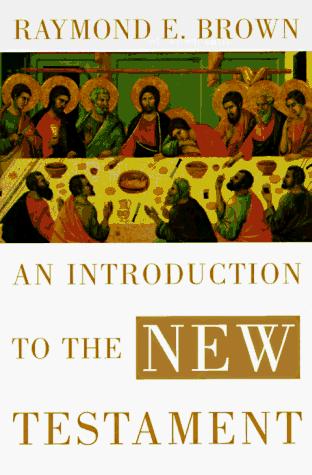
Raymond E Brown · Buy on Amazon
"Yes, he is focused on the text. He thinks we ought to read the text of the New Testament and preferably read it in Greek. The reason I’ve chosen him is that he’s part of a great tradition, maybe the start of a great tradition, of Roman Catholic biblical scholarship. He was a giant among biblical scholars, but an absolutely faithful Roman Catholic. I remember being at a conference in North America where he was given an award and, without any notes, he gave a wonderful talk on the Old Testament and then began to talk about his own attitudes to the church and to the faith. At one moment, he broke down because he was so moved when thinking of the church. That was in spite of the fact that many people from within the church attacked him as a heretic and denier of all truth. This book is a very good piece of work. It must be 30 years old, I should think, but it’s still worth reading. Raymond Brown is always worth reading because he’s always carefully measured in what he says, but he is writing from within the perspective of faith, and from a profound acquaintance with up-to-date scholarship. He was attacked because he did serious biblical scholarship and people read him as saying that the Bible is a pack of lies. But that is not what biblical scholarship means! What he was actually saying was that you can safely do serious study. You can learn the languages of the Bible and you’re safe to do so. It’s not a dangerous thing to do serious academic study. He thinks you’ve got to do both theology—asserting that there is a God—but also history, to examine the history of the texts of the books of the Bible in both the New Testament and the Old Testament. It’s safe to investigate them."

Geza Vermes · Buy on Amazon
"Geza was born a Jew in Hungary in the 1930s. His parents saw what was coming with the German invasion and so they sent him to a Catholic boarding school run by the sisters of the fathers of Zion. He never saw his parents again. They were swept up into the concentration camps and died. Geza became a Catholic. He wasn’t forced to do so, but genuinely wanted to. He became a Catholic priest, joined the fathers of Zion and then through that did his biblical studies, a lot of work on the Dead Sea Scrolls, and a doctorate on the Pesher on Habakkuk (one of the best preserved of the dead sea scrolls). He became a famous scholar and then met his first wife Pam and left the priesthood as well as religious life. He spent the rest of his life concentrating on early Judaism. He gave up on Catholicism and if he went in any direction, he reverted to a kind of liberal Judaism. He certainly belonged to a London synagogue. He used to pray on his own in the garden quite a lot, as he hadn’t lost any faith in God and actually hadn’t entirely lost faith in Jesus. He used to say things about Jesus that seemed to me to come very close to what Christians would believe, and I think he had a kind of personal relationship with Jesus, although he might not have wanted to say that. But this book is important because with the discovery of the dead sea scrolls, for the first time scholars were able to see how Jesus fitted in to his Jewish background. The dead sea scrolls didn’t disprove anything about Christianity. What they did was to give us the background out of which Christianity emerged, because here you’ve got one Jewish movement at odds with other Jewish movements and we get a fair idea of what it was like to be Jewish in that first century. That he remained a good and faithful Jew. That’s absolutely right. Yes: all 27 documents of the New Testament are written by Jews. There’s no doubt about that in my mind at all. That’s very important. We can’t really understand them unless we understand the Jewish background out of which Christianity emerged. This book is both scholarly and readable, which is amazing considering that English was about Vermes’ fifth language. His command of English was terrific."

Amy-Jill Levine · Buy on Amazon
"I think that’s right. She’s a very funny and entertaining speaker and she writes entertainingly too. She’s very much writing from a Jewish perspective. She’s part of a trend that Vermes started, of Jews who were really interested in the New Testament and rediscovering their own Judaism through it. They also realised that they could tell us Christians something about the Judaism out of which Christianity emerged and therefore are able to enlighten us about Judaism in a way that is liberating for Christians. She really writes the stories. The book is called the Misunderstood Jew: the church and the scandal of the Jewish Jesus . It is a scandal that very often Christians have tried to avoid the Jewishness of Jesus and have viewed Jews as in some way inferior. She has chapters on Jesus and Judaism and then ‘from Jewish sect to Gentile church’. By the end of the first century Christianity was, in effect, Gentile, but it didn’t start like that. Then you’ve got ‘the New Testament and anti-Judaism’ and a very interesting chapter on stereotyping Judaism, her point being that Judaism comes in a multitude of dimensions and you can’t really stereotype it at all. Support Five Books Five Books interviews are expensive to produce. If you're enjoying this interview, please support us by donating a small amount . The book has a lovely opening. She says “when I was a child it was my ambition to be Pope”. She has this cheerful openness, which is very attractive. That’s right and she doesn’t pull her punches, either. I think she is. I mean most educated Christians nowadays would accept her points about anti-Judaism in Christianity, but we’re not really sufficiently aware of how much persecution of Jews has gone on in our name. We still need to resist that. You often find people casually making anti-Jewish remarks who are Christians; and she’s committed to educating them and she can do that because she is Jewish and she loves the New Testament. And she can say, “you Christians must get this sorted out.” Yes. She says it’s there, for example, in John’s gospel. The Greek words the evangelist uses are Hoi Joudaioi , which can mean either ‘the Judeans’ or ‘the Jews’. I always translate it as ‘the Judeans’ meaning the inhabitants of Judea, which makes it sound less horrible. In John’s gospel there are one or two rather dark remarks about ‘the Jews’, or ‘the Judeans’ and it sounds much worse if you translate it as ‘the Jews’. It gives some kind of impetus to anti-Jewish persecution. No, that’s Matthew. It’s another good example, and that has been used by Christians, but he clearly doesn’t intend it to enjoin persecution of the Jews. Matthew is a good Jewish boy and if you were to say to Matthew, “look, we can use this to attack those horrible Jews” he would be astonished."

Markus Bockmuehl · Buy on Amazon
"He calls it ‘refocusing New Testament study’ and I advise readers to look at the little miniature on the front cover. Because you’ve got Saint Luke pictured as an artist. He certainly is an artist with words, if nothing else. You’ve got him painting and you can see the model for his painting. She is a slightly slovenly looking woman gazing lovingly at her little child. The little child is mischievously pulling at her throat. Then you can see the painting that Luke is getting out of this and it’s a wonderful painting of a very pious beautiful woman and the child not nearly so mischievous and a bit calmer. What I think Bockmuehl is saying is that the gospel paints a picture which is the truth, but it’s painting it out of the reality of human life; nevertheless it’s seeing the deeper truth that God is producing here. The reality is both the awkwardness of ordinary human life plus the reality that God is at work in this awful reality. Luke’s gospel is a very good example of that because he’s aware of what’s going on in life and but paints a beautiful picture. Thousands of artists have tried to paint one of Luke’s greatest achievements, the story of the Annunciation to Mary and you can see artists really trying to capture that moment. Honestly, I think he is. I mean you have very good biblical scholars who have no religious faith and I listen to them with interest but I think they’re missing an important dimension of the Bible. It’s not that you’ve got to be dogmatic about it. It’s not that the church forbids you from saying something. We must allow all the richness that top-class scholars can offer, whether they’re believers or not; but somehow or other if you’re not open to that dimension of the transcendent, the idea of God, the possibility of the resurrection of Jesus, then you’re going to miss out, particularly on the New Testament. Yes, he sometimes talks about the ‘footprint’ left by these texts. I think that’s a very important idea and it tells you something about the literature of the books that we call the Bible, that it’s left this mark on us and then left this mark on our civilisation that can’t be eliminated. John Barton’s History of the Bible , because anyone can read that book and it’s beautifully done and it’s the fruit of a lifetime’s work. It’s really well done, and it’s not heavy at all. So get out and buy that."