Monica Ali's Reading List
Monica Ali is a bestselling writer whose work has been translated into 26 languages and nominated for several accolades, including the Booker Prize and the George Orwell Prize. She is the author of five books: Brick Lane, Alentejo Blue, In the Kitchen, Untold Story and Love Marriage . The success of these books led to Monica being elected a Fellow of the Royal Society of Literature, a lifetime honour that gives her the opportunity to support other writers and readers.
Open in WellRead Daily app →Recent Fiction Highlights: The 2024 Women's Prize Shortlist (2024)
Scraped from fivebooks.com (2024-06-18).
Source: fivebooks.com
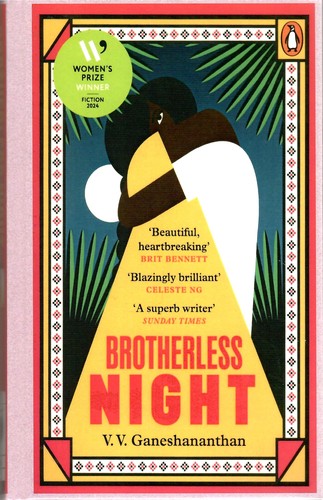
V. V. Ganeshananthan · Buy on Amazon
"I mean, where to start? Once you’ve read this book, you’re never going to forget it. It’s absolutely searing, deeply moving. And it’s an utterly compelling piece of storytelling. There have been quite a few novels recently that have looked at the Sri Lankan civil war. But this novel is unique in the way that it centres women’s experience of the war. She uses that lens of women’s experience to examine the impact on families, on the war of values that can tear families apart as much as the violence. And she’s unflinching in her commitment to complexity and nuanced and clear-eyed moral scrutiny of all sides of the conflict. It’s a novel that rewards multiple readings as well, because it’s packed with historical detail. It ranges in scale from the intimate to the epic. I mean, there’s range within the shortlist. In Anne Enright’s The Wren, The Wren , Phil is a huge presence in the book, who dominates the family dynamic. So it varies, doesn’t it? I don’t think we can put women’s writing in a box. Women, at times, centre women’s experience. Other times they might choose a different perspective."
Anne Enright · Buy on Amazon
"Yes. It’s an intergenerational saga set in Ireland, exploring the really messy, fraught relationship between Carmel and her daughter Nell. They’ve moved from being a very close single-mother, only-daughter unit to having quite a fractured relationship. It also encompasses the long shadow thrown over their family by Carmel’s father, Phil, who is now deceased but was a famous poet. He’s a big absence, and also a huge presence in Carmel’s life. And he was a monstrous person in many ways. I mean, he abandoned his family, for instance. But it’s also “devastatingly easy”—that’s a phrase from the book—to love him, because he was so charming. “The Women’s Prize criteria are: excellence, originality, and accessibility. All of those things can come in different forms” Through Phil, Anne Enright raises a lot of questions about art. For instance: is it possible to separate the art and the artist? If the person who has produced the art has done terrible things in their life, does that affect how you view that art? Phil’s poems also appear in the book, which is quite an original feature. And those poems are absolutely brilliant, as well. So there’s a lot going on in this novel. It’s centred on family relationships, but it raises those bigger questions about art as well."
Kate Grenville · Buy on Amazon
"Yes, it’s a historical novel that begins on a sheep farm in New South Wales in the 1880s. It goes right through until the 1950s. In Dolly we have a character who constantly fights against the constraints placed on her as a woman in a man’s world. And she pays a really high price for her nonconformity. She builds a business, loses everything, is forced to start over. But she never loses her fighting spirit. Grenville’s prose is just immaculate: simultaneously plain and poetic. She conjures up those very harsh and beautiful landscapes so perfectly. It’s a book that transports you to another time and place, and all of us judges fell in love with Dolly—we were there for the pain and the beauty of all Dolly’s struggles."
Isabella Hammad · Buy on Amazon
"It’s a very accomplished piece of storytelling. It weaves history, politics, and family with a profound meditation on the purpose of art. It’s very nuanced, multi-layered, gorgeously written. And it’s original—because it plays with form. Parts of the book are written as a script, fo example. And it asks deep questions about the purpose of art: whether it can be a form of resistance; whether a play written centuries ago can resonate with the lives of people in the West Bank in the present day. It’s very subtle, its outlook. Very humane. It’s generous, compassionate. It’s a book you won’t necessarily romp through. But you sink into it, and then you really reap the rewards. There’s a lot of food for thought. A political context, a social context, an intellectual context. It’s thinking about all dimensions of art: Can it uplift the human spirit? Is it just entertainment, or can it be more meaningful than that? What is art for?"
Claire Kilroy · Buy on Amazon
"The word that came up most frequently during the judging meetings when we spoke about this book was “visceral.” It’s a gut-punch of a book, which provokes so many emotions in the reader: sorrow, rage, tenderness, laughter—it’s often funny, you know. The whole range. It balances the light and the dark. And it’s suffused with love. It’s written in the form of a love letter from ‘Soldier,’ as she calls herself, to ‘Sailor,’ her son. Alongside the grief and the rage there are comedic aspects—of trying to make dinner and bath a baby at the same time, and the disasters that ensure. What did you say they called it? Brief, and— Well, I don’t agree with that. The ending is almost metaphysical, it’s philosophical. You stand back and think about the big picture of life and this eternal cycle that we’re in, generation after generation. It’s uplifting, actually."
Aube Rey Lescure · Buy on Amazon
"Alva is one of the protagonists. She’s a moody, rebellious teenager who is starting to pull away from her mother, a white American woman. Alva has a dual identity—she has a Chinese father who she doesn’t know, and an American mother. She’s in the midst of grappling with who she is and who she wants to be. This is Shanghai in the mid 2000s, and the country is in a state of flux—starting to open up to the outside world. This sort of mirrors the state of flux that she’s going through internally. She starts at a local Chinese state school, but really wants to attend this international American school that she manages to go to in the end. But she’s an outsider at both places. So there’s a lot about identity and belonging and homeland and colonialism all tackled in a really seamless way and integrated into the narrative. Then there’s a second perspective devoted to Lu Fang, the Chinese businessman who Alva’s mother marries. Through Lu Fang, we get a sweep of Chinese history, from the Cultural Revolution onwards. So it’s a book that tackles big themes and a lot of history, but always through a propulsive narrative that keeps you turning the pages. Certainly, in our initial reading, we found a lot about migration, immigration, displacement—which is not surprising, giving that’s often in the enws at the moment. It’s something that countries and societies are grappling with on a daily basis. The environment was a theme that came up quite often as well. And, as with Restless Dolly Maunder , how the work of women has often been under-recognised and under-paid, and the constraints under which women, in particular, must operate under."