Mitchell Thomashow's Reading List
Mitchell Thomashow is the author of four books, Ecological Identity , Bringing the Biosphere Home , The Nine Elements of a Sustainable Campus , and To Know the World: A New Vision for Environmental Learning . He is a former university president, professor, and sustainability consultant. Thomashow lives in the hill country of southwest New Hampshire in the shadow of Mount Monadnock. He loves to explore the fields, forests, wetlands, hills, and lakes of Northern New England.
Open in WellRead Daily app →The Best Books For Environmental Learning (2021)
Scraped from fivebooks.com (2021-10-28).
Source: fivebooks.com

Lauret Savoy · Buy on Amazon
"Lauret Savoy is an African American geologist who has written a groundbreaking book. She’s talking not only about her relationship to place, but the places that, in a way, have been stolen from her and her family and their legacy. A lot of environmental literature—since I’ve been involved, going back to the late 60s—has assumed that a place-based orientation builds commitment. It builds affiliation to both the natural and the human community. That is true and there’s a whole generation of environmental educators and thinkers who’ve written about this, as I have. “These books bring more depth to our lives: that’s why I chose them” What Lauret Savoy does in this book, brilliantly, is she brings the issue of race and equity into the equation in a highly personal way. She discusses her travels through America as a child and as an adult. In every case, her affiliation with place is disturbed by the legacy of racism and slavery. It’s a reminder to us that places have legacies that are historical and cultural, as well as ecological, and all of these functions are tied together. They are part of the picture of what we mean by human-nature relationships. Plus, this book is really well written. The language is beautiful and evocative. She brings her scientific sensibility and aesthetic to it, while at the same time uncovering a lot of the dark side of American history , both in terms of the African American experience and the indigenous experience. No, it’s not, it covers a lot of her travels. It covers her family travels as a young child, some of the things they had to do, where they had to avoid certain places. Then she revisits them and looks at the places, again, both ecologically and historically. I use this book in my teaching a lot. Students from a variety of backgrounds resonate with it."
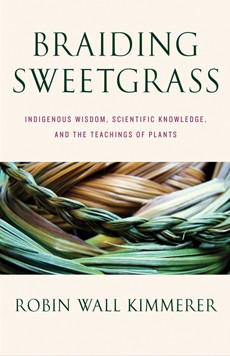
Robin Wall Kimmerer · Buy on Amazon
"Robin Kimmerer is another scientist; she is at State University of New York at Syracuse. She’s a botanist and her expertise is vast and wide. She has a previous book called Gathering Moss , which is a very beautiful book. Braiding Sweetgrass caught on because she tries to balance her scientific expertise with indigenous wisdom, especially as based in her own heritage and traditions. She writes it from the perspective of a family member, a woman, a mother and a daughter. She weaves this together into a domestic ecology of sorts, the indigenous traditions that she’s familiar with in her own history and her very deep understanding of botany and environmental science more broadly. She’s a wonderful writer, a fine essayist. This book has really hit a chord. It’s become very popular because people are interested in understanding how to integrate indigenous wisdom with science. They’re very interested in a woman’s perspective on family and natural history. At the same time, when you read her work, every time you finish an essay and you go outside—wherever you are, you could be in a city, or you can be out in the woods—you see the world a little bit differently. That’s what I’ve tried to do with all the books I’ve chosen. They are books that you just read for 15 minutes, half an hour, and suddenly you’ve changed your perception of the way the world is, the way it works, the way the natural world is. Kimmerer does that very well in this book and that’s why I chose it. I think that one of the trends that we’re seeing in the environmental field right now is the importance of the multiplicity of voices. So I tried to select books that gave us a great variety of cultural voices."

Kathleen Dean Moore · Buy on Amazon
"I added this book late—replacing The Great Derangement by Amitav Ghosh , which is also a fantastic book—because it has what I think is a very interesting perspective. Kathy is a great writer. She’s a philosopher and has written many books. She’s a climate activist and has been on the front lines of climate activism in the Pacific Northwest. What she’s accomplished in this book, about as well as anyone I’ve read, is she’s balanced the intrinsic grief we often experience when we internalize the ecological prospects—habitat destruction, species extinction, the loss of biodiversity and the threats of climate change —but she also fills the book with celebration. She is able to experience joy in the natural world in the present moment. And she does it through sound and through music. I’m a musician—I taught a course called music and ecology some years ago—and I love the idea of using sound as a means of amplifying your perceptual depth in understanding human nature relations. She chooses the sounds of the natural world to celebrate and she still has space in her heart for that celebration, while also acknowledging and feeling the grief—and she writes about it in such a way that you feel those things, too. It’s a lovely book, it’s one of her best I think, and it very nicely balances all of these questions and issues. She also writes about her family, multiple generations of grandparents and grandchildren. She writes about other creatures as if they are part of her family as well, which is, by the way, something that Robin does, too. Full disclosure: I should say that I’ve worked with both Kathy and Robin over the years. I’m always biased towards writers that I know because you know what great people they are and what great hearts they have. Yes. I wrote a book some 20 years ago now, with the MIT Press, called Bringing the Biosphere Home. I look at the existential challenges of perceiving global environmental change. I cover the issue of balancing hope and despair, indifference and wonder, creation and extinction, faith and doubt. Anyone who’s been in this field deals with these ubiquitous challenges all the time, but they are not discussed as much as they ought to be. These are real feelings that people have. It’s better to discuss, understand, share those feelings rather than deny them or stay silent. Right now, we’re in a very complicated phase of denial in relationship to a whole range of Earth phenomena, from the pandemic and communicable disease to the challenges of climate change and species extinction. There are many reasons for this. Many folks are struggling with basic issues of emotional and material survival. However, these environmental challenges are the most profound questions of all because they are about our planet and our future as a species. That’s a great question. And I have a two-fold response to it. First I will address my role as a teacher and my philosophy of education in general and second I will discuss my personal responses. My teaching is primarily based on personal experience and memory, expressed through art and writing. I typically design learning experiences and activities for adults. I only work with graduate students at this point, and have for most of my career, although I have worked with undergraduates too. I focus on narrative experience. So, for example, if I teach about migration, which I think is a seminal issue—which we’ll get to in a moment with Sonia Shah’s great book—I ask students to create migration maps of their own family’s movement and to create migration maps of the various species that live where they live. I use memory quite a bit in asking people to understand their lives. I encourage them to share their experiences. Then, a text in a class becomes their text. When they read material, the reading is much more alert and alive, because they’ve experienced it in their own words. When I teach, I use those as the basis of how we proceed. Then I create improvisational lectures based on what I think will most engage the group and where I need to fill in some substantive relationships or knowledge. I’ve been doing this long enough that I never have prepared notes, I just think about where they are and what they need, and what I can give them. That’s how I teach. My new book reflects this pedagogy: To Know the World contains a dozen activities of this sort, not just for the classroom, but for anyone who wants to engage in important environmental challenges. For example, I have a chapter called “Is the Anthropocene Blowing your Mind?” where I talk about screens and their impact on how we perceive the world. I suggest what I call a ‘deliberate pause’, taking various moments during the day to get away from the screen and focus on the natural world. In a class, I’ll ask people to engage in such deliberate pauses, and then to write about what they experience. That is really important because it empowers the folks who you’re working with to practice the exercise on their own, while applying and adapting the exercise in whatever learning environments are relevant as teachers or practitioners. Get the weekly Five Books newsletter In terms of myself, I’m in my own head way too much. It’s amazing to me how much I don’t see when I’m walking through the woods. Any opportunity I have, I try to remind myself to get out of my head and look at the world. Writing, interestingly, is one way to accomplish this. I often ask myself, when I’m thinking about my next book project, ‘Why do I want to do it? It’s so consuming, and you never know how many readers you’re going to get.’ Ultimately, when I look back at my work—and I don’t want to sound too egotistical here—I’m amazed that I got my act together enough to write it down, to write a book that I still believe in. When you’re just going through your normal day, you don’t have that discipline. Writing (and teaching too) takes you to places that you didn’t know you had inside you. It brings a depth of experience and an enrichment that challenges you to go deeper into your own world, what you see and what you observe and what your own memories are. I find that the writing process deepens my awareness of what I’m looking at and what I’m observing. It sharpens my focus: that is ultimately the best reason to engage in the writing process."

Sonia Shah · Buy on Amazon
"I believe that the migration challenge, the movement of people and species, is the most pertinent environmental challenge of the next several decades. And it’s upon us right now. There are all kinds of demographic ways of parsing this question, but the number of migrants in the world is somewhere between one in eight and one in 12, depending on what kind of statistics you’re looking at, and how you want to define what migration is. That’s a challenging issue, but migration also exists within countries and can be the result of an environmental catastrophe of one kind or another. Recently, in North America, you can see what happens when there are hurricanes or wildfires. People lose their homes and they have to go somewhere else. Wildlife is massively disrupted. This is only going to get worse. Then there are the political dislocations, the dislocations of gentrification, which mean that lots of people are displaced. These are not always people from communities of color, but often, and not always poor people, but often. It could be anybody at all, who is suddenly forced to move for one reason or another. Support Five Books Five Books interviews are expensive to produce. If you're enjoying this interview, please support us by donating a small amount . It’s very hard for folks, certainly in Europe and the United States, to understand the full dimension of what migration means not only in human history and cultural history, but also ecologically speaking, because everything’s on the move all the time. It’s very important for people to think about new species and new people that are coming into their communities, and what they do about it, how they accept it, and how they find a place in their hearts to share what they have with people who have been dispossessed, or species that are forced to leave their environment. Sonia Shah’s book, The Next Great Migration is a fantastic overview of exactly these questions. She looks at the ecological and cultural challenges. She talks about a lot of the contemporary issues, but also goes back over several hundred years of Western history and explains how population restrictions and even a lot of ecological theory is racially biased. That affects the way we look at everything from the migration of people and species to so-called invasive species. Her book is great. It investigates these interconnected challenges. It’s very well written. It’s learned. The Next Great Migration is a must read, because if we’re thinking about environmental learning, this is the issue that’s going to be on everybody’s plate. I have a slideshow that begins with a photograph of human-built walls around the world. It’s pretty staggering, from the US-Mexico border, to barbed wire in Eastern Europe, to the Great Wall of China. These walls are meant to keep people out. They never ultimately work, because people and species alike always find a way through them yet they still wreak serious disruptions. The very idea of a wall is so anti-ecological. In fact, the whole notion of borders and boundaries is anti-ecological, because most borders and boundaries have to do with property rights and property ownership or imperial issues of one kind or another. We need a reconceptualization of what borders and boundaries mean, which I also cover in my book, To Know the World , because talking about environmental learning, we need to perceive borders and boundaries differently than we do if we’re going to solve any of these problems."

Robert Macfarlane · Buy on Amazon
"I love this book. Macfarlane is another evocative writer and the premise of it is fascinating to me. In the introduction he writes that he was dismayed when he saw a recent edition of the Oxford Junior Dictionary and realized that some natural history words were replaced by tech words. That was his motivation. His research project, as he explains it, was to find as many words as he could, in the various ancient languages of the British Isles, that describe the landscape or ecology or species dynamics. He collated a compendium or glossary of all these words. There is a chapter on uplands, on waterlands, on coastlands, on underlands, on edgelands, and so on. Each of these chapters is filled with words and each of these words describes a phenomenon of the natural world, or the human interaction with the natural world, that opens your mind to a whole new way of seeing it. That’s the beauty of this book. There are words that describe things that we didn’t know there was a word for. And, in the meantime, he writes colorful and engaging essays that connect the glossaries. I have a friend, David Lukas, who wrote Language Making Nature , a parallel to Macfarlane’s work. David suggests ways for readers to invent your own words. You can do this anywhere: in an urban or rural landscape, you ask folks to look at their observations and see if there’s an observation for which there is no word and ask them to make up a word for it. Using these books together is very interesting. I love David’s book too, enormously, and I mention it because it complements Macfarlane so well. I think there’s a whole new genre of environmental writing that brings all of this together. It changes perception. It deals with the questions of grief and celebration. What’s new and different is the way these books link deep human history to these questions, evoking a deep natural history. These books all do it and some of them are brilliantly written: The Brilliant Abyss, written by a marine scientist, explores the deep ocean. It points out how little we know about these incomprehensible depths, and how they are just an absolutely extraordinary, unexplored habitat that holds so much wonder and information in it. She opens you up to that world in a way that is picturesque and thorough. At the same time, she describes why, to this point, we’ve known so little about it and why a lot of the science about it has been largely wrong because we had no data. There is also a threat to the deep ocean bed because of its deep-sea mining potential for the rare minerals and materials that we think we need for tech. So, it’s an emergent environmental challenge. In this book, Helen Scales brings it to public attention by citing the threat, and describing the mysterious beauty of the deep sea. Cynthia Barnett is an excellent environmental journalist. She looks at the deep natural and human history of seashells. She engages readers by writing about her childhood shell collection. She explores why people collect seashells, but then moves from there into how seashells provide so many clues about the Earth’s history, the fate of the oceans, how we look at the edge between land and sea, the fate of human species: there are countless other ways of understanding the natural world—all through seashells. I love the way she takes something that everyone is familiar with, and everyone loves, and brings to it a whole other level of understanding. I love the idea of nature rebounding and the courage that it took for Cal Flyn to explore abandoned places, places of toxicity or places that appear monstrous on some level, but where so much ecological. restoration takes place amidst the abandonment or toxicity. Again, she’s a fine writer and I was very attracted to the concept in the book. First of all, it helps us deal with the question of hubris. Yes, we are powerful enough to destroy places, but we’re not powerful enough to stamp all life out because these places are rebounding in very interesting ways just because we’re leaving them alone. Given the number of disturbed places there are throughout the world, this gives us a way to think about them, how they become wild in their own right. Again, it changes your perception of how you move through the world. It brings a kind of faith and hope in the possibilities of resilience. These are new ways of thinking about environmental learning as opposed to, ‘Let’s just go out in the woods and hug a tree’. I don’t mean to sound cynical because there is a sensory awareness that you develop when you do that. But this book suggests, ‘Have the courage to go and look at abandoned places because there are likely to be some in your own community, right in your backyard. They’re all around, you can find them anywhere and there’s a lot that you can learn from them.’ This is some of the best writing I’ve seen in any venue in a long, long time. Rebecca Giggs is a great, great writer. First of all, her understanding of the language is magnificent. The breadth of her learning, the dimensionality of her research, her journalistic eye, her sensibility, are fascinating. The book starts with a dying whale and its decomposition on the South Australian coast. She writes about this with great compassion, and great mystery. You can see she’s going to write about whales in a way that’s going to help us better understand our own, human condition. The whale is such a complex, intelligent, and mysterious creature, and she’s going to bring all of this to bear as she looks at the history of whaling, our ecological understanding of whales, our understanding of whale communication, and finally, whales in relationship to the deep history of humankind. In this book Suzanne Simard looks at the whole system of the forest—the entanglements, the communication systems, the relationship trees have with their own kin, that they have with other trees, that they have with mycelium and soil microorganisms. The writing is not as polished as the other books, but the content and the concepts are. She is the model for the character in Richard Powers’s great book Overstory , which might be the best environmental novel I’ve ever read. Paul Stamets, the great mushroom visionary, describes mycelium as the original internet. If you compare the number of mycelium or soil scientists and the number of lawyers and bankers, you can’t even scale it. Yet arguably, some of the most important information about how the planet works is located in the forest beneath our feet. By the way, Macfarlane writes about this too in his book Underland and Entangled Life by Merlin Sheldrake covers this as well. Those are also fine books, it would be a nice trio to read Sheldrake and Macfarlane together with the Mother Tree book. All of these books open our vistas in remarkable ways. They bring out this notion of perceptual reciprocity that I mentioned earlier. You realize in reading them that there’s so much happening around us that we don’t understand or that we don’t see—because we all live in our heads so much and we’re surrounded by screens. It’s hard to make good choices about what we should look at next and anything that we can do to present people with clear reasons for making good choices makes sense. That’s my emphasis in addressing your fine questions. These books bring more depth to our lives: that’s why I chose them."