Michael Wert's Reading List
Michael Wert is Associate Professor of East Asian History at Marquette University, specializing in early modern and modern Japan.
Open in WellRead Daily app →Samurai (2020)
Scraped from fivebooks.com (2020-01-16).
Source: fivebooks.com

Luke Roberts · Buy on Amazon
"This is a book that came out in 2012 and in fact we just had a mini conference at Yale and the whole conference was based off of this book. We had some historians of Japan but then there were also scholars who were doing everything from Ptolemaic Egypt and the Holy Roman Empire to modern Chinese politics. We were looking at the phenomenon of having a surface truth in the political structure and then the way things might actually function behind that: is that something unique to Tokugawa Japan and the warrior regime, or is this something that we see in general, in other places and at other times? The whole purpose of the conference was to ask that question. So this book, Performing the Great Peace , was important. It’s also really entertaining. It shows us how the warrior regime is not so strict, it’s not so rigid, it’s not so fearful and that there’s a lot of negotiating among smaller warrior domains and the national warrior regime. The book has a lot of very interesting and humorous examples of how this plays out, which is why it’s assigned in a lot of courses. Get the weekly Five Books newsletter People often ask me, ‘What is my definition of a good book?’ I usually have two ways I define it. One is a book that changes the way I think about something in a large, conceptual way. Those tend to be books of philosophy or of critical theory that I like to read. They change how I think about the concept of ideology or politics or something like that. Another good book for me is one where, once I’ve read it, I can never go back to before having read that book. There’s no turning back. The way I lecture about something, the content of my lecture changes and I can’t unread what I’ve read. Luke Roberts’s book fits into that latter category. There are so many tidbits and ways of thinking about Japan that he articulates that are useful for teaching and thinking about Japan at that time period. It’s the Tokugawa period, which is the last warrior regime in Japan and lasts from the 17th through the 19th centuries. It’s about how the warrior regime is able to maintain relative peace in Japan, despite the fact that there’s some 260 relatively autonomous mini-domains throughout the country."
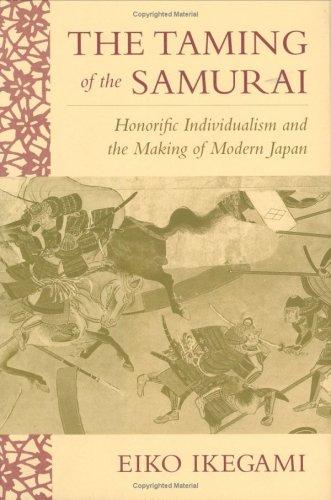
Eiko Ikegami · Buy on Amazon
"This is an older book. I don’t necessarily agree with everything in it, but it’s a book that tries to do a lot of very broad things that are very bold and ambitious in a good way. Again, she’s looking at the Tokugawa period from the 17th through the 19th centuries and asking, how does the warrior regime function? What does it mean to be a warrior? And how do we go from having warriors who were very violent in warfare during the Warring States period of the 16th century into the not-so-violent types of this later period? How do we tame them, essentially? How do we do that by changing the ethos and the notions of what it means to be a samurai? She does this by looking at notions of honour. Essentially, what it means to be a samurai is that, sure, you learn how to use weapons and that kind of thing, but really a true warrior is someone who has self-restraint and holds himself back, who doesn’t take an insult and just fly off the handle and get into a fight. That’s one of the big things that she’s looking at. That is part of the book, but I’m not sure it’s the strongest part. Usually, when people read it, it’s more for the samurai ethos and the taming part, rather than the ‘this is how we get to the 20th century.’"

Constantine Vaporis · Buy on Amazon
"This is about the same time period, the 17th through the 19th centuries. Like the first book by Luke Roberts, this book has a lot of wonderful detail. The ‘tour of duty’ in the title refers to one of the defining characteristics of this time period, which is that all these mini-lords (called ‘daimyō’ in Japanese) have to spend every other year living in a compound in the capital city of Edo. The other years, they live in their home domain. Their wives and the heirs to their domain live permanently in the city of Edo, which is why Edo becomes so huge. Daimyō have to maintain compounds with lots of servants and that costs money. But the key feature is that the daimyō have to travel back and forth every other year, with hundreds—and in some cases thousands—of warriors and servants. What was that like? What did that mean for the spread of food culture, fashion trends, dialects, popular culture? How did it actually function in terms of the political structure? “I tell my students, ‘If you want to understand samurai thought, you should read the seven military classics of China.” Specialists, students—in fact anyone who has a passing knowledge of Tokugawa Japan—knows about the tour of duty, this alternate attendance system, but no one had really gotten into the details of how it actually functioned. This is a book that gets into those details and again, for me, it’s a book where I can never go back. When I teach students, I take a lot of wonderful anecdotes from the book. For example, I say to them, ‘Imagine you’re the heir to a lord’s domain. You grew up in London or Manhattan, but the domain you’re going to take over some day is out in the boondocks. How excited would you be going to live out there in the middle of nowhere?’ That’s what happens in Tokugawa Japan. There are teenagers who refuse to go out with their fathers to visit the old homeland. Advisors are berating them saying, ‘If you don’t go out and visit the land that you’re one day going to be the lord of, it doesn’t look good.’ In the book, there are all kinds of tidbits like that that are just wonderful. When most people think of the samurai, it’s the Tokugawa period, also called the Edo period, or just early modern Japan. A lot of the sources are from this period, so we can get into the details. That’s not to say that in the medieval period or premodern Japan there weren’t sources. There were, but they tend not to give us a lot of insight into rank-and-file warriors. They tend to be top-heavy, a lot of institutional or political history. Most of the depictions of samurai that we see in popular culture are not from that earlier period, they’re from the Warring States period through the Tokugawa period. That’s also the field that I’m a specialist in. I chose books that were meaningful for me and I think would also be meaningful for people interested in learning more about the samurai in general."

Teruko Craig (editor and translator) · Buy on Amazon
"This is a wonderful autobiography from the 19th century of a really low-ranking, dirty warrior. He’s essentially recording his ne’er-do-well ways for his son—getting into fights, partying, being arrested. Sometimes he’s a sword seller—non-warriors sometimes liked to imitate the image of the samurai so he would appraise swords for commoners and buy and sell for them—sometimes he’s scamming people out of money by being a fortune teller. This book is assigned in a lot of Japanese history classes so students can understand that warriors were not these noble men we see on TV or in popular culture. Some of the lowest ones had a real rough time of it and were scoundrels, and this book is just a perfect example of that. It’s short and easy to read and regular folks will love reading it as well. It really destroys the noble image of the samurai in wonderful ways. Yes, which is why I liked it at the beginning when you said that the samurai became their own caste. A lot of people would say they became their own class, but they’re not a class in the economic sense. Some of the lords or daimyō might be wealthy, but a lot of samurai were poor and because they’re born into their career, they have a hard time earning money. Sometimes they do it on the sly, and their boss looks the other way. Sometimes they get permission to do something on the side for money and sometimes they get into real gangsta-type stuff, as Musui does. They don’t really own the land they have. It depends on what rank of samurai you are, but if you’re a lowly guy like Musui, you don’t have any connection to land whatsoever. Once we get to mid- and higher-ranking samurai you might have land of which the produce is assigned to you as part of your salary, in some sense. But you would never be able to go out and rule that land directly. The land is not yours as such; you don’t live on it and you have little or no interaction with the village that might be assigned to your family’s income. In a domain, the daimyō owns all the land. All the samurai live in one capital city in each domain, to keep an eye on them. It’s also to keep them out of the countryside where they could get up to no good. The Warring States period was all about local warriors banding together and overthrowing a lord. So the way you avoid that is to put all the warriors in one town and then they can’t plot and plan out in the countryside. Peasants love this as well, because there are no warriors living next to them all the time constantly monitoring them. A warrior might be sent out once in a while to check on them and to assess their produce for tax purposes. Support Five Books Five Books interviews are expensive to produce. If you're enjoying this interview, please support us by donating a small amount . So most of the land is owned by the local daimyō but then a quarter of the total land in Japan is owned by the Tokugawa shogunate. The Tokugawa clan runs the regime and they have lands scattered all around Japan. So in a particular domain, a daimyo might own most of the land, but there might be a little chunk that is assigned to the Tokugawa clan’s own warriors or something like that. Yes, he’s a warrior, but he’s at the top. Those are few in number. Most of the warriors are not daimyō."