Maya Jasanoff's Reading List
Maya Jasanoff is a professor at Harvard, where she holds named chairs in history and in the arts and sciences. She is the author of three works of global history—most recently The Dawn Watch (2017), about the life and times of Joseph Conrad—which have won honours including the National Book Critics Circle Award, the Duff Cooper Prize, and the Cundill Prize, and been shortlisted for the Baillie Gifford and the James Tait Black Prizes. A 2013 Guggenheim fellow, in 2017 she was awarded the Windham-Campbell Prize for non-fiction literature. She is the chair of the judges of the 2021 Booker Prize.
Open in WellRead Daily app →The Best Fiction of 2021: The Booker Prize Shortlist (2021)
Scraped from fivebooks.com (2021-10-22).
Source: fivebooks.com

Patricia Lockwood · 2021 · Buy on Amazon
"First of all, Lockwood is a poet, as well as a novelist. This really shows in the care at the sentence level of this book. There’s a kind of crystalline brilliance in the writing of the sentences that makes it quite remarkable. The book is full of these very short little snippets, these little vignettes. You can see where ‘Poet Laureate of Twitter’ comes from. I think that she’s able to pull that off because she is so in command of her sentences. That’s certainly one of the things that I responded to very strongly. Then it’s a book that manages to be formally inventive without flaunting it, in a way that really makes sense for the story it’s trying to tell. She has, I think, created a method of storytelling that mirrors the experience of being extremely online. The final thing I would say about it is that if you look at the plot, it really hinges on this question of how a certain kind of language, how a certain mode of experiencing the outer world can contain or respond to experiences that fall so wildly beyond it. And that’s what happens at the second half of the book when it takes a very marked turn into family drama and, ultimately, tragedy. It’s a book that is genuinely unlike any other book I have read in terms of style and form and the way in which it’s really pressing on the relationship between the methods that we have of speaking and experiencing and communicating today, and the ways we have of being human."

Damon Galgut · 2021 · Buy on Amazon
"It is a very introspective examination of the lives of a group of individuals, a study of a family and family dynamics, and an account of South Africa over the course of decades—from the later years of Apartheid, into the present. And he’s able to manage all of these registers with a seamlessness that is almost deceptively simple. There’s an incredible flow. It’s in four sections, and each of the sections is unbroken as a piece of narrative. But what he’s doing through it is moving you subtly from one person’s mind to somebody else’s mind, from the past into the present, from one kind of consciousness to another. To me it’s evocative of Virginia Woolf in the way that it brings together —as the human mind does—past and present, memory and subjectivities, and the way people sort of bounce off each other. I do think that novels are stronger when they have ideas in them. But I’m not sure that I would want to set guidelines around how we understand those ideas. Because, after all, one of the magical things about novels is that they’re able to enter experience from so many different vantage points on so many different scales. And I think that there’s a risk sometimes when people talk about ‘big ideas’ that they’re implying certain forms of treatment of them. Support Five Books Five Books interviews are expensive to produce. If you're enjoying this interview, please support us by donating a small amount . I see this in my ‘real life’ as a historian, that there’s this idea that the ‘big book’ is the book that is, first of all, actually heavy, and, second of all, is dealing with particular things, usually to do with state power, international relations and war . By contrast, books that deal with families or women’s lives, or the cultural sphere, or sexuality, or aspects of race, are not put into that category of ‘the big book’. I’m speaking here about nonfiction . But I do think that sometimes there’s a little bit of a risk, even with fiction , where you see people dismissing certain sorts of books as being too much about, for instance, the domestic. Right. I think ideas are really important, but how they’re approached can vary wildly."
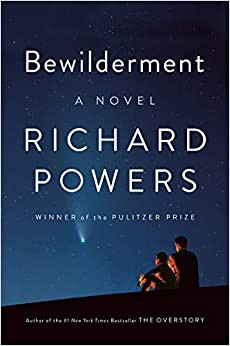
Richard Powers · Buy on Amazon
"Powers is a writer for whom the ideas are very close to the surface—he makes them part of the plot. In this book he’s engaging with ideas about neuroscience and the brain, like: where does emotion reside? Where does reason reside? How do these relate to each other? And how does this fit into our ideas about what counts as ‘normal behaviour’. And he’s exploring all of that, in a landscape, a created world that is itself clearly shaped by the present realities of climate change . What is considered normal human behaviour is then understood against a global set of circumstances in which what is considered normal is being disrupted by the “abnormal” conditions of climate change. It’s a tension that I think he uses very fruitfully in the novel. We certainly responded to all of that, and then, against that, he manages to make a novel that is very much engaged with these ideas about what’s normal, what’s abnormal, what’s typical, and what’s not. It is also a moving portrait of single parenthood, a father trying to make a go of it with his son, who is not the easiest child to raise in certain ways. The father is trying to process his own grief against the backdrop of raising this child. I think that the combination of the emotional dynamics of the father-son relationship, as set against the more metaphysical dynamics—I’m not sure if that is quite the right word—of how to relate to a world that is seemingly itself at imminent risk of going off the rails is quite powerful."

Anuk Arudpragasam · 2021 · Buy on Amazon
"It’s by a quite young novelist—this is Arudpragasam’s second book. One of the things that really captured us from the first page is its incredibly wise, meditative voice. It’s looking at the legacy of a conflict that is not that well known to many people. The Sri Lankan civil war was an incredibly violent, some would say genocidal, conflict. The story is told from the point of view of a young man who has grown up in its aftermath. The book asks a question that I haven’t seen addressed in fiction, or not that I can think of, which is: what happens to all of those people who are just trying to process what happened, even if it didn’t happen directly to them? That’s something that we’re all going through in finding our own ways of processing this incredible experience of the global pandemic. “One of the magical things about novels is that they’re able to enter experience from so many different vantage points on so many different scales” Anyway, I think the way in which he’s able to tack between this young man’s very personal coming-of-age struggles with his ex-girlfriend and what that relationship signified, and then this larger sort of society-wide question of how the society finds its way out of this devastation, a society suffering PTSD , is really magnificently handled. He does it by zooming in on a particular moment: his trip to the funeral of his grandmother’s carer, who has just died. So this whole story is framed against a journey taken from the southern part of the country to the northern part of the country, and that becomes a kind of spine for this series of extended meditations. When I think about each of these books, I think each of them does something distinctive with narrative structure. But this one shares with the Galgut a seamless, sinuous quality of processing things through a very interior gaze. In this one, there’s a movement across the country, which becomes a movement across time and a processing of experience. It’s interesting. Other books don’t really have big wodges of dialogue either. Galgut doesn’t use quotation marks. Lockwood is written in fragments. They come in different forms. Honestly, I didn’t even notice that it had no dialogue until one of the judges pointed it out. That’s where there’s an incredible richness in having a variety of judges because people respond to things in different ways. But the ability that he has to create a feeling of exchange between characters despite not breaking it up with dialogue is itself a narrative accomplishment."

Nadifa Mohamed · Buy on Amazon
"I will just say right off the bat, this was a story I had no idea about. And I’m assuming that almost everybody who encounters the book won’t have any idea about it either. Yet it’s a story that seems to me exactly the sort of story that we should know about, because of the ways in which empire and its legacies continue to affect the lives of people within Britain and the lives of those in places formerly colonised by Britain. So this book is a really important intervention. She destabilises what readers might think they know about British society. It really isn’t a work of nonfiction. I say that as a compliment, because I think one often sees heavily researched novels that are talking about some episode in the past, which give you the feeling that the author has been carried away by their research and wants to show off what they’ve learned. And in the meantime, not necessarily taking advantage of all of the opportunities that fiction provides—to go to places where you don’t have sources. Get the weekly Five Books newsletter Mohamed really takes advantage of the novel as the vehicle for telling this story. She certainly takes advantage of the use of time, the passage of time. The other books we’ve talked about all handle that quite differently. On the one hand, we get this extremely condensed timeline—the event happens, there’s a trial, there’s an execution, all over a short period—but within that she’s giving us this whole global story that also goes back in time through the character’s earlier life. She gives us the backstory of the victim of the crime as well. So she’s able to use this novel to give what seems like a detective story, on one hand, but then bring into it all of these other kinds of perspectives. And she’s able to mobilise our empathy in a bunch of ways. You certainly feel horror at what happens to Mattan, but at the same time she’s not turning him into some kind of saint. Equally you feel real compassion for the victim of the crime and the family that’s left behind. So it’s really great at pressing against the record of the past but doing it in a way that gives us a much more enriched and nuanced picture of how people deal with the constraints that their historical moments place upon them."

Maggie Shipstead · Buy on Amazon
"‘Epic’ is the word. This is a book that really pulls off this immersive experience, creating a really richly imagined set of locations and characters and places. This is a book you feel like you can move through. You can see it, you can walk into the rooms. There’s an incredible tangibility about it that I find really powerful, and I don’t know how she does it. She has an incredible ability to make you believe in the reality of what she is describing, even in this exuberantly imaginative book. She’s swinging from the launching of a luxury liner for transatlantic voyages to show-pilots in western Montana in the 1920s and bush pilots in Alaska, to Hawaii in the 1960s and ’70s. And then, of course, there is this other narrative strand set in Hollywood in the here and now. Each of these brings you in, you live in it, and you want to see where you’re going to go next and then live in that one as well. That’s what’s so powerful about this book. I think what I meant by that is that this is a big book in terms of scale. It is long, but it shares with some of those really long books from the 19th century this feeling that you’re in it, and you just don’t want to leave. And I think for me, this is the sort of reading experience that mimics some of the qualities people are drawn to in television series. There’s this iterative quality to it. World building is what I had in mind; Trollope and Dickens are building these worlds that are densely inhabited. Once you’re in that world, you understand where you are and what its rules are, and you can just dwell in it indefinitely. Yeah, absolutely. The pressure part is funny. One’s basic experience is just of reading a lot of books and talking about a lot of books. For me that is a fundamentally enjoyable thing to do, although I acknowledge that maybe not everybody feels the same way. But I basically like reading a lot of books and talking about them and since for me, reading, particularly in this moment, is so cut off from anything else, it was an immense pleasure to be able to meet up with the other judges and connect with them. It’s funny, I have the impression that every year people are trying to come up with some statements about ‘the novel.’ I don’t tend to think that the novel changes on a yearly basis. I would say that I go back to this point about what are you looking for, versus what do you find. What I find is that there’s an incredible range of ways that people have of telling stories and an incredible range of stories that there are to tell. I think that it would be great to see an ever widening range of stories being told, and more kinds of people telling those stories, alongside what is obviously a very robust, flourishing literary sphere with great style, and voice and craft and talents. Long may it live. So that may be a way of saying, no, actually I don’t have a very specific answer about 2021. I would hope that there will continue to be a range of outlets that can represent a wide range of ways of writing, people who write and stories to be told."